
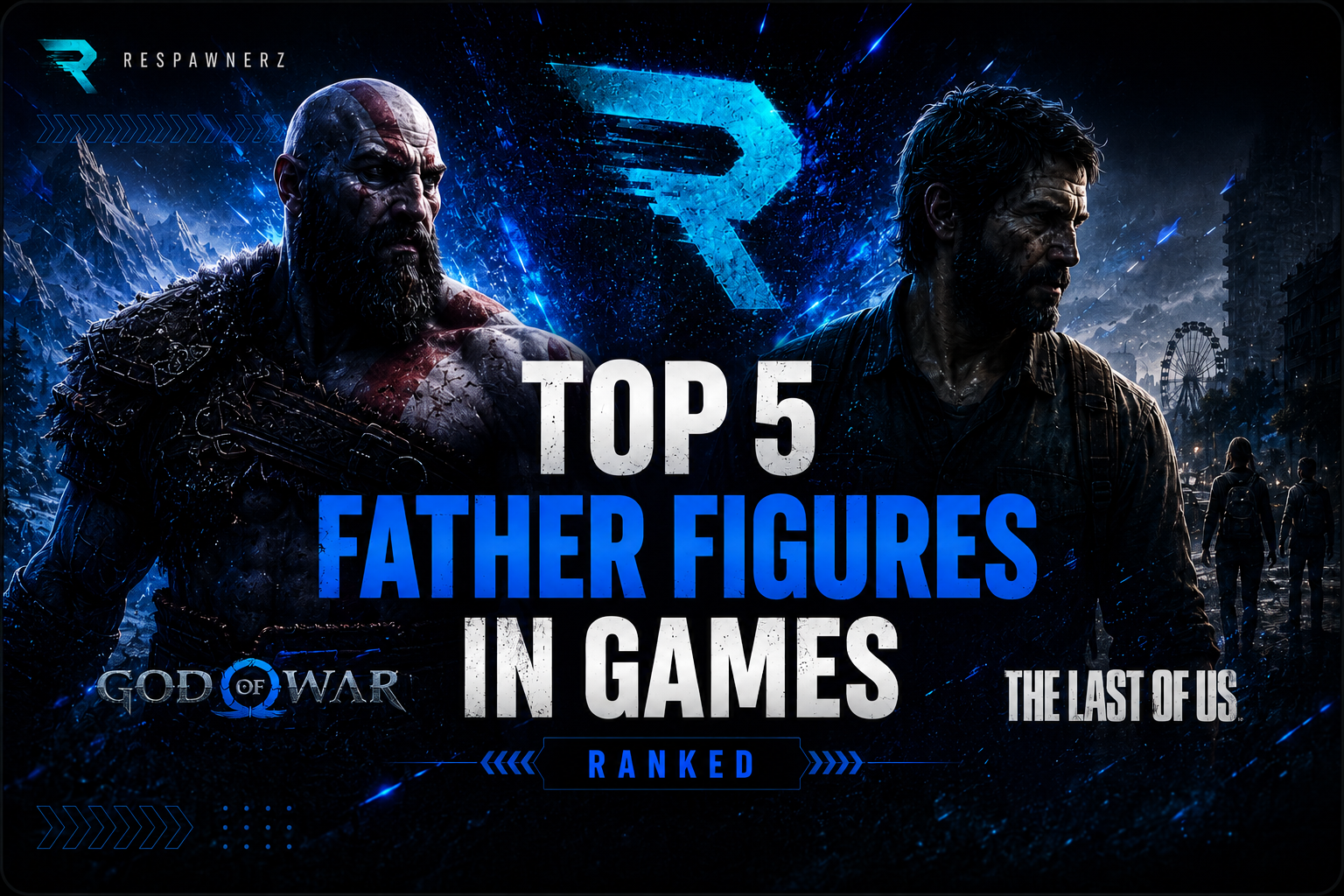
Video games figured out something about fatherhood that movies never quite managed: time. You do not watch Joel and Ellie cross a ruined country in two hours. You walk it with them, scavenge with them, sit through the dull stretches and the terrifying ones, and by the time the credits roll you have effectively raised a kid yourself, badly and well, the same way real parents do.
That is the part worth dwelling on before we rank anything. The father figure in games is rarely a side character who shows up, delivers a speech, and exits. He is usually the avatar. You are him, or you are walking beside him for forty, sixty, a hundred hours, and his failures as a parent become a little bit your failures too. That proximity is the reason this list exists, and ranking it honestly means looking past whoever shouts the loudest line and asking who actually behaved like a parent.
One rule before the countdown: biology did not decide anything here. Plenty of biological fathers in games are barely characters, let alone good ones, and some of the most affecting parent-child bonds in the medium involve no blood relation at all. What mattered was depth, growth, sacrifice, and whether the relationship actually shaped the story instead of decorating it.
5. John Marston, Red Dead Redemption
John Marston earns his spot for a relationship that is messier and more uncomfortable than most of what is on this list, which is the point. Red Dead Redemption 2 shows a John who, by his own later admission, was a bad father. He is distant with Jack, slow to even believe the boy is his, too consumed by loyalty to Dutch's collapsing gang for fatherhood to register as a priority. Rockstar did not soften this. They let John be genuinely bad at the job for most of a hundred-hour prequel before the original game ever picks up the thread.
That is what makes the ending of Red Dead Redemption land the way it does. By 1911, John has clawed his way into something like decency. He runs a ranch, tries to teach Jack to read, attempts the slow work of being present. When the Bureau of Investigation forces his hand one last time, his final act is not a speech. It is buying his family a few extra minutes by standing his ground against a firing squad while Abigail and Jack escape. The camera does not linger. It just lets him die so they do not have to.
The tragedy is that his sacrifice does not break the cycle. Jack picks up his father's gun, hunts down Edgar Ross, and becomes the kind of man John spent the back half of his life trying to outrun. Love does not always stop a kid from repeating your worst chapter, only your best intentions. Marston ranks fifth because the central relationship gets comparatively little screen time on its own terms, filtered mostly through John's guilt rather than scenes of the two of them simply existing together. What we do get, though, hits hard precisely because it is so spare.
4. Kazuma Kiryu, Yakuza / Like a Dragon
If the rest of this list is intense, compressed fatherhood, Kiryu is the opposite case: a man quietly raising kids across nearly two decades of games who rarely gets credit for it outside the series' own fans. Kiryu adopts Haruka Sawamura, the daughter of a woman he loved, in the very first Yakuza game, and from there the franchise turns his life into one long, exhausting attempt to give a found family the normal existence he never had.
He fails constantly, and that is the point. Kiryu opens Morning Glory Orphanage in Okinawa for Haruka and eight other children, then keeps getting pulled back into the underworld he is trying to escape, dragging danger to the orphanage's doorstep again and again. Haruka gets kidnapped more than once specifically because she is his weak point. By Yakuza 6, he takes the only move left to a man who has run out of ways to protect his family from himself: he fakes his own death, cuts every tie, and walks away so the people he loves can finally be safe from him.
What separates Kiryu from a simple tough-guy-with-a-soft-spot is duration. This is not one game's worth of growth. He spends roughly twenty years of real-world releases trying, often badly, to be present for kids who are not his by blood, including a wounded fugitive he nurses back to health and eventually Haruka's own son, whom he dotes on like a grandfather. Fans have written at length about how much of Haruka, her stubbornness, her instinct to protect strangers, her refusal to quit, mirrors the man who raised her. That kind of generational echo, built patiently across more than a dozen games, is something almost no other franchise has the runway to attempt. Kiryu lands at four because the arc, while deep, is also diffuse, spread across so many side plots and tonal swings that the father-daughter thread sometimes has to share space with karaoke minigames and street brawls. The bond is real. It is just less concentrated than what is ahead of him here.
3. Lee Everett, The Walking Dead: The Telltale Series
Lee Everett had one season, five episodes, roughly twelve hours, to do what other names on this list get whole trilogies to accomplish, and he might still have the cleanest, most devastating father-daughter arc in the medium. Telltale built the entire game around Clementine before writing a line of dialogue, and they deliberately made Lee her surrogate father rather than a sibling or stranger, because the shorthand of parent and child was the only relationship strong enough to carry what they wanted to tell.
What makes Lee work is how unglamorous his arc is. He is not a warrior or a god. He is a disgraced history professor convicted of killing his wife's lover, being driven to prison when the outbreak starts. Over five episodes he becomes Clementine's protector almost by accident: teaching her to shoot, cutting her hair badly and apologizing for it, pushing her on a swing in a rare quiet moment, slowly turning into exactly the steady guardian his criminal record suggested he could never be. The writers were explicit that they wanted Lee to push back against how Black fathers are typically depicted in media: not absent, not incompetent, but quietly and fiercely present.
The ending earns its reputation as one of gaming's most brutal moments. Bitten and dying, Lee spends his last strength helping Clementine secure a weapon and the will to survive without him, then the game hands the player the unbearable choice of how his story closes. There is no ambiguity about whether Lee loved her or did right by her. The only open question is how she has to say goodbye. Years later, in the series' later seasons, Clementine raises a child of her own using lessons that trace straight back to Lee, proof that what he taught her outlived him. Lee sits at three rather than higher because his story, while immaculate, is brief by design. He does not get the decades of mess and repair Kiryu gets, or the multi-game arc of failure and growth Kratos gets. He gets one perfect season and makes every hour of it count, but the runtime is the only thing keeping him out of the top two.
2. Kratos, God of War series
No father figure here was allowed to be this bad before being allowed to get this good, and that arc, stretched across nearly two decades and two completely different eras of the same franchise, is why Kratos lands at number two. The original Greek-era games gave players a man defined almost entirely by rage, tricked into killing his first wife and daughter in the series' own backstory. He should have been the last character anyone expected to anchor a story about good parenting.
Then 2018's God of War happened, and Santa Monica Studio did something genuinely rare for a blockbuster: they let their flagship protagonist be visibly, uncomfortably bad at fatherhood and treated that as the whole point. Kratos raises Atreus after his wife Faye's death, and the game never pretends the transition from monster-slayer to single dad is smooth. He is curt, emotionally walled off, so afraid of passing on his own rage that he withholds nearly everything about himself, which backfires when Atreus learns he is part god and spirals into arrogance without his father's guidance to check it. Critics at outlets like The Washington Post and IGN pointed to exactly this discomfort as the strongest writing choice in the game: not an idealized dad, but a flawed man consciously trying to be better than the one who raised him, with the player watching every stumble.
God of War Ragnarok pushes it further, surrounding Kratos with a cast of worse fathers, an absent, alcoholic Thor, a manipulative Odin, so that Kratos's effort, however clumsy, reads as genuinely heroic by comparison. The series finally lets him say the words he could never manage before, and the contrast with where he started is staggering. More than one critic, including a writer who used the game to process his own estrangement from his father, has pointed to this arc as one of the rare times a game's central relationship felt less like entertainment and more like something closer to therapy. Kratos sits at two rather than one because his redemption, however earned, is built on the back of one of gaming's most violent protagonists. The growth is real, but it is growth away from monstrousness rather than growth from an already decent baseline, and that distinction matters when you are measuring fatherhood on its own terms.
1. Joel Miller, The Last of Us
Joel Miller takes the top spot because no other father figure on this list forces players to sit with the actual cost of love the way he does, and no other choice in the genre has generated this much sustained, serious argument about what a parent is willing to do to the rest of the world in order to keep one child alive.
Naughty Dog built The Last of Us around the bond between Joel and Ellie so deliberately that, by the developers' own account, casting Joel's actor took longer and mattered more than almost any other decision in the game's production. The reason is obvious once you have played it. Joel begins the story hollowed out by the death of his daughter Sarah in the outbreak's opening hours, twenty years gone by, working as a smuggler, keeping everyone at arm's length. Ellie, infected but immune, starts out as cargo to him. A job. The slow, believable thaw from professional obligation to genuine paternal love, built across a year-long journey through ambushes, betrayals, and quiet campfire conversations, is widely considered one of the best-written character arcs the medium has produced, and it earned the game and its actors a stack of BAFTAs and industry awards along the way.
What makes Joel the best father figure here, rather than simply the most acclaimed character, is the ending. When Joel learns that curing the Cordyceps infection requires Ellie to die on an operating table without her consent, he does not hesitate. He kills the surgeons, the soldiers, anyone between himself and his daughter, and carries her out of the hospital. By any measure outside the bond between these two specific people, it is an act of staggering selfishness that potentially dooms humanity's one real shot at a cure. It is also, simultaneously, the single most purely parental decision in the medium: a father who has already buried one child deciding, without negotiation, that he will not bury another, whatever it costs everyone else on the planet.
That moral knot is exactly why Joel's choice still gets argued about in comment sections years after the game's release, and why The Last of Us Part II spent an entire sequel interrogating the consequences of that one decision instead of letting it sit as a happy ending. Critics have described Joel as morally complex rather than heroic, and that is precisely what makes him ring true as a father instead of a fantasy of one. Real parents do not always make the choice that is best for the world. Sometimes they make the choice that is best for their kid and quietly accept those two things are not the same. No other character on this list embodies that uncomfortable truth as completely, or pays for it as dearly, as Joel Miller does.
Honorable Mentions
A list this size cannot fit every game that earned a spot in the conversation.
Geralt of Rivia raised Ciri in The Witcher 3 without ever fathering her biologically, and the back half of that game is built around his search to protect her from the Wild Hunt. Their reunion is one of the more quietly moving scenes in the franchise, even if Geralt's gruff exterior keeps him from the rawer emotional beats that rank higher here.
Sojiro Sakura, the cafe owner from Persona 5, took in both Joker and his late friend's daughter Futaba without much hesitation, and his slow thaw from reluctant landlord to genuine guardian is one of the JRPG genre's most beloved subplots, even if his role stays supporting rather than central.
Rost, from Horizon Zero Dawn, raised the outcast Aloy alone in the wilderness and died protecting her path toward the truth about her origins. It is a quietly devastating arc that gets less attention than it deserves simply because the game is not really about him.
And BioShock's Big Daddies deserve a mention for taking paternal protection and making it literal and bioengineered, turning monstrous guardians into one of gaming's strangest, most effective metaphors for unconditional devotion.
Closing Thoughts
There is a reason this list keeps circling back to flawed men instead of perfect ones. Kratos was a monster before he was a father. Joel made a choice most of us would call selfish. John Marston spent years failing the son he eventually died for. Kiryu can never stop getting pulled back into the underworld he is trying to shield his children from. Lee Everett was a convicted killer who became, in a few months, exactly the guardian a scared eight-year-old needed.
None of that is an accident. Fatherhood, the real kind, has never been about getting it right from the start. It is about trying, failing, showing up again the next day anyway, and the moments when love overrides every reasonable argument for doing the safer thing. Games have gotten unusually good at putting players inside that mess instead of just watching it from the outside. That is probably why these five, more than almost any other archetype in the medium, stick around in people's memory long after the credits stop rolling.
Happy Father's Day, to the real ones and the in-game ones both.