

Gaming has always had a soft spot for crossovers. There's the upcoming Battlefield 6 x Top Gun content landing in Season 4, the F1 Movie tie-in making its way into F1 26, and plenty of others before them. These partnerships keep showing up because they're an easy way to get two fanbases talking to each other.
Most of them work the same basic way, too. One franchise borrows characters or cosmetics from another, drops them into an existing game, and calls it a day. Every so often, though, two ideas come along that feel less like a licensing deal and more like they were built for each other.
That's the feeling with Control and Inception.
One is a supernatural action game from Remedy Entertainment. The other is Christopher Nolan's dreams-within-dreams thriller. Different mediums, different characters, completely different stories, and yet the bones underneath are strangely similar. Both mess with your sense of what's real. Both turn hallways and buildings into part of the plot. Both keep you second-guessing right up to the end.
A Control x Inception collaboration isn't interesting because one should get adapted into the other. It's interesting because, put together, they could build something gaming hasn't really tried before: not another licensed movie tie-in, but an original story where impossible spaces and psychological tension actually function as gameplay instead of just set dressing.
Some crossovers work because nobody saw them coming. This one works because, once you sit with it for a minute, it starts to feel like it should already exist.
Control and Inception Share the Same Creative DNA
Despite living in completely different mediums, Control and Inception run on the same core idea. Neither one leans on monsters or standard sci-fi threats to build tension. Both ask a simpler, more unsettling question instead: what happens once you can't trust the rules of the space you're standing in?
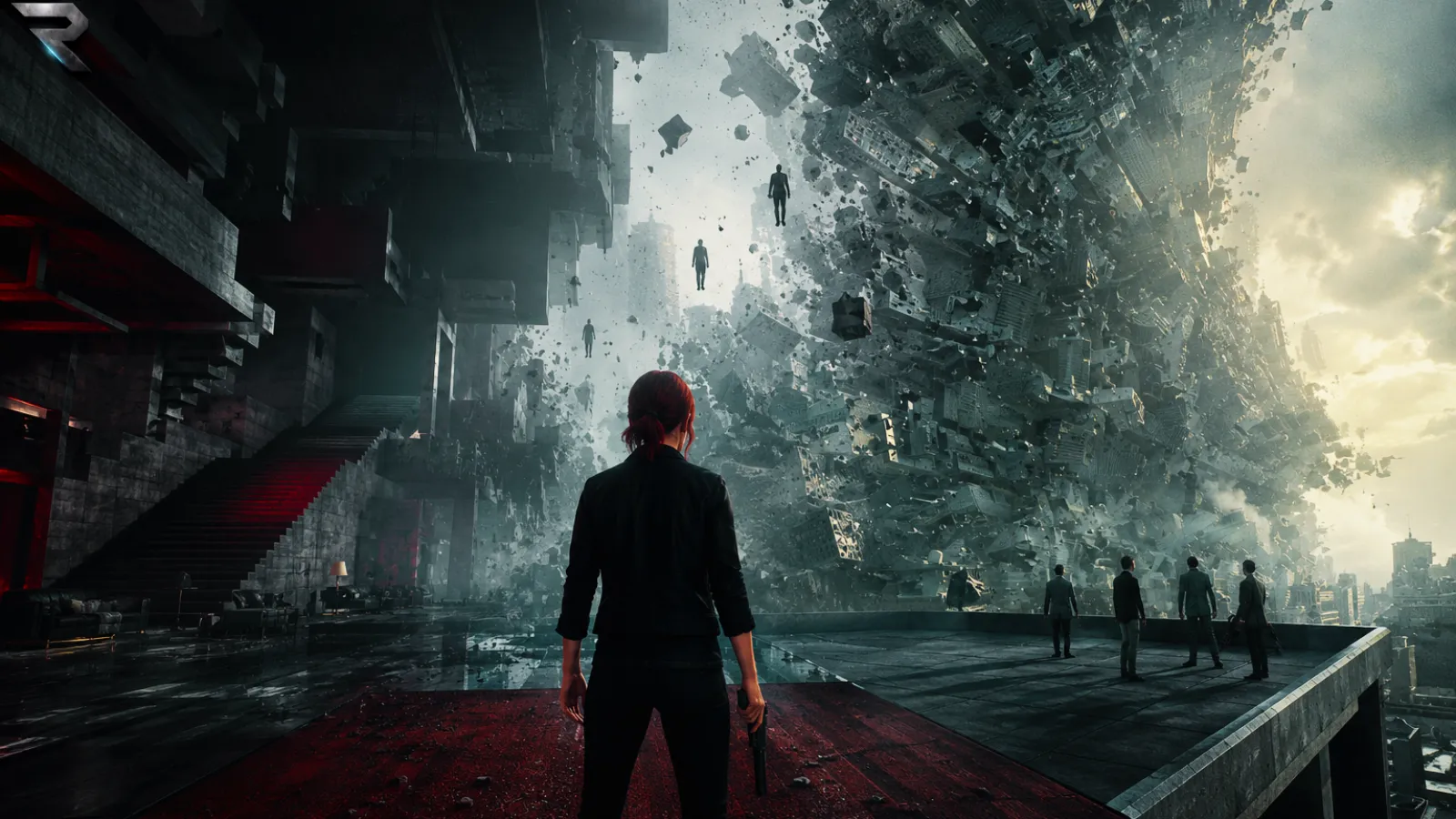
In Control, the Federal Bureau of Control's headquarters, the Oldest House, isn't just a government building. It actively works against you understanding it. Rooms appear where they shouldn't. Corridors reroute themselves mid-walk. Gravity stops being a law of physics and starts being more of a suggestion.
Inception gets to a similar place by a different road. Dreams become entire cities folding onto themselves, staircases that loop forever, environments that shift to match whoever's subconscious built them. The architecture isn't backdrop here, it's part of the plot, and it's just as capable of surprising the characters as it is the audience.
That shared instinct, using space itself as the mystery, is what makes this pairing feel less forced than most crossovers do. Both worlds reward people who actually look at their surroundings instead of chasing the action, and both are comfortable leaving you a little unsure of what's even real.
They share something rarer, too: restraint. Neither rushes to explain itself. Control and Inception both leave real gaps, the kind that keep people arguing in comment sections years after release, instead of tying everything up in a bow.
When two stories are built on the same foundation like this, putting them together isn't fan service for its own sake. It's closer to letting one finish the other's sentence.
A Story Only a Video Game Could Tell
If this collaboration ever happened, it shouldn't retell Inception's plot beat for beat, and it shouldn't work as a Control sequel either. Both stories already got told, and told well.
What it should do is borrow the DNA of both and build something new out of it.
Picture a structure sitting somewhere between waking life and the subconscious, where dreams, memories, and architecture that shouldn't exist keep bleeding into each other. Every hallway could lead somewhere different depending on what you've already seen. Every door could open onto another layer of the same reality. Small decisions made early on could quietly reshape rooms you visit hours later.
A film can only show you spaces like that. A game lets you walk through them, and that's a different kind of immersion entirely. A building that rewrites itself in response to what you do stops being a set and starts being a character, and every discovery feels like yours because you found the path, not because the camera showed it to you.
The story itself could shift the same way the environment does. A character might remember the same conversation differently depending on which layer you're standing in when you talk to them. Rooms could physically change shape based on memories you've uncovered. Whole sections of the map might vanish or reappear as your understanding of what's actually going on evolves.
None of this needs a tidy answer at the end. Control and Inception both trust their audience to sit with ambiguity, and a game built from both could do the same, letting people piece the truth together through exploring, noticing, and interpreting rather than sitting through another cutscene that spells it all out.
That's the actual pitch here. Not recreating a famous scene from the film or dragging in a familiar face from the game, but using what both mediums are genuinely good at to tell something that only works as something you play.
Gameplay That Would Bend More Than Reality
The story is one thing. The bigger opportunity is in how this would actually play, because this is where "impossible" turns into "interactive."
Most games settle into a predictable rhythm once you've learned a level. Beyond scripted set pieces, layouts tend to stay put. A Control x Inception mashup could throw that assumption out entirely.
Walk down a corridor, turn around, and the room behind you has changed shape. Staircases shift direction mid-fight. Walls fold into new paths. Gravity stops being a visual flex and becomes an actual mechanic you have to plan around. Every fight forces you to adapt instead of memorize.
Combat could grow out of that same instability. Instead of ducking behind the same three pieces of cover every encounter, you could reshape the architecture around you, drop a section of ceiling on an enemy, or flip gravity to launch yourself and whoever's shooting at you into part of the room nobody could reach a second earlier. Fights would start to feel like puzzles wearing a combat skin.
The puzzle-solving could stretch across layers, too. Something you do in one version of reality could quietly change another version somewhere else, so a locked door on one layer only opens once you've rearranged the architecture in a different one. That forces you to think in more than one direction at a time, which most games never actually ask of you.
Even exploration could stop being passive. Instead of secrets sitting behind a locked door waiting for a key, the world could respond to you poking around in it. Go back to a room you've already cleared and find it isn't the same room anymore. That rewards curiosity over checklist-hunting.
The most interesting part might be that no two people would end up seeing quite the same game. Small shifts, branching discoveries, realities that don't hold still, all of that means two playthroughs could genuinely diverge, which is exactly the kind of thing that keeps people comparing notes online for months.
Open worlds, destructible environments, procedural generation, gaming has tried all of it. What it hasn't really tried is making the instability of reality itself the actual mechanic, not a gimmick bolted onto a normal shooter.
Why Remedy Is the Perfect Studio
Something this ambitious needs more than a good engine behind it. It needs a studio already comfortable blending strange, unconventional gameplay with stories that don't spell everything out, and Remedy Entertainment has been doing exactly that for two decades.
From the psychological horror of Alan Wake to the bureaucratic supernatural weirdness of Control, Remedy keeps building games that blur the line between what's real and what isn't, and keeps trusting players to work out the difference themselves.
The Oldest House is the clearest proof of that instinct. It isn't a static level, it's a building that keeps evolving alongside the story, effectively becoming another character in it. Stretching that same design philosophy into Inception-style dream logic, where every hallway feels alive and slightly wrong, isn't much of a stretch for a studio that already built the Oldest House.
Remedy has also shown that cinematic presentation doesn't have to fight against gameplay. The studio's mix of exploration, fast combat, environmental storytelling, and its odd live-action segments already feels distinct from most action games on the market. A crossover like this wouldn't ask Remedy to become a different studio, just to push further in the direction it's already been walking.
The Northlight Engine helps, too. Its lighting, physics, and destruction systems already power some of the most striking moments in modern games. Point that same tech at cities folding in on themselves and dreamscapes that won't sit still, and you get something nobody's really built before.
Maybe the biggest reason Remedy fits is simpler than any of that. The studio clearly believes mystery works better than explanation. It doesn't drown players in exposition, it lets them dig, theorize, and land somewhere on their own. That's basically Inception's entire thesis, too, which makes this feel less like an odd-couple crossover and more like the two were circling each other the whole time.
What Inception Brings to the Equation
Remedy has already proven it can build reality-bending worlds through Control. What Inception adds is a different set of tools for pushing that further.
The film's best idea is layered reality, several versions of the same world stacked on top of each other, each running on its own rules, each one bleeding into the next. Turning that into an actual game mechanic opens up design space most level design never touches.
Solve something in one layer and watch the effects show up in a different layer entirely. A small choice made early could reshape a completely different environment hours later, which rewards the kind of player who actually pays attention instead of speed-running to the objective marker. Instead of one fixed world, you'd be tracking several interconnected ones at once.
That dream logic could change exploration, too. A familiar room could shift without warning. A space that felt safe five minutes ago could turn hostile. You'd never be fully sure whether you'd hit the bottom layer or just another illusion pretending to be it, and that uncertainty is exactly what makes every discovery feel like it matters.
Narratively, Inception thrives on questions it never fully answers, without ever feeling cold about it. Paired with the kind of environmental storytelling Remedy already does well, that could build a world where the plot comes together through exploring and noticing things rather than through another wall of dialogue.
If there's one thing Inception really brings to this, it isn't the visuals or the gravity-defying set pieces people remember it for. It's the fact that it never lets you feel certain about anything until the very end. Bring that same discomfort into something interactive, and you get a game that sticks around in your head well after you've put the controller down.
The Challenges of Making It Work
None of this is easy to actually pull off, and some of the exact things that make the pitch exciting are also the things most likely to break it.
Clarity is the first problem. A world that keeps shifting, several layers of reality running at once, a story that's intentionally vague, all of it can tip into confusing fast if players lose track of what they're even trying to do. Getting the balance between mystery and basic playability right would take real discipline.
Gameplay is its own hurdle. Reality-bending mechanics need to make exploration and combat better, not just weirder. Every shift in the environment has to feel like it means something, or it just reads as noise.
There's a real risk of leaning on spectacle instead of substance, too. Folding cities and gravity-defying fights look great in a trailer, but they don't mean much without characters worth caring about. The games people remember years later usually aren't remembered for how much stuff happened on screen.
And then there's the weight of expectation itself. Both Control and Inception have built fiercely loyal audiences by delivering something genuinely different, and any attempt to combine them would get measured against both standards at once, by people who already have strong opinions about what that combination should look like.
Still, that's kind of the point of a big swing. The ideas that carry the most risk are usually the ones that end up mattering, if the studio has the patience to actually see them through. Handled with the same care both properties already show, this could end up setting a new bar for how psychological storytelling and environment design work together in games.
Respawnerz Verdict
This doesn't exist, and it's entirely possible it never will. Licensing alone would be a nightmare, and getting two very different creative teams to agree on tone would be its own project. None of that makes it less fun to think through.
A Control x Inception collaboration was never really about slapping familiar faces on the same poster or bolting a movie license onto an existing game. It's about two ideas that have been circling the same question, what happens when you can't trust the space you're standing in, from two completely different directions. Put them together properly and you'd have something the industry genuinely hasn't made yet.
Will it happen? Probably not. But some of the best editorials aren't about guessing what's coming next, they're about pointing at what could exist if somebody actually took the swing. If any pairing has a real shot at redefining what psychological storytelling and reality-bending gameplay look like together, it's this one. Until then, it stays exactly what it is: one of gaming's best "what if" ideas, waiting for someone brave enough to build it.