

Crystal Dynamics and Flying Wild Hog have shared a new developer diary for Tomb Raider: Legacy of Atlantis, offering the clearest look yet at how Lara Croft's iconic movement has been rebuilt for the upcoming reimagining. Rather than simply modernizing the original animations, the developers say they returned to the 1996 Tomb Raider to understand what made Lara feel unique before rebuilding her traversal from the ground up.
It's worth being clear about what Legacy of Atlantis actually is here. This isn't a remaster of the 1996 original with sharper textures bolted on. Crystal Dynamics and Flying Wild Hog are rebuilding the game from the ground up, and that extends past the visuals into how Lara moves and how the world around her is put together.
Rebuilding Lara From the Original Games
According to the developers, recreating Lara's movement wasn't about making the animation prettier. The team went back to what made the original games memorable first, then worked out how to translate that into something that plays well today.
Game Director Raul Siqueira said getting Lara's movement right was one of the team's highest priorities. "Getting Lara's movement, I think, is one of the most important things to get right when you're making a Tomb Raider game." He added that movement has to feel natural for players while staying true to the character's established identity, and also adding,"Whenever you're playing a game, if a character doesn't move the way that you expect them to move, you are likely going to get frustrated."
Lead Gameplay Designer Bartek Schweiger said the process was about studying the essence of the classic games rather than copying them directly, keeping Lara's identity intact while changing how players actually interact with her movement.
Game Director Raul Siqueira put it more bluntly. Lara doesn't dodge like anyone else would.
"A normal person would step to the side. Lara Croft doesn't step to the side. She cartwheels."
Rather than treating movement as a collection of animations, the developers view it as character storytelling. Even something as simple as avoiding an obstacle reflects Lara's personality. Siqueira's comments suggest that philosophy extends across the entire traversal system, from climbing and jumping to the acrobatic flourishes longtime fans associate with Lara Croft.
Every Jump Was Designed to Feel Like Lara
Movement keeps coming up as one of the things the team cares about most. Creative Director Michał Kuk said the details that separate Lara from other action heroes are subtle, how fast she moves ledge to ledge, how confident her climbing looks, how far she actually jumps.
Lead actor Alix Wilton Regan talked about training for the role too. Weight training, running, yoga, and rock climbing all went into getting closer to Lara's physicality during performance capture.
Expanded Traversal Options
Legacy of Atlantis gives Lara a much bigger traversal toolkit than the original game had, and the developers are careful to point out that none of it was added just to look modern. Crystal Dynamics and Flying Wild Hog wanted every new move to feel like something Lara herself would actually do.
Players will get access to:
- Pole climbing
- Ledge climbing
- Horizontal pole traversal
- Grapple swinging
- Long-distance jumps
- Acrobatics such as handstands and swan dives
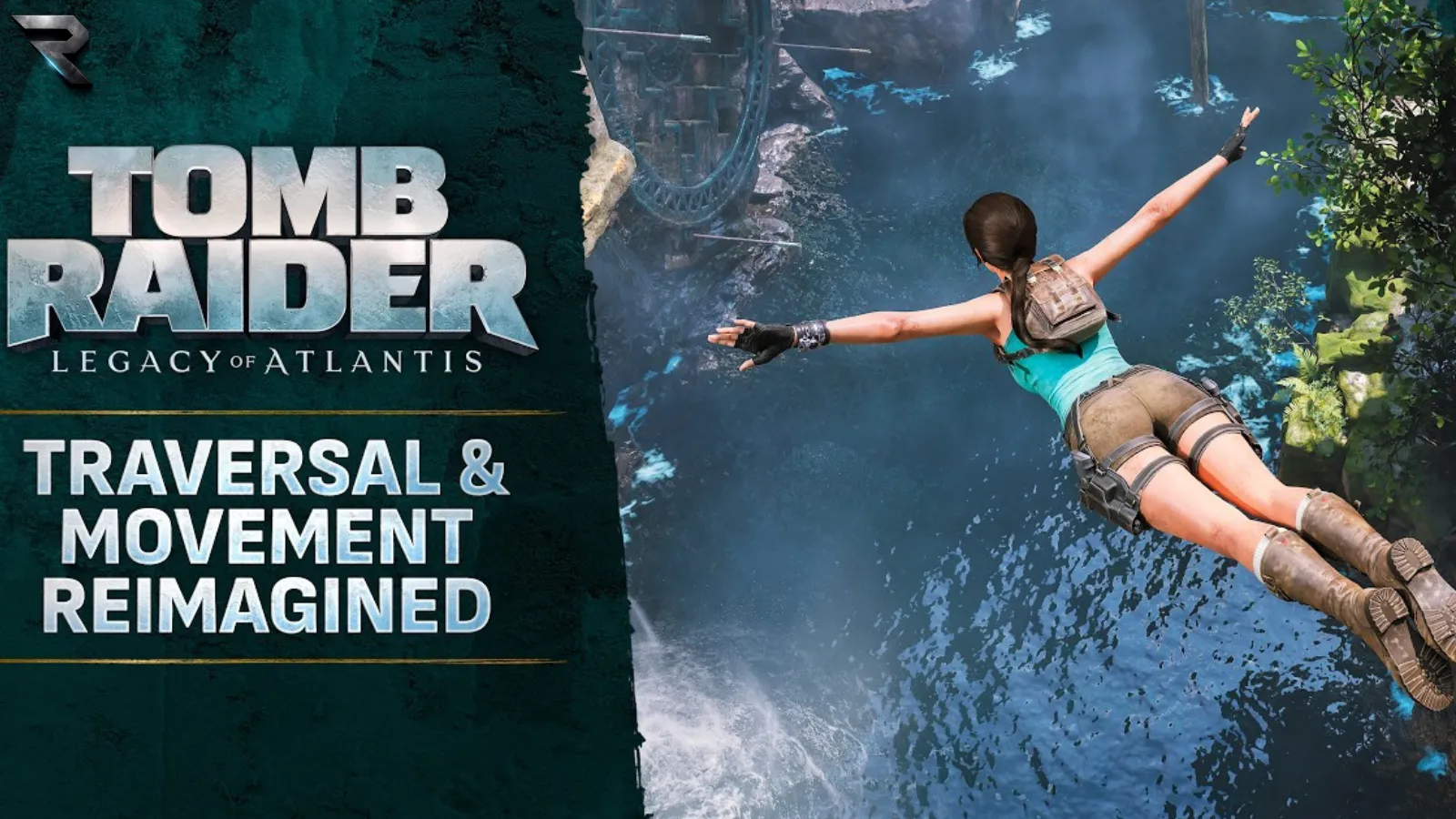
A lot of this was built around Lara's confidence and agility. Whether she's launching herself between ledges or swinging across a gap on her grapple, the movement is supposed to look deliberate and fluid, the kind of thing only Lara would pull off.
That comes through clearly in the reveal trailer. There's one sequence where Lara leaps off a horizontal pole onto a ledge, drops into a handstand, then finishes with a swan dive, and it's the moment fans keep bringing up. It's the kind of reaction Crystal Dynamics and Flying Wild Hog were hoping for, proof that the acrobatic style Lara has had since the original Tomb Raider games is still intact here.
Subtle Systems That Guide Exploration
Movement isn't the only thing getting attention. The developers also talked about small environmental cues built to guide players without leaning on objective markers. Birds that fly off to point attention somewhere. Fish that swim toward the path forward. Lighting and composition doing quiet work in the background.
Art Director Arek Tomaszewski called this part of the game's visual language. Creative Director Michał Kuk also confirmed the guiding fish idea, first floated in earlier concepts, made it into the final game.
More Than Just Better Animations
Some of what the team described are things most players probably won't consciously register. Lara now turns her head toward nearby objectives on her own, shifts her weight while standing still, and reaches for grapple points mid swing. None of it is flashy, but it's meant to make traversal feel like one continuous, believable motion instead of a series of animations stitched together. The bigger picture here is that Legacy of Atlantis isn't trying to reinvent who Lara Croft is. Crystal Dynamics and Flying Wild Hog keep circling back to the same point, that her athleticism, her confidence, and her sense of adventure are as much a part of the franchise as the puzzles and the ruins she explores.
That extends to level design too. Classic environments from the 1996 game are being expanded into larger, interconnected spaces rather than recreated as smaller, self-contained levels, which should give players more room to move while keeping the original adventure's structure recognizable.
Whether people spend their time chasing collectibles, exploring old ruins, or just throwing themselves into a swan dive for the fun of it, the developers seem to think all of that counts as part of what makes Tomb Raider, Tomb Raider.
The Bottom Line
Crystal Dynamics and Flying Wild Hog studied what made Lara's original animations work before building an expanded traversal system around pole climbing, grapple swinging, and acrobatics like handstands and swan dives.
Classic levels are also being opened up into larger, connected spaces, which points to a game trying to honor the original adventure while giving players more room to explore it. The developer diary suggests Crystal Dynamics understands that Lara Croft's identity isn't defined by her dual pistols alone. It's in the way she climbs, lands, leaps, and navigates ancient ruins. If Legacy of Atlantis delivers on that philosophy when it launches, longtime Tomb Raider fans may finally get a modern reimagining that feels as authentic as it looks.
Tomb Raider: Legacy of Atlantis is scheduled to release on February 12, 2027, for PlayStation 5, Nintendo Switch 2, Xbox Series X|S, and PC.