
With three weeks to go before Denshattack! launches on PS5, developer Undercoders posted a deep dive on the PlayStation Blog revealing the game's first boss fight. The post was written by David Jaumandreu, the studio and game director, and it covers how the team approached designing train-to-train combat, what Yoshie is as a character, and why the publisher was already asking where they could possibly go after this before the game even shipped.
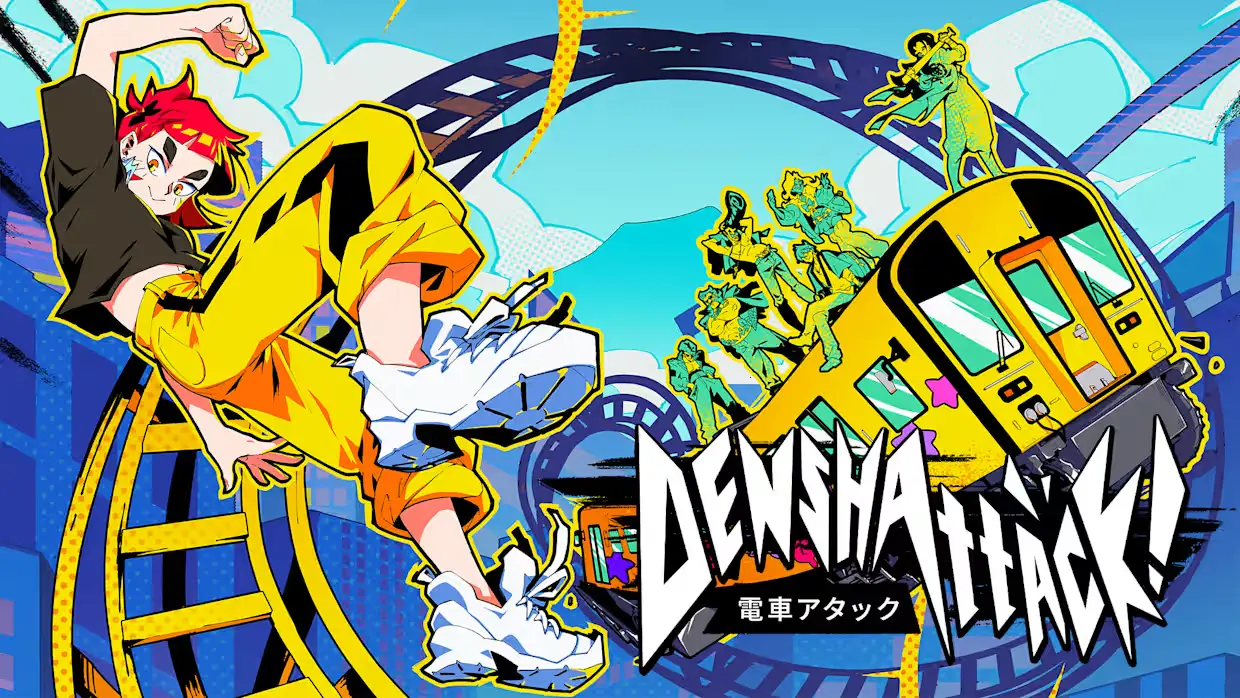
If you have not been following Denshattack!, here is the short version. It is a trick-based action game where you play as a train. You kickflip. You ollie. You grind rails. The comparison points Undercoders cites are Tony Hawk's Pro Skater, SSX, and the visual aesthetic of Jet Set Radio and Auto Modellista. It is set in a dystopian future Japan rendered in cel-shaded Y2K styling, and it came out of nowhere to become one of the more interesting PS5 games on the July calendar.
Yoshie is the boss who closes out the first chapter. She is a lot.
The Setup: Who Yoshie Is and Why She Matters
Denshattack! has a full story running through it. The protagonist is Emi, a ramen delivery girl who stumbles onto the underground Denshattack movement and ends up travelling Japan from Kyushu to Hokkaido, fighting gang leaders who control each region's abandoned railroad tracks.
The Denshattack world has a class divide built into its premise. The wealthy live inside climate-controlled domes following some unspecified environmental collapse. Everyone else is outside, surviving in the wastelands and reclaiming whatever infrastructure the rich left behind. The railroad tracks are the main battleground. Gang leaders control territory, and Emi has to beat them to move forward.
Yoshie controls Fukuoka. She is described as an influencer whose following grew so large that the government classified her as a threat, which tells you something about the kind of satire Undercoders is going for here. Her visual design is built around gyaru, a Japanese subculture defined by its rejection of traditional Japanese beauty standards in favor of something louder: elaborate hair, heavy makeup, bold accessories, maximum glamour. All of that carries through to her train, her soldiers, and eventually her mecha.
The gang she leads is called the Dashing Queens. The whole chapter has its own visual identity, musical character, and fashion coding, and Yoshie is the concentrated expression of all of it.
The Boss Fight: Three Phases, One Giant Mecha
Undercoders structured every boss fight in the game around the shonen anime template. Each chapter teaches you mechanics. The boss fight at the end puts those mechanics to the test, usually with several phases that escalate the challenge. Yoshie's fight follows this structure but goes somewhere that the description alone makes hard to picture.
The fight starts with Emi using tricks and combos to reach the battle itself. From there, the player has to perform quick rail changes to dodge Yoshie's attacks, use grinds and ground pounds to land hits, and time openings between her patterns. Those are all moves the first chapter has drilled into you by this point. The fight is not introducing anything new mechanically. It is asking you to apply what you know under pressure.
Then Yoshie transforms.
Her train, her soldiers, and her personal style all merge into a giant mecha. Not a gritty industrial one. A magical girl mecha. Bows, stars, hearts. The transformation sequence is described as being reminiscent of classic Sentai shows and Sailor Moon. The gyaru aesthetic does not drop when she scales up to city-wrecker size. If anything it gets louder.
This is the first boss. The publisher, Fireshine Games, apparently saw this and asked Undercoders directly where the game could possibly go from here if this was the opening. Jaumandreu's answer in the blog post is that the only direction was up.
The Music: An Actual Collaboration
The battle theme for Yoshie's fight is not just background music matched to an aesthetic. It is a proper creative collaboration. Composer Sean Bialo worked with Yunosuke, a Vocaloid producer, and Alice Peralta, described as a pop singer and real-life gyaru idol. The result is a battle theme that fits the character rather than just the genre.
This is worth noting because it suggests Undercoders took the musical identity of each chapter seriously enough to go outside their own team for it. Every gang in the game has its own musical character. If Yoshie's chapter has this kind of production behind its boss theme, the other chapters likely got similar treatment. The game's soundtrack could end up being one of its strongest elements.
How Undercoders Designed Train-on-Train Combat
The design challenge Jaumandreu describes in the blog post is genuinely interesting. Boss fights with trains sound like they should be limited. Trains go on rails. Rails are lines. How do you build interesting combat out of that?
The answer is that Denshattack!'s trains are not conventional trains. They can jump, wallride, grind, and defy gravity. When you can do all of that, dodging a punch is the same as grinding past an obstacle, parrying a projectile is the same as timing a trick, and launching yourself at a mecha is just taking an air move to its logical extreme. The movement vocabulary from the core game maps directly onto the boss encounters rather than being replaced by a separate combat system.
That is good design in a concrete sense. Games that introduce entirely different mechanics for boss fights often feel disconnected from the rest of the experience. The player has spent an entire chapter learning to move, and then the boss asks them to do something else. Denshattack! apparently avoids that by treating boss fights as trick runs with a target that fights back.
The gang structure also gives each boss a distinct identity beyond just different attack patterns. Each leader has their own visual language, personality, and local cultural inspiration. Yoshie is gyaru and Fukuoka. Other bosses presumably pull from other regions and subcultures across Japan. That gives the game a reason to care about each fight beyond difficulty escalation.
What Denshattack! Is, For Anyone Just Catching Up
Denshattack! is developed by Undercoders and published by Fireshine Games. It launches July 15, 2026, on PS5. The game is also listed on the PlayStation Store if you want to add it to your wishlist now.
The core loop is skating-game style trick accumulation applied to trains moving through Japan's abandoned railroad network. Points, combos, objectives, rival races. The visual style draws directly from Y2K cel-shading, the kind of aesthetic that was everywhere in early 2000s games and has had a genuine revival in indie development over the last few years. Jet Set Radio and Auto Modellista are the closest touchstones, but Denshattack! is doing something specific enough with its setting that those comparisons only go so far.
The story follows Emi from Kyushu north through Japan, fighting regional gang leaders as she goes. Each region has its own gang, its own visual identity, and its own boss fight at the end of the chapter. Yoshie is the first of those bosses, which means there are more waiting through the rest of the game's geography.
Fireshine Games is the publisher, and they have a track record with indie titles that have strong visual identities. That relationship seems to have given Undercoders enough runway to build something with actual production depth behind it, including the music collaborations and the apparent care that has gone into each chapter's theming.
Why This Boss Reveal Matters
Boss reveals before launch usually exist to show off spectacle and get people excited. This one does that, but the blog post Jaumandreu wrote goes further. It explains the design thinking behind the fight, the character work behind Yoshie, and the structural decision to use shonen anime chapter-ending catharsis as the template for the whole game's boss pacing.
That transparency about design intent is useful because it tells you something about what kind of game Denshattack! is trying to be. It is not hiding behind cool screenshots and hoping the concept sells itself. The studio is explaining how it works and why it is structured the way it is. That suggests a team that has a clear vision of what they built and confidence in it.
The Yoshie fight in particular seems designed to set a tone. A giant gyaru magical girl mecha as the opening boss is not a safe or conventional choice. It is a statement about the game's sense of humor, its relationship to Japanese pop culture, and its willingness to be loud about what it is. If the rest of the bosses escalate from here, which Jaumandreu says they do, Denshattack! could end up being one of those games people talk about primarily because of its boss fights long after launch.
Whether it lands depends on whether the core movement and trick system has enough depth to stay interesting across a full playthrough. A spectacular boss is only as good as the chapter that earns it. But based on what Undercoders has shown, the design ambition is there. July 15 is when we find out if the execution matches it.
Denshattack! launches on PS5 on July 15, 2026. The PlayStation Store listing is live at store.playstation.com.