
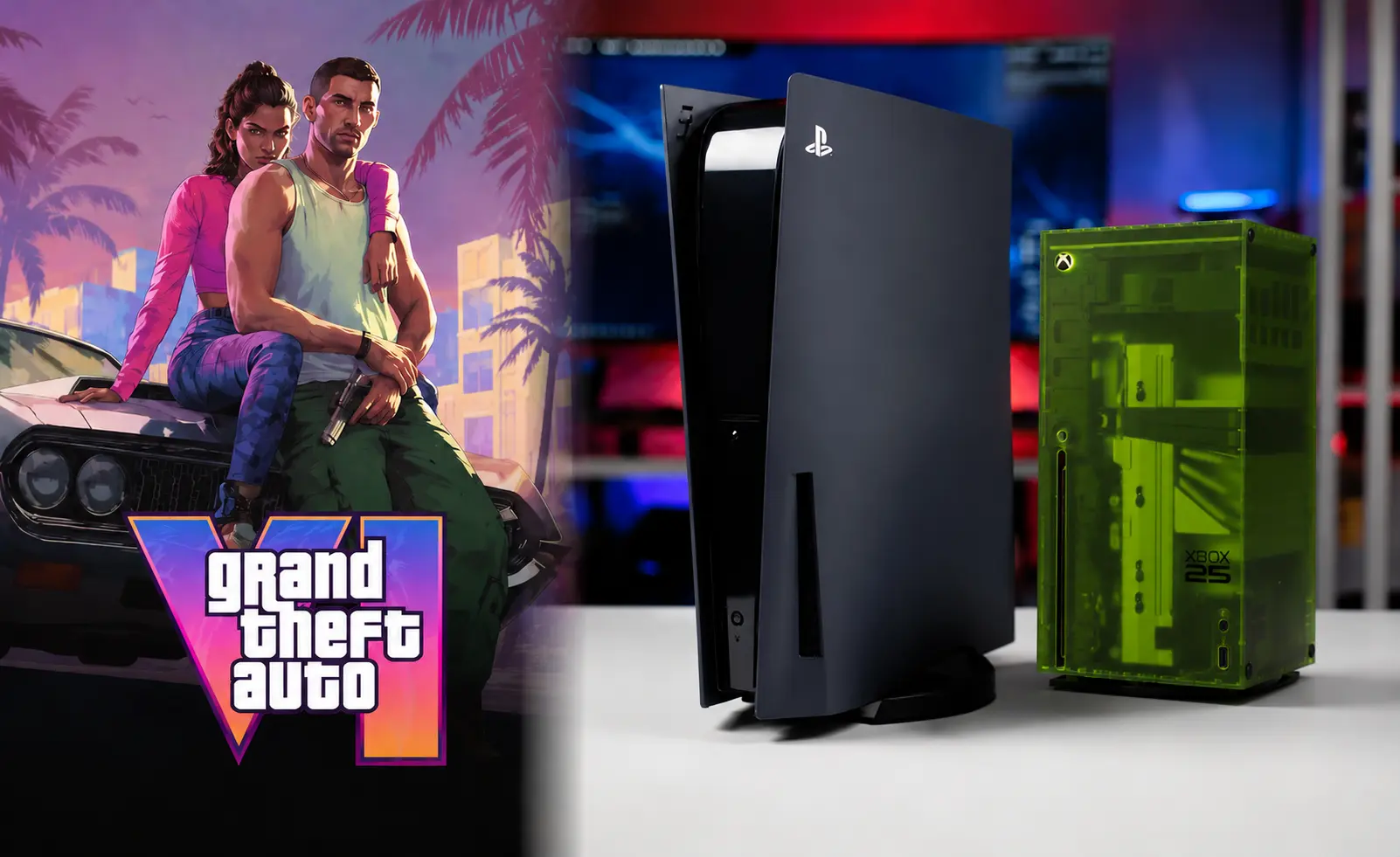
November 19, 2026. That is the date, confirmed by Rockstar Games through its own Newswire and reaffirmed by Take-Two CEO Strauss Zelnick on an earnings call, and it is closer than it feels. If you have spent the last few years putting off a console upgrade because nothing felt urgent enough to justify it, this is the upgrade cycle that actually matters. GTA 6 is not launching on everything. It is launching on exactly two console families, and the hardware you already own, or plan to buy, is going to shape how the biggest game of the year actually looks and runs in your living room.
This is not a buying guide stuffed with affiliate links pointing at whatever is cheapest this week. It is a straight breakdown of what Rockstar has confirmed, what every console in the supported lineup actually offers, and how to think about the screen you pair it with. No filler, just what you need to know before November.
What Rockstar Has Actually Confirmed
Start with the facts, because there is a lot of noise around this game and not all of it is accurate. GTA 6 is confirmed for PlayStation 5 and Xbox Series X|S only. There is no PS4 or Xbox One version, and Rockstar has not announced a PC release window, though history suggests one eventually follows, probably in 2027 or 2028 based on how long GTA V and Red Dead Redemption 2 took to reach PC after their console debuts.
That single decision, current generation only, no last gen support, is what makes this hardware conversation worth having in the first place. Rockstar is not asking old machines to stretch. It is building Leonida specifically around what the PS5 and Xbox Series consoles can do, and that means the gap between the strongest and weakest supported hardware is going to show up on screen in a way it never did with GTA V.
Ranking the Supported Consoles
Here is how the confirmed lineup stacks up, from the console that will show you the most of what Rockstar actually built, down to the one that will technically run the game but ask you to compromise the most to get there.
1. PlayStation 5 Pro
The PS5 Pro sits at the top, and it is not particularly close. Sony's mid-generation upgrade brings a meaningfully stronger GPU and PSSR, its AI upscaling technology, both of which matter enormously for a game built around dense crowds, dynamic weather, and the kind of simulation-heavy open world Rockstar is known for. Industry insiders and hardware analysts widely expect the Pro to be the version that gets closest to a genuine 4K presentation with ray tracing effects intact, and some early speculation has pointed toward a dedicated 60fps mode that the base consoles may not be able to sustain.
None of this is officially confirmed by Rockstar yet, and there is real disagreement among hardware analysts about whether GTA 6's simulation demands are GPU bound or CPU bound, since the Pro's CPU is largely unchanged from the base PS5. Digital Foundry has been openly skeptical that even the Pro will hit a clean 60fps at full settings. But on raw rendering horsepower alone, this is the strongest confirmed platform for the game.
2. Xbox Series X
The Series X lands second, just behind the Pro, and for most players the difference will be hard to notice without footage playing side by side. It has the GPU muscle to handle 4K output and is expected to run GTA 6 at a similar baseline to the standard PS5, likely a 30fps "Quality" mode with the option of a lower-resolution performance mode, depending on what Rockstar ultimately ships. The Series X has consistently proven itself capable of going toe to toe with the standard PS5 across most major releases this generation, and there is no indication GTA 6 will be the exception.
3. PlayStation 5
The standard PS5 sits just under the Series X, mostly because Rockstar captured its second official trailer running on PS5 hardware specifically, which suggests this is the console getting the most direct optimization attention from the studio. That counts for something. But on paper, the base PS5 and Series X are close enough in raw specs that most players will not notice a meaningful gap between them in day to day play. Expect a similar split between a higher resolution Quality mode and a smoother but softer Performance mode, mirroring how most major current gen titles have handled the tradeoff.
4. Xbox Series S
The Series S is the clear floor of the supported lineup, and it is worth setting expectations accordingly. It is a meaningfully less powerful machine than its Series X sibling, built around a smaller GPU and far less memory bandwidth, and most early technical breakdowns expect it to land around 1080p at 30fps with reduced visual settings rather than anything close to the 4K target the other three machines are chasing. If you are choosing hardware specifically with GTA 6 in mind, the Series S is the one console here where you are knowingly trading visual fidelity for affordability rather than getting the full picture Rockstar built.
None of these framerate or resolution numbers are official. Rockstar has not published technical specifications for any platform yet, and everything above is built from hardware analyst projections, leaked early builds, and how each console has historically performed on comparably demanding titles. Treat the ranking as a hardware capability order, not a confirmed performance chart, and expect Rockstar to publish real numbers closer to launch.
4K OLED TV or 4K OLED Monitor: Which One Actually Makes Sense
Once you have settled on hardware, the screen is the other half of the equation, and this is where a lot of people overthink the decision. Both OLED TVs and OLED gaming monitors are excellent in 2026, and the right pick mostly comes down to how you actually play rather than which technology wins on a spec sheet.
The case for an OLED TV
If GTA 6 is going to be a couch experience, played on a controller from a few feet back with friends watching or jumping in for a turn, a TV is the obvious answer and you should not second guess it. Modern OLED TVs from LG and Samsung's current lineups support refresh rates up to 165Hz on flagship models, full HDR10+ gaming support, and response times effectively indistinguishable from a monitor for anything you will notice on a controller. The bigger screen size also genuinely matters for an open world this dense. Leonida is built to be looked at, and a 55 or 65 inch panel does that job a 27 inch monitor simply cannot.
The one thing to watch with TVs is static UI elements and long term burn-in risk, though this has become far less of a practical concern with modern panel protections than it was a few generations ago, and an open world game with a constantly shifting HUD is a low-risk use case for it anyway.
The case for an OLED monitor
If your setup is a desk, not a couch, the math changes. OLED monitors deliver true sub-millisecond response times with each pixel switching on and off independently, which translates to noticeably cleaner motion clarity during fast camera pans and vehicle chases compared to even a strong LCD panel. Desk distance also means you do not need a massive screen to fill your field of view the way you would on a TV, so a 27 to 34 inch ultrawide OLED can deliver an objectively sharper, more immersive image at a viewing distance a TV was never designed for.
The practical tradeoff is connectivity. PS5 and Xbox Series consoles output over HDMI 2.1, not DisplayPort, so if you are buying a monitor specifically to pair with a console, confirm it has a proper HDMI 2.1 input rather than assuming every gaming monitor supports the bandwidth a current-gen console actually needs.
The honest answer
Neither option is the objectively correct pick, and most of the marketing noise around input lag differences between the two is smaller in practice than it looks on a spec sheet. For a game like GTA 6, built around scale, atmosphere, and a sprawling open world meant to be soaked in rather than reacted to with frame-perfect precision, the deciding factor should be where you actually sit when you play, not which panel technology wins an argument online. Couch and controller points toward a TV. Desk and a closer viewing distance points toward a monitor. Either way, OLED itself, TV or monitor, is the right call over a non-OLED panel for a game this visually ambitious.
The Bottom Line Before November
If you already own a PS5 or Xbox Series X, you are in good shape and do not need to panic-buy anything before launch. If you are sitting on a Series S or considering one purely off price, go in knowing exactly what you are trading away on this specific title. And if you are weighing a PS5 Pro purchase between now and November, GTA 6 is about as strong a justification as that upgrade is going to get this generation.
The screen matters more than people give it credit for, but it is a personal setup decision, not a technical one. Get the console situation locked down first. Everything else is a smaller adjustment once November 19 actually arrives.