

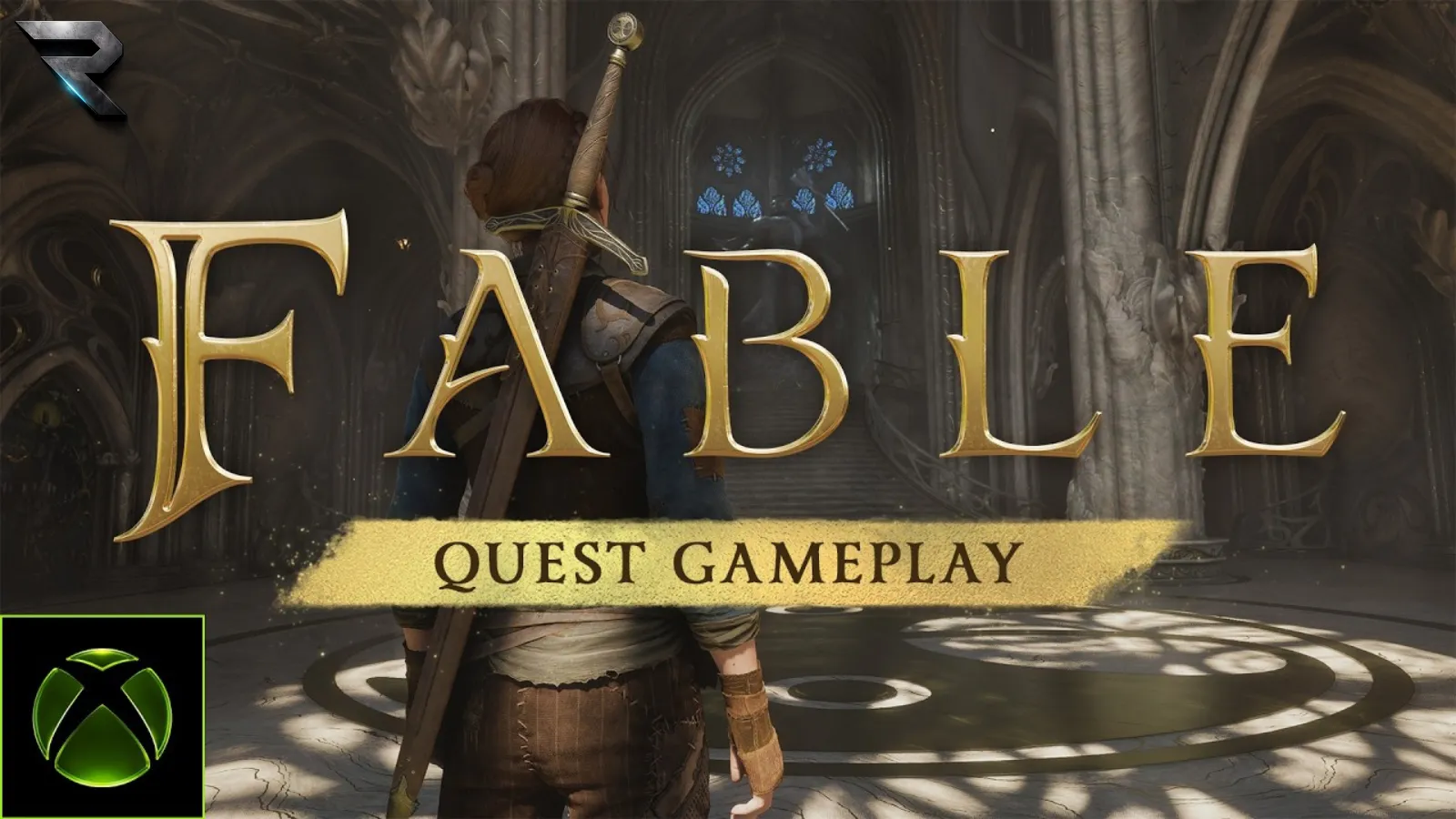
Xbox and Playground Games have put out a proper 18-minute gameplay demo for Fable, titled Fable Quest Gameplay, and it is easily the most complete look at the RPG so far. Hosted by Playground Games Art Director Conar Cross, the footage follows the Hero through an early quest and touches almost every system the studio has been talking about: exploration, dialogue, reputation, and combat, all folded into a single walk through Bowerstone.
The demo does not sit on any one feature for long. Instead it keeps showing how the pieces feed into each other. A conversation turns into a choice, a choice affects how Albion sees the Hero, and progression decides what tools are on hand once things stop being polite. That approach ends up saying more about Fable than a trailer ever could.
Bowerstone Runs on More Than 400 NPCs
Bowerstone, Albion's capital, is not treated as a quest hub with scenery attached. Playground says the city holds more than 400 members of what it calls the Living Population, fully voiced NPCs with their own jobs, routines, families, and homes. Every one of them can be talked to.
Playground is framing this as more than dressing. The NPCs run on realtime systems built to produce behaviour that was not scripted ahead of time, so the population is meant to keep going whether or not the Hero is around to see it. The city backs that claim up with scale: more than 130 homes and over 30 businesses, most of which players can walk into, and many of which can be bought outright if they have the gold.
The Market district gets the first look. The Hero passes Crown, a hairdresser that changes appearance, and Stitch Please, Butterfield Market's upscale tailor. Small details like these are doing the actual work of selling Bowerstone as a place people live in rather than a backdrop built for one player's errand.
A Hero With a Life Outside the Quest
By the time the demo starts, the Hero already has a home, a spouse named Elliot, and a daughter named Daisy. Elliot has his own job, his own hobbies, and his own memory of events, and he is not just standing around waiting for the player to show up. The same Living Population logic that governs the wider city applies to the people closest to the Hero.
The footage includes a short visit home to check on the family, and it is a small moment, but it says a lot about how far the simulation is meant to reach. The Hero has also picked up shifts at a bakery for gold, on top of helping locals with whatever they need. None of it is combat. It is just a second life running alongside the main quest, and Playground clearly wants players to notice it.
Finding a Way Into the Heroes' Guild
The quest itself starts with the Hero looking for the Heroes' Guild, the traditional home of Heroes in Albion. The reason is personal: the Hero's grandmother and their entire village have been turned to stone by Isabel, a mysterious Hero in a red cloak, and the Guild is the only lead worth chasing. It has been locked so far, but the Hero has just gotten hold of a key from their adoptive brother, Connor.
Inside, the Hero meets Humphry the Golden, the Guild's legendary master, and the tone shifts fast. The Hero asks for a beer before anything else, and it becomes clear pretty quickly that Humphry is nowhere near the state a legendary guildmaster should be in. He has lost the Guild's deeds in a bet, which means the Hero now has to track them down before the search for Isabel can go anywhere.
That sends the Hero after Ronnie and her gang, the Slicks, who are holding the deeds. But first, Playground uses the walk through the city to make its case for how much choice actually matters here.
Also Read:Forza Horizon 6 Adds Drift Attack, a New Competitive Drifting Experience
Choices Build a Reputation, Not Just a Story Branch
Playground is drawing a line between big, world-shifting decisions and much smaller ones, and the point of the demo is that both count. Every choice, according to the studio, feeds into the Hero's reputation, which shapes how the people of Albion see and treat the player character over time.
Along the way, the Hero runs into a resident about to be evicted over unpaid debts, and hears a genuinely ridiculous story about a local sculptor and an unpaid commission that somehow helped put Humphry in his current mess. Neither conversation exists just to explain lore. They are there to make the people the Hero meets feel like they have their own problems and their own reasons for acting the way they do.
One character who sticks around is Billie, a self-described part-time playwright and full-time orphan, introduced while delivering a script to Humphry. She has a plan: write a musical, get Humphry to star in it, and cheer him up in the process. She is already on her fifth draft after he rejected the first four. Playground confirms Billie is not a one-off. She comes back later, which fits the demo's larger point that characters do not just vanish once their scene ends.
When the Hero finally corners the Slicks, the first move is not violence. The Hero tries to talk it out, giving the gang a chance to back off. It does not work. The Slicks insist Ronnie owns the deeds legally, which makes Humphry the trespasser in his own Guild, and the standoff turns into a fight. That is the demo's first real bridge between its dialogue systems and its combat, and it is not the last time the two overlap.
Building the Hero: Skills, Weapons, and Willstones
Before heading deeper into Bowerstone to chase the Slicks, the demo pauses to show off progression. Skill points come from quests and general exploration, and the presentation uses one to unlock Blades, a spell built to handle groups of enemies. The Hero equips it right away, since combat in Fable can apparently start without much warning.
Weapons get their own upgrade path through Willstones, magical gems found around the world that unlock new combos and abilities. Between skill points, spells, weapon upgrades, and combos, players end up with a lot of pieces to combine, and Playground has a name for the result: style-weaving combat, where the Hero mixes different tools into a loadout that fits how they like to fight.
Copperbottom and the Pour House
Ronnie's pub sits in Copperbottom, a working-class part of Bowerstone that looks nothing like the Market district shown earlier. Playground describes it as cramped and struggling, shaped by poverty and unemployment. The Hero uses their Wisp to navigate there, passing businesses along the way including The Painted Prince, a tattoo parlour.
Playground repeats a point it made earlier: changing how the Hero looks does not change how Albion treats them. Actions do that. The demo even suggests the Hero's decisions can influence the local economy, which ties back into the same reputation system running under everything else. The question Playground keeps circling back to is simple: what kind of Hero are you actually being?
Getting to Ronnie herself is not automatic. A guard outside the Pour House says she is not seeing anyone new, and in this playthrough, the Hero just pays to get past him. It works, and it is a small reminder that combat is rarely the only way through a problem in Fable. Before that, the Hero also talks to a nervous worker on placement at the pub who is scared of failing and ending up mixed up with the Oakshire gangs, a conversation that stays just as irreverent as everything else in the demo, right down to a joke about the character needing to swear more.
The Fight for the Guild Deeds
Once inside, the Hero tracks down the deeds, and the mood in the room changes fast once Ronnie realises who has been interfering with her business. She takes a shot at Humphry's reputation along the way, describing a version of him that used to actually have it together. Then the Slicks attack.
This playthrough is set to Legend difficulty, which Playground calls one of the harder settings on offer, and the fight is built to show why leaning on a single move is not enough at that level. The Blades spell gets its moment here, clearing space against the group, while the Hero also switches between weapons and abilities as the fight develops. It is the clearest demonstration yet of style-weaving combat working the way Playground has been describing it: skill points unlock spells, Willstones upgrade weapons, and all of it comes together once things get physical.
Ronnie's forces go down, and the Hero finally has the Guild deeds. The immediate job is done, but the larger one is not even close. Humphry still needs convincing to help, the village is still stone, and Isabel's motives are still a mystery. The demo ends there on purpose, treating the deeds as one step in a longer chain rather than the finish line.
What the Demo Says About Fable Going Forward
Bowerstone alone covers hundreds of NPCs, dozens of businesses, and well over a hundred homes, and Playground has been clear that it is only a piece of Albion. The rest of the map is still unseen. What the 18 minutes actually prove is how the systems are meant to connect: a walk through the city turns into a conversation, a conversation turns into a problem, solving that problem can mean money or persuasion instead of a fight, and every choice along the way builds toward a reputation the Hero has to live with.
The tone stays as uneven as ever in a way that feels deliberate, sliding from a village turned to stone to jokes about beer and a terrible five-draft musical without much friction. That contrast has always been part of what Fable is, and this footage suggests Playground is building its Albion around the same idea. Fable is scheduled to launch on February 23, 2027.