
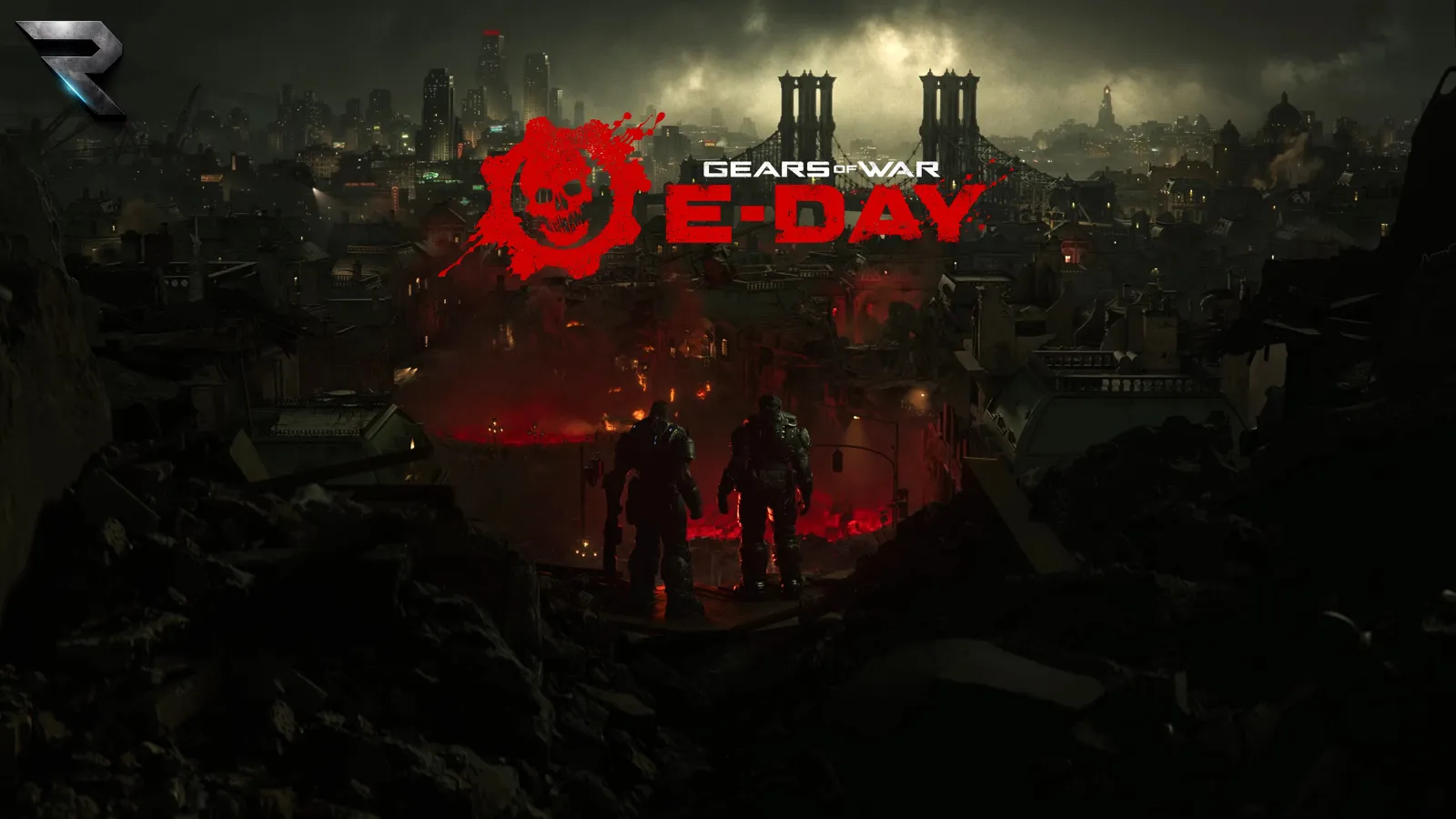
Gears of War: E-Day is going back to the beginning, but The Coalition isn't treating Emergence Day as a simple excuse to revisit the origins of Marcus Fenix and Dom Santiago. The studio is using the defining catastrophe in Gears history to rethink how the franchise's campaigns actually work, from the way combat spaces are built to how familiar weapons can be customized.
Studio creative director Matt Searcy and art director Aryan Hanbeck laid out the thinking behind E-Day in an IGN Gamescom interview, covering the game's combat overhaul, its new weapon modification system, and how the team plans to tell a meaningful prequel story when players already know how it ends for the two leads. The core idea driving E-Day is that Emergence Day should feel like something players are living through for the first time, rather than a piece of history players are simply touring the aftermath of.
Marcus and Dom's Story Begins Before Their Brotherhood
E-Day catches Marcus and Dom at an unusual point in their lives. Both have already been through war, but neither has become the legendary duo Gears fans know. Marcus has come home from combat with no war left to fight and no clear idea what comes next. Dom is approaching civilian life from the opposite direction, counting down to being reunited with his family.
Grief shapes their relationship just as much as any of that. The two are mourning Carlos, Dom's older brother, and that shared loss pulls them together emotionally while also creating some distance between them early in the story. It's a very different entry point than the trilogy gave players. Marcus isn't yet the hardened soldier everyone remembers; he's a younger man still working out who he is once the battlefield is taken away. Dom is going through his own version of the same thing.
The effect The Coalition is going for is a central relationship that feels like it's forming in front of the player, rather than an established piece of series lore being recapped. The studio has previously framed E-Day as an origin story for Marcus and Dom's brotherhood, and that idea still sits at the center of the game's identity.
The Prequel Problem Is Bigger Than Marcus and Dom
Telling a story set before the original Gears of War comes with an obvious hurdle: everyone already knows Marcus and Dom make it out alive. The Coalition isn't trying to work around that. Instead, the studio is leaning on how much space actually sits between E-Day and the first game.
Fourteen years separate the two stories, and E-Day fills that gap with new members of Marcus and Dom's squad and a much larger supporting cast. That shifts where the tension actually comes from. It's not really about whether Marcus or Dom survive; it's about everyone and everything around them, including new characters, locations, and relationships that a playable Gears campaign hasn't touched before. Some of those new faces will make it. Others won't.
That gap gives The Coalition more room to work with than a prequel premise usually allows, and it lets E-Day land differently depending on who's playing it. Longtime fans get lore connections to chase, returning players get to see familiar faces at a completely different stage of life, and newcomers arguably get the biggest payoff of all. Marcus and Dom don't know what's coming any more than the player does. When the Locust surface for the first time, nobody's fighting enemies that have already been catalogued and explained. Everyone's discovering them at once, which gives E-Day a natural way back into the dread that defined the earliest Gears games.
One City Will Change as E-Day Unfolds
The setting itself is doing a lot of the same work. E-Day plays out largely within the city of Kalona, letting the game stay locked to one location while showing that location fall apart in real time. That's a real departure for the series. Past Gears games have typically dropped players into environments where the destruction already happened. E-Day gets to show the collapse actually unfolding around the player.
The scope of the event is massive, but the story keeps its focus tight on a small group of characters. Marcus, Dom, and the rest of their squad move through Kalona encountering survivors, fellow Gears soldiers, and civilians caught in the middle of the invasion, with the campaign occasionally opening into wider sections of the city while still keeping players tied to a specific goal. Players can push straight toward the next objective or slow down to look around, and that choice is meant to make exploration feel purposeful rather than a matter of hoovering up collectibles scattered across a bigger map. The Coalition wants the city itself to tell the stories of the people who lived there right up until the moment everything changed. Recent hands-on previews have described the campaign the same way, mixing traditional linear missions with broader city sections that hold optional objectives and things to find.
Gears' Cover Combat Is Becoming More Flexible
For a series built around cover shooting, E-Day's biggest gameplay shift is less about replacing that foundation and more about stretching it. The Coalition rebuilt the classic Gears combat formula from scratch while keeping cover at the center of it, but cover itself is no longer as rigid as it used to be.
E-Day brings in different heights of cover, more irregular shapes, and a lot more verticality. Players can climb, slide, and jump, which gives both players and encounter designers far more freedom to move through a fight. That changes what a Gears battlefield looks like on the ground. Instead of leaning on rows of predictable waist-high barriers, environments can mix in lower cover, uneven structures, and vertical routes, so a space can support more than one way to approach it without losing the deliberate, tactical rhythm that makes Gears combat recognizable in the first place.
The Coalition also wants these systems to feel like a natural part of the world rather than a level-design trick. A ruined city shouldn't look like it was built to hand players a perfectly spaced series of chest-high walls; it should just look like a city. That's a small-sounding distinction, but it could shape how E-Day feels moment to moment in a meaningful way. None of this is meant to turn Gears into a platformer. The added movement is there to give players more routes through and around a fight, including chances to flank or fight from higher ground.
Familiar Weapons, More Ways to Make Them Yours
Weapons matter to Gears' identity just as much as its cover system does. The Lancer and Gnasher aren't being swapped out for a new arsenal. Instead, E-Day adds a weapon modification system built to let players tune those familiar guns to fit how they actually want to play.
Want a Lancer that holds up better at range? A scope helps, though it comes with trade-offs elsewhere. Players can also boost ammo capacity and make other adjustments that change how a loadout behaves, and the system works across both campaign and Horde, so customization isn't limited to single-player progression. Some of the mods go further than simple stat tweaks. The Gnasher, for instance, can take a bayonet, turning one of the series' most iconic close-range weapons into an even nastier melee option. The key point is that E-Day isn't using mods to make every weapon feel the same. Each gun keeps its identity; the modifications just give players more say over how that weapon fits their approach to a fight. Recent hands-on coverage has echoed this, calling out mods that alter weapon stats and, in some cases, change how a gun functions outright.
The Lancer's Story Starts on the Battlefield
E-Day also gets to dig into series history through one of its most recognizable weapons. The Lancer isn't just in the game because a Gears title needs a chainsaw rifle. The Coalition is using the prequel setting to actually show how the weapon came to exist, drawing on established lore about Marcus's broken bayonet and Tai's improvised fix with a power saw. E-Day turns that backstory into something players can live through, including the rough prototype that eventually becomes the Lancer fans know.
It's a good example of what a prequel lets The Coalition do that a straight sequel couldn't. Rather than just bringing back familiar gear for the sake of nostalgia, the game gets to show the circumstances that made that gear matter in the first place. And no matter what else changes, one rule apparently still holds: a Gears game needs a chainsaw.
E-Day Is Trying to Make the Apocalypse Feel Personal
That might be the biggest difference between E-Day and everything that came before it. Emergence Day is one of the largest events in Gears history, the moment the Locust surface from beneath Sera and start the war that defines the entire series. The Coalition isn't treating it purely as spectacle, though.
The studio is putting Marcus and Dom inside that catastrophe before either of them becomes the hardened hero players remember, showing a city while it's still alive instead of after it's already rubble, and surrounding them with civilians and soldiers who are just as blindsided by what's happening. On top of that, the combat system is being rebuilt around spaces that feel less like a shooting gallery and more like an actual place.
None of this is The Coalition walking away from the classic Gears formula. It's closer to the opposite. Cover combat, brutal close-range weapons, Marcus and Dom, huge set pieces, and a world defined by war are all still here; they're just being given more room to breathe. E-Day ends up feeling less like a nostalgia trip through Gears' past and more like an attempt to figure out why that past worked in the first place.
Gears of War: E-Day launches October 6, 2026, on Xbox Series X|S and PC.