
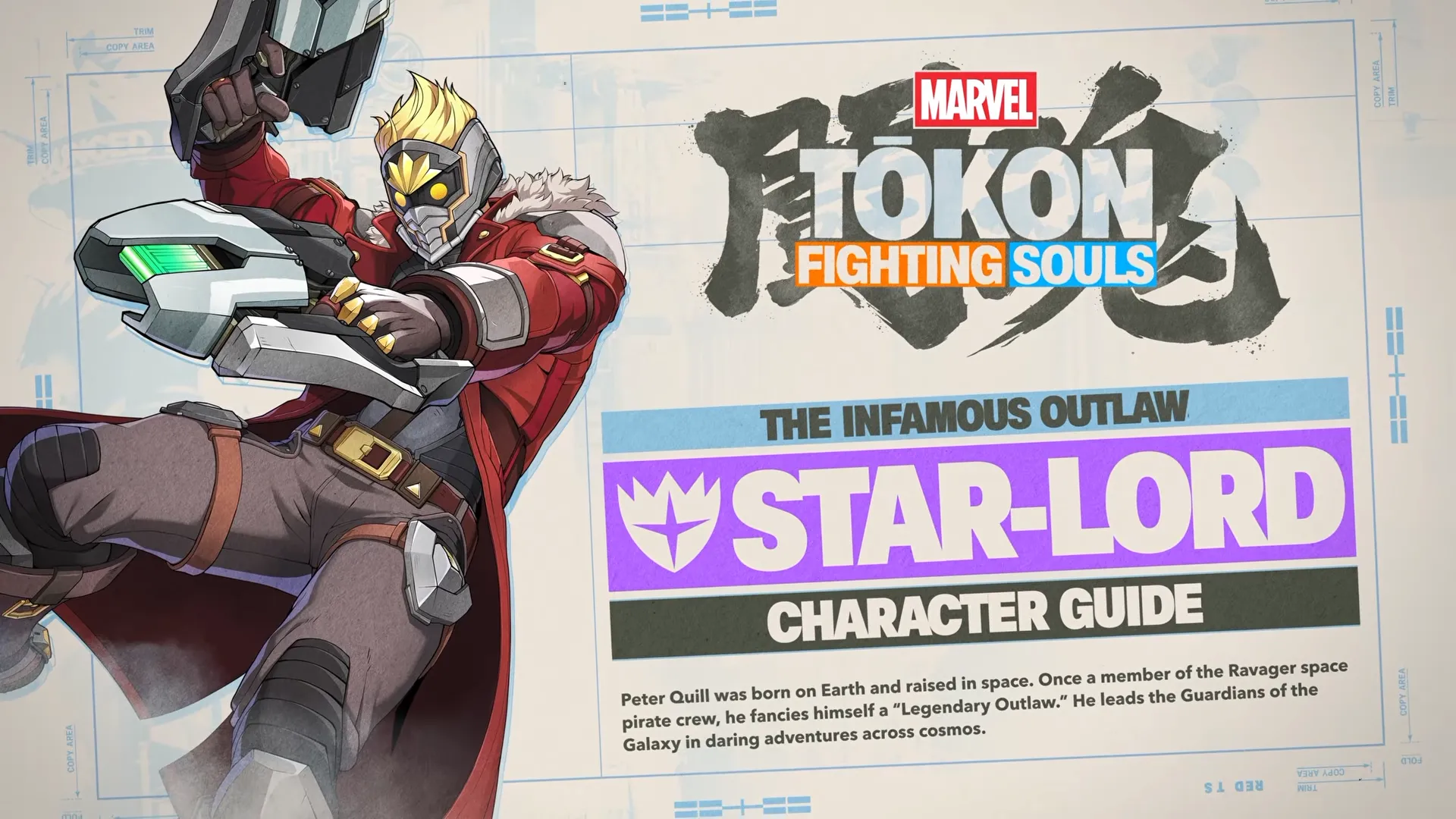
Peter Quill joins Marvel Tōkon: Fighting Souls as Star-Lord, bringing his Element Guns, jet boots, and a stash of explosives from the Guardians of the Galaxy. He's built around movement and unpredictability, constantly forcing opponents to guess where the next hit is coming from.
He's not a straightforward rushdown character. Star-Lord can zone from range with projectiles, pressure with fast movement, dominate the air with Free Flight, or swap elemental ammunition depending on the matchup. Learning his movement and managing his resources takes practice, but the payoff is one of the more flexible characters in the game.
Here's a breakdown of Star-Lord's kit, from his Element Blast system to his Ultimate Skill.
Is Star-Lord Easy to Play?
Star-Lord sits in the middle of the roster in terms of execution. His basic attacks and projectiles are straightforward, but his Element Blast system adds a layer most beginners will need time with — choosing the right element, tracking remaining shots, and mixing aerial movement into grounded pressure all take practice. The game rates him three stars for Ease of Use: approachable, but with room to grow into.
Star-Lord Playstyle Explained
Star-Lord is a mobile zoner who moves between offense and defense quickly. Rather than sticking to one plan, he shifts the pace of a match through movement and elemental attacks. Projectiles keep opponents cautious about approaching, and his air mobility lets him escape pressure or start offense from angles that are hard to predict.
Opponents who settle into blocking his fireballs can get caught by a sudden Rocket Step or Ravager Rush. Players trying to chase him down run into Gravity Mine setups or Element Blast variants that change how his attacks behave mid-match.
If you like controlling neutral while keeping multiple options open, Star-Lord fits that style.
Star-Lord's Unique Mechanics
A few mechanics set Star-Lord apart from the rest of the cast so far.
Element Blast
Element Blast sits at the center of Star-Lord's moveset. Instead of firing the same projectile all match, he equips elemental ammunition that changes how several of his attacks behave. Knowing when to switch elements is one of the bigger skills separating new Star-Lord players from experienced ones.
| Element | Effect | Best Against |
|---|---|---|
| Earth | Blocks projectiles, then fires a blast that causes Break | Zoning-heavy opponents |
| Ice | Short-range blast that freezes on hit | Aggressive opponents, combo starters |
| Fire | Multi-hit fireball with wider screen coverage | Sustained pressure and chip damage |
Earth Element
Earth creates a shield that blocks incoming projectiles before firing an energy blast with a Break effect. It's useful against zoning-heavy opponents, or any time you want to challenge enemy projectiles safely.
Ice Element
Ice fires a short-range blast that freezes on hit. The range is limited compared to the other elements, but a landed freeze opens up combo opportunities or punishes an overly aggressive opponent.
Fire Element
Fire turns the attack into a multi-hit fireball. It's built for sustained pressure and chip damage, and covers more of the screen than the Ice version.
Groove Switch
Once Star-Lord runs out of shots for his current element, Groove Switch kicks in automatically and rotates him into a new element. Keeping track of remaining shots matters if you want to hold onto offensive momentum.
Free Flight
Free Flight lets Star-Lord hover in the air for a short window, giving him aerial positioning most of the cast doesn't have. Instead of committing to a fixed jump arc, he can reposition mid-air, bait an anti-air, or delay his landing to throw off timing.
Multi-Dash
Multi-Dash lets him change direction rapidly while airborne. Paired with Free Flight, it makes his air game hard to pin down, since he can shift his approach angle several times before committing to an attack.
Normal Attacks
Like every character in Marvel Tōkon: Fighting Souls, Star-Lord has standing, crouching, and aerial Light, Medium, and Heavy attacks. His Heavy attacks add directional variations that open up more combo routes and movement options, and his Link Attacks flow naturally into several of his specials.
Blaster Shot
Blaster Shot is his main projectile. On the ground it fires straight across the stage; in the air it angles down toward grounded opponents. It links directly into Element Blast or Groove Switch, which makes it the backbone of his zoning, and the downward aerial angle is useful against opponents trying to move underneath him.
Gravity Mine
Gravity Mine tosses a grenade forward rather than firing directly at the opponent, and it can be manipulated with Element Blast before it goes off. The Heavy version detonates during the toss itself, which varies the timing and catches opponents trying to rush in. From here, Star-Lord can move into Element Blast or Groove Switch.
It doesn't look like much on its own, but the real value is in the hesitation it forces. Even a short pause is enough time for Star-Lord to reposition or set up ranged pressure.
Best uses:
- Force defensive reactions.
- Control sections of the stage.
- Create safe openings to switch elements.
- Cover your movement while taking to the air.
Ravager Rush
Ravager Rush is Star-Lord's main offensive special, with different versions depending on the button used.
Light Version: A ranged projectile that can trigger a Break version by extending the input after a Link Attack. Useful for confirming damage at range while keeping opponents honest in neutral.
Medium Version: Opens with a low slide before continuing into more hits. Depending on the strength used, it either continues pressure on the ground or launches the opponent up for an aerial follow-up. The Heavy version can transition directly into Free Flight for extended combos.
Air Version: Slams the opponent down before Star-Lord fires multiple shots on the way down. If the opening hit connects, the rest lands automatically, making it a strong combo finisher or punish after an aerial confirm.
Rocket Step
Rocket Step is Star-Lord's movement special and a big part of why he's slippery to fight. It launches him into a short leap that changes behavior by version: Light moves forward, Medium retreats, and Heavy attacks during the leap and can flow into Free Flight on hit. Since opponents can't tell whether he's advancing, retreating, or attacking, it keeps his offense unpredictable.
Best uses:
- Escape corner pressure.
- Fake an approach.
- Start aerial offense.
- Extend pressure into Free Flight.
Super Skill: Elemental Outlaw
Elemental Outlaw is Star-Lord's Super Skill. He unloads a barrage from his Quad Blasters, then finishes with an attack based on whichever element is currently equipped — the grounded version fires straight ahead, the aerial version angles down toward grounded opponents. Because the finisher changes with the active element, players can pick the version that fits the matchup instead of relying on one fixed super.
At 50 Skill Gauge, it's relatively cheap, which makes it a solid combo finisher through most of a match.
Ultimate Skill: Dance Off
Dance Off is Star-Lord's Ultimate Skill. It opens with an invincible lunging strike before moving into an extended sequence that runs through most of his arsenal. Landing the opening hit grants bonus Element Blast shots once the move ends, giving Star-Lord both damage and extra resources to keep pressing. Because the opener is invincible, it also works as a reversal against predictable offense.
Tōkon Assemble
Star-Lord's Tōkon Assemble activates once the opponent is one round from losing. The Guardians leader calls in his teammates for a cinematic assault, and like every Tōkon Assemble, it's his highest-damage option and can swing a match late. At 150 Skill Gauge, it's best saved for moments where closing out the round matters more than holding onto resources.
Assist Types
Assemble Assist Aerial
Fires multiple projectiles down from above, which makes it useful against airborne opponents or for extending pressure after a knockdown. It also allows an immediate Member Switch if it connects.
Assemble Assist Shooter
Fires an Element Blast that inherits whichever element Star-Lord has equipped as the leader character, so the assist itself changes depending on your loadout.
Best Tips for Playing Star-Lord
Star-Lord rewards planning over button-mashing. A few things to keep in mind:
- Learn every Element Blast before chasing advanced combos.
- Stay airborne when you can to make use of Free Flight.
- Use Blaster Shot to bait opponents into mistakes.
- Mix Rocket Step with aerial movement to stay unpredictable.
- Save Elemental Outlaw for after a confirmed combo.
- Keep track of remaining elemental shots so Groove Switch doesn't catch you off guard.
His biggest strength isn't raw damage — it's making opponents guess where the next attack is coming from.
Final Thoughts
Strengths: Strong aerial mobility, multiple projectile options, flexible elemental attacks, good screen control, strong combo routes, versatile assists, and a resource system with real depth once you learn it.
Weaknesses: Element Blast takes time to master, resource management is a constant factor, damage is lower without solid combo routing, he needs good positioning to get the most from his mobility, and mistimed aerial movement leaves him open to anti-airs.
Star-Lord is worth learning if you like characters built around movement and improvisation. Between his projectiles, air mobility, elemental weapons, and combo routes, he has tools for most situations, though he takes more practice to get comfortable with than a straightforward brawler. For players who like controlling neutral and switching things up mid-match, he's one of the more interesting characters revealed for Marvel Tōkon: Fighting Souls so far.
Continue Reading Our Marvel Tōkon Coverage
Explore more Marvel Tōkon: Fighting Souls character guides in our Marvel Tōkon Guide Hub.
Note: This guide is based on Arc System Works' official Star-Lord character guide and currently available gameplay footage. We'll continue updating it as Marvel Tōkon: Fighting Souls receives balance changes, new discoveries, and additional competitive strategies after launch.