

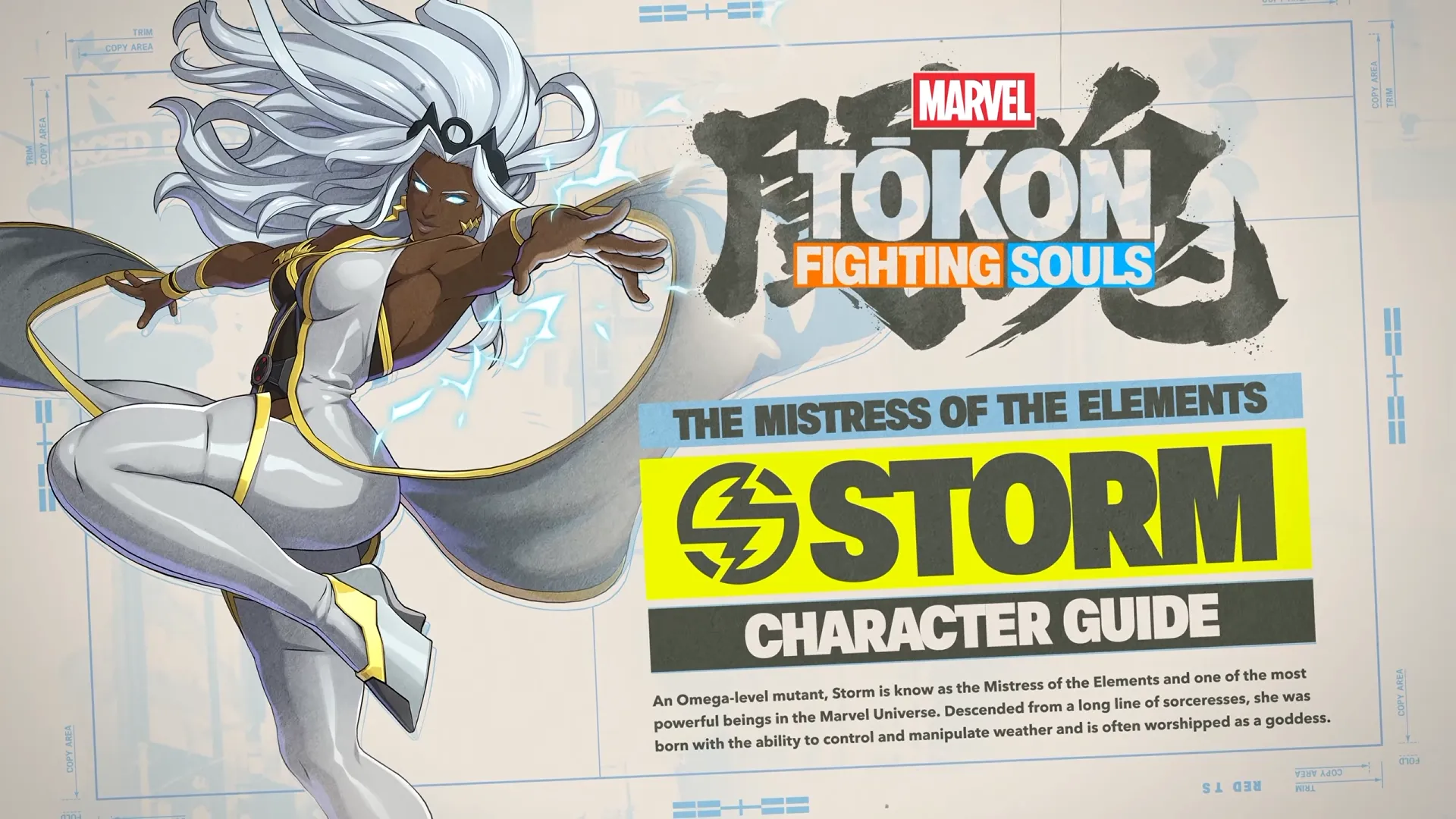
Storm doesn't simply battle her opponents in Marvel Tōkon: Fighting Souls, she reshapes the battlefield around them. While many characters rely on overwhelming rushdown pressure or straightforward projectile zoning, Storm constantly manipulates the arena itself, creating tornadoes, summoning massive icicles, calling down lightning, and using powerful wind currents to dictate exactly how every engagement unfolds.
Arc System Works has designed Storm as one of the game's premier control specialists, but calling her a traditional zoner doesn't tell the whole story. Her unique Tempest mechanic fundamentally changes how several of her attacks behave, allowing her to reposition hazards, alter her own movement, and create offensive sequences that few other characters can replicate. Combined with unrestricted aerial movement through Free Flight, Storm becomes one of the most expressive fighters currently revealed for the launch roster.
Despite being rated three out of five stars for ease of use in Arc System Works' official character guide, Storm possesses one of the highest skill ceilings in the game. Mastering her means learning when to spend Tempest, how to control space with lingering weather effects, and how to convert that control into relentless pressure without leaving yourself exposed.
This guide covers Storm's complete moveset, including every Skill, her Tempest mechanic, Super Skill, Ultimate Skill, Assist Types, advanced strategy, beginner tips, and everything you need to know before taking the weather goddess into battle when Marvel Tōkon: Fighting Souls launches on PlayStation 5 and PC.
Storm Overview
Storm is best described as a battlefield control character with exceptional aerial mobility. Rather than overwhelming opponents through raw aggression, she gradually limits their options until every movement becomes dangerous. Tornadoes occupy valuable space, icicles remain active long after being summoned, lightning punishes hesitation, and Tempest ties everything together into one cohesive gameplan.
Unlike many setup characters in fighting games that sacrifice mobility for control, Storm excels at both. Free Flight allows unrestricted aerial movement for a limited duration, enabling her to approach from unexpected angles, retreat safely after pressure, or continue aerial offense without committing to a predictable jump arc.
The result is a character who constantly forces opponents to make uncomfortable decisions. Stay grounded for too long and Storm fills the screen with weather effects. Challenge her in the air and she possesses the mobility to reposition before punishing your approach. Even when blocking successfully, opponents must remain aware of lingering tornadoes and icicles that continue influencing neutral long after their initial activation.
Storm's strongest players won't necessarily be the ones with the fastest execution. They'll be the players who understand positioning, resource management, and how to make every Tempest activation create another difficult decision for their opponent.
| Attribute | Rating |
|---|---|
| Ease of Use | ★★★☆☆ |
| Mobility | ★★★★★ |
| Battlefield Control | ★★★★★ |
| Combo Potential | ★★★★★ |
| Pressure | ★★★★☆ |
| Defense | ★★★★☆ |
Storm Playstyle
Storm dominates through complete battlefield control.
Her objective isn't simply to throw attacks across the screen. Instead, she wants multiple threats active simultaneously. A tornado occupies one section of the stage. A lingering icicle controls another. Lightning threatens any reckless approach, while Storm herself remains airborne looking for the perfect opening.
This layered offense makes Storm incredibly difficult to predict. Opponents cannot focus exclusively on Storm herself because her weather effects remain active independently. At the same time, ignoring Storm allows her to freely reposition using Free Flight and begin another offensive sequence.
Tempest amplifies this philosophy even further. Rather than acting as a simple damage buff, Tempest transforms many of Storm's existing attacks into entirely new tools. Tornadoes move. Icicles shift position. Storm herself gains additional movement during attacks. Even command grabs gain entirely new combo routes through altered launch angles.
This creates an unusual rhythm compared to most fighting game characters. Storm alternates between establishing weather effects, activating Tempest to manipulate them, then capitalizing on the chaos before repeating the cycle. Every successful sequence naturally flows into the next, giving experienced players tremendous freedom to improvise.
| Strengths | Weaknesses |
|---|---|
| Outstanding battlefield control | Requires careful Tempest management |
| Excellent aerial mobility through Free Flight | Steeper learning curve than straightforward characters |
| Persistent weather effects create constant pressure | Many setups require planning and positioning |
| Can transition between zoning and offense seamlessly | Misusing Tempest greatly reduces her pressure potential |
| Powerful assists for team-based play | Beginners may struggle with resource optimization |
Ease of Use: ★★★☆☆ (3 out of 5, according to Arc System Works' official character guide)
Storm's Unique Mechanic: Tempest
Everything about Storm revolves around Tempest.
Instead of functioning as a temporary buff or install mechanic, Tempest acts as a powerful wind current that interacts with numerous aspects of Storm's moveset. Activating it consumes one segment of the dedicated Tempest Gauge, which gradually refills over time, encouraging players to spend the resource regularly instead of hoarding it.
The most obvious benefit is movement. Several attacks allow Storm to change direction while Tempest is active, dramatically increasing her unpredictability. Rather than committing to a fixed trajectory, she can drift across the screen, adjust spacing mid-attack, or reposition herself before continuing pressure.
Its influence extends far beyond movement, however. Tornadoes can be relocated after they've already been placed. Lingering Hailstones shift position to maintain pressure. Cold Embrace gains additional range while also changing the opponent's launch direction after a successful grab. Even Whirlwind changes how it travels depending on Tempest's influence.
This means Tempest isn't something players activate in isolation. The strongest Storm players will usually establish weather effects first, then activate Tempest to manipulate those existing hazards into even stronger offensive situations.
Because Tempest naturally regenerates, the resource encourages an aggressive rhythm. Spending it at the right moment often generates enough momentum to rebuild the gauge before the next major engagement begins.
Free Flight
Complementing Tempest is Storm's ability to enter Free Flight.
Unlike a conventional double jump or air dash, Free Flight grants unrestricted aerial movement for a limited duration. Storm can float, reposition, adjust spacing, or completely change her approach angle before continuing her offense.
This dramatically improves her ability to control neutral. Grounded opponents must constantly monitor both the battlefield hazards already in play and Storm's current aerial position, making defensive reactions considerably more difficult.
Free Flight also creates unique combo opportunities. Several attacks naturally transition into flight, allowing Storm to continue pressure immediately instead of returning to the ground. Skilled players can repeatedly weave between grounded and aerial offense while remaining surprisingly difficult to pin down.
Rather than treating Free Flight purely as a mobility option, players should view it as another extension of Storm's pressure. Constant movement forces hesitation, and hesitation gives Storm more opportunities to establish her weather effects.
Normal Attacks and Link Attacks
Storm's normal attacks follow the standard Light, Medium, and Heavy structure shared across Marvel Tōkon: Fighting Souls, with standing, crouching, and aerial variants available for each strength. Heavy attacks also include directional aerial options, allowing Storm to threaten multiple approach angles while airborne.
On their own, her normals are solid without being extraordinary. Their real importance comes from how naturally they transition into Link Attacks and subsequently into Tempest-enhanced specials. Most of Storm's highest damage routes begin with simple confirms before expanding into far more elaborate sequences using her weather mechanics.
Because Free Flight allows Storm to reposition during offense, opponents often struggle to determine whether her next attack will land in front of them, above them, or after crossing to the opposite side. This unpredictability turns otherwise straightforward normal attacks into surprisingly effective pressure tools.
Mastering Storm's normals isn't about memorizing individual buttons. It's about understanding how they connect the rest of her toolkit together. Every successful confirm becomes another opportunity to activate Tempest, reposition existing hazards, and begin controlling the match on Storm's terms.
Storm Skills
Storm's special moves are where her identity truly begins to shine. Individually, each Skill performs a specific role, whether that's controlling space, extending combos, punishing reckless approaches, or opening defensive opponents. Together, however, they become far more dangerous thanks to Tempest.
Unlike many characters whose specials remain largely static throughout a match, Storm constantly changes how her abilities function. Tempest alters movement, repositions lingering weather effects, increases effective range, and even changes combo routes depending on when it is activated. Learning these interactions is far more important than simply memorizing button inputs.
The strongest Storm players won't rely on one signature attack. Instead, they'll rotate between every weather effect available, forcing opponents to adapt to multiple overlapping threats before converting even the smallest mistake into sustained pressure.
Lightning Strike
Lightning Strike is Storm's primary offensive special and one of the safest attacks in her toolkit. Storm summons a powerful bolt of lightning that strikes quickly, making it an excellent option for interrupting movement, checking aggressive approaches, or ending pressure strings without placing herself in significant danger.
What immediately separates Lightning Strike from many traditional projectile attacks is Storm's ability to move during the attack itself. Directional inputs allow her to reposition while the lightning descends, making her offense considerably harder to predict. Opponents aren't simply reacting to the attack, they're also tracking Storm's movement at the same time.
Activating Tempest increases the distance Storm can travel during Lightning Strike. Instead of remaining near her original position, she can glide much farther across the battlefield before recovering. This dramatically improves her ability to continue pressure, escape dangerous situations, or unexpectedly close the distance after conditioning opponents to expect zoning.
The move's relatively quick recovery also makes it difficult to punish on block compared to many other ranged specials. Even when Lightning Strike doesn't score a direct hit, Storm usually remains in a favorable position to either establish additional weather effects or safely disengage.
Best used for: neutral control, pressure resets, combo extensions, movement mix-ups, and punishing hesitant opponents from medium range.
Cold Embrace
Cold Embrace gives Storm something many zoning-oriented characters lack: a command grab that forces defensive opponents to constantly respect close-range pressure.
Storm grabs the opponent before freezing them in a devastating burst of ice. On its own, the move serves as an excellent answer against players who become overly comfortable blocking tornadoes, projectiles, and aerial approaches. Once opponents begin expecting ranged attacks, Cold Embrace introduces an entirely different threat that discourages passive defense.
Tempest transforms the move from a straightforward command grab into one of Storm's strongest offensive tools. Both the Light and Heavy versions gain significantly increased range as Storm rides powerful wind currents directly toward her opponent before initiating the grab.
Successful command grabs also replenish a portion of Storm's Tempest Gauge, rewarding players for integrating Cold Embrace naturally into their offense instead of relying exclusively on ranged pressure. This interaction encourages a satisfying gameplay loop where Tempest strengthens the grab, while the grab helps rebuild Tempest for future sequences.
The mechanic goes even further. Tempest also changes the opponent's launch trajectory after a successful grab, opening combo opportunities that simply don't exist without the mechanic active. Depending on spacing and positioning, Storm can route into follow-up attacks that dramatically increase both damage and corner carry.
When combined with horizontal Tempest movement, Cold Embrace additionally triggers the Break effect, making it a particularly threatening option against opponents attempting to weather Storm's offensive pressure.
Best used for: opening defensive opponents, extending combos, rebuilding Tempest resources, and forcing respect during close-range pressure.
Whirlwind
Whirlwind perfectly demonstrates Storm's hybrid identity as both a mobility character and a battlefield controller.
Storm surrounds herself with violent winds before launching toward the opponent in a spinning attack. At first glance it appears to be a fairly conventional advancing special, but Tempest dramatically changes how the move behaves.
The Light version serves as a reliable combo tool and movement option, while the Medium version attacks while ascending before transitioning directly into Free Flight. This allows Storm to remain airborne immediately after connecting, creating opportunities to continue pressure from above without ever returning to the ground.
The Heavy version commits even further to sustained offense, continuously attacking until Storm lands. Rather than functioning as a single burst of damage, it occupies space for an extended period, making it useful for catching airborne opponents or extending longer combo routes.
Tempest changes Whirlwind's trajectory, letting Storm alter both her movement and the amount of knockback generated by the attack. Experienced players can therefore adapt the move based on screen position instead of relying on fixed combo routes.
This flexibility makes Whirlwind valuable in nearly every stage of a match. It can begin offense, extend combos, reposition Storm safely, or transition directly into Free Flight for continued aerial pressure.
Best used for: mobility, combo extensions, aerial pressure, repositioning, and transitioning into Free Flight.
Tornado
Tornado is arguably the single most important move in Storm's entire arsenal.
Rather than functioning like a traditional projectile that disappears immediately after contact, Tornado creates persistent whirlwinds that remain active on the battlefield long after Storm has resumed moving. These lingering hazards fundamentally reshape neutral by restricting where opponents can safely stand.
The Light version summons a nearby tornado, making it ideal for close-range pressure or protecting Storm while she establishes additional weather effects.
The Medium version creates a whirlwind farther away, allowing Storm to influence neutral from a safer distance and challenge opponents attempting to maintain space.
The Heavy version summons two tornadoes simultaneously, giving Storm immediate control over multiple sections of the stage. Even without Tempest, this dramatically limits an opponent's movement options.
Tempest elevates Tornado from an excellent zoning tool into the centerpiece of Storm's entire gameplan. Existing whirlwinds can be repositioned after they've already been created, allowing Storm to constantly adjust her control over the battlefield without needing to summon entirely new tornadoes.
This creates tremendous psychological pressure. Opponents cannot simply avoid an existing tornado because Tempest may suddenly reposition it into their escape route. Every movement becomes another prediction game that overwhelmingly favors Storm once multiple hazards are active.
Tornado also synergizes directly with several of Storm's other abilities, particularly Hurricane, making it one of the first weather effects players should establish whenever possible.
Best used for: controlling neutral, restricting movement, protecting Storm's approach, forcing mistakes, and preparing stronger Tempest sequences.
Hailstone
Hailstone complements Tornado by introducing a second persistent battlefield hazard that opponents must constantly account for.
Storm summons a massive icicle directly in front of her. The Medium version immediately launches the projectile forward, allowing it to challenge opponents attempting to advance through neutral.
The Heavy version functions quite differently. Instead of immediately flying forward, the icicle remains active on the battlefield for a limited time, creating another lingering obstacle that continuously threatens nearby opponents.
Once Tempest enters the equation, Hailstone becomes significantly more dangerous.
Storm can reposition the lingering icicle using wind currents, altering its location long after it has been summoned. Even more importantly, activating Tempest causes Heavy Hailstone to strike repeatedly, dramatically increasing both damage potential and combo opportunities.
This interaction rewards planning rather than improvisation. Players who establish Hailstone early before activating Tempest gain far more value than those who simply throw the move out randomly.
Combined with Tornado, Hailstone allows Storm to create layered weather effects that control multiple areas of the stage simultaneously. Opponents must navigate around moving tornadoes, lingering icicles, and Storm herself, all while anticipating when Tempest will completely change the battlefield once again.
Best used for: screen control, layered pressure, combo extensions, controlling movement, and strengthening Tempest setups.
How Storm Controls Neutral
Neutral is where Storm truly excels. Rather than relying on a single dominant projectile, she slowly fills the battlefield with overlapping threats until opponents run out of comfortable options.
A typical sequence begins by establishing Tornado or Hailstone from a safe distance before using Lightning Strike to discourage reckless movement. Once the opponent begins respecting these hazards, Storm activates Tempest to reposition existing weather effects, forcing another defensive adjustment before she transitions into Whirlwind or Cold Embrace.
This layered approach means opponents rarely deal with just one attack at a time. Even when blocking successfully, lingering weather effects continue influencing their movement, allowing Storm to dictate the pace of nearly every exchange.
Against impatient players, Storm simply waits for mistakes. Against patient players, she gradually fills the stage with enough weather effects that patience becomes increasingly difficult to maintain. Either way, the battle slowly shifts onto Storm's terms, exactly where she wants it.
Super Skill: Hurricane
Skill Gauge Cost: 50
Hurricane is Storm's primary Super Skill and perfectly represents how her entire kit revolves around manipulating the battlefield rather than simply dealing raw damage. Upon activation, Storm surrounds herself with a massive whirlwind that damages nearby opponents while granting invincibility during startup, giving her an excellent defensive reversal whenever opponents overextend their offense.
While the invincibility alone would make Hurricane a valuable defensive tool, its true strength comes from how it interacts with Storm's existing weather effects.
If Tornadoes are already active when Hurricane is activated, every existing whirlwind immediately expands into an enormous storm. Instead of controlling isolated portions of the battlefield, Storm suddenly dominates massive sections of the screen simultaneously, making escape considerably more difficult.
Tempest expands Hurricane's versatility even further. Rather than remaining fixed in one location, Storm can move Hurricane forward or backward after activation, allowing her to chase retreating opponents, maintain offensive pressure, or reposition the attack to catch attempted escapes.
This flexibility makes Hurricane useful in almost every situation. It can interrupt pressure, punish unsafe attacks, finish combos, protect Storm while weather effects remain active, or simply force opponents to respect her space whenever she has 50 Skill Gauge available.
Best used for: defensive reversals, combo finishers, punishing pressure, expanding existing tornadoes, and maintaining screen control.
Ultimate Skill: Eye of the Storm
Skill Gauge Cost: 100
Eye of the Storm is exactly what players expect from the goddess of weather, a spectacular display of overwhelming elemental power that converts successful confirms into devastating damage.
Storm unleashes an enormous burst of lightning during a cinematic sequence before striking the opponent with tremendous electrical force. Like every Ultimate Skill currently revealed in Marvel Tōkon: Fighting Souls, Eye of the Storm can be activated directly or by extending a successful Heavy Link Attack.
The official character guide also notes that players can hold the appropriate input during the Link Attack to perform an EX move beforehand, allowing Storm to maximize damage before finishing with her Ultimate. This creates strong meter management decisions throughout every match.
Although Eye of the Storm certainly deals impressive damage, players shouldn't throw it out randomly. Storm already controls neutral exceptionally well without relying on Ultimate meter, making Eye of the Storm significantly more valuable as a guaranteed combo finisher or punish after forcing a major mistake.
Saving 100 Skill Gauge until a confirmed opening often produces much better results than spending resources inefficiently throughout the round.
Tōkon Assemble
Skill Gauge Cost: 150
Like every member of the Marvel Tōkon roster, Storm gains access to Tōkon Assemble only when losing the current round would also lose the match. Rather than functioning as a standard super, it serves as the game's primary comeback mechanic.
Storm begins the attack with an invincible strike before the rest of her team joins the battle during a cinematic sequence that delivers massive damage. The invincible startup allows players to challenge pressure, punish reckless offense, or convert a successful Link Attack into one final opportunity to steal victory.
Because of its significant meter cost, players should avoid building their overall gameplan around Tōkon Assemble. Instead, think of it as an emergency resource that rewards careful meter conservation throughout earlier rounds.
Storm Assist Types
Storm's assists reinforce her identity as one of Marvel Tōkon's premier battlefield control characters. Rather than focusing exclusively on direct damage, each assist either creates additional space control or enables stronger team pressure through Member Switch opportunities.
| Assist | Effect |
|---|---|
| Assemble Assist Aerial | Launches a downward icicle projectile. Successful hits immediately allow a Member Switch for combo extensions. |
| Assemble Assist Assault | Creates a whirlwind that pulls opponents inward before enabling Member Switch pressure. |
| Assemble Assist Shooter | Fires a whirlwind projectile across the screen, providing long-range support while maintaining offensive momentum. |
Each assist naturally complements characters that appreciate additional screen control, making Storm a valuable teammate even when she isn't the active fighter.
Storm Character Archetype
| Category | Rating |
|---|---|
| Battlefield Control | ★★★★★ |
| Aerial Mobility | ★★★★★ |
| Zoning | ★★★★★ |
| Combo Creativity | ★★★★★ |
| Pressure | ★★★★☆ |
| Defense | ★★★★☆ |
| Beginner Friendly | ★★★☆☆ |
| Execution Difficulty | ★★★★☆ |
| Resource Management | ★★★★★ |
Meter Management
Storm asks players to manage two independent resources throughout every match: Skill Gauge and Tempest Gauge.
Tempest should rarely remain unused for extended periods. Since it naturally regenerates, spending it proactively often creates more overall value than waiting for a theoretical perfect opportunity that never arrives.
Skill Gauge, however, deserves more careful consideration. Heavy special variations, Hurricane, Eye of the Storm, and Tōkon Assemble all compete for the same resource pool. Experienced Storm players constantly evaluate whether immediate pressure is worth sacrificing future combo potential or defensive options.
Learning this balance is one of the biggest differences between intermediate and advanced Storm players.
Advanced Storm Strategy and Tempest Synergies
Learning Storm's individual moves is only the first step. The real depth of her character comes from understanding how those abilities interact with one another. Tempest doesn't simply make attacks stronger, it allows Storm to create layered sequences that continuously force opponents to adapt while she dictates the pace of the match.
Instead of thinking about each Skill independently, experienced Storm players build every offensive sequence around weather effects that remain active on the battlefield. Once multiple hazards are established, Tempest ties everything together, transforming ordinary pressure into some of the most creative offense currently available in Marvel Tōkon: Fighting Souls.
Establish Your Battlefield First
One of the most common mistakes new Storm players make is activating Tempest immediately after the gauge becomes available. While the movement benefits are certainly useful, Tempest becomes significantly stronger once weather effects have already been placed.
A much more effective approach is to establish a Tornado or Heavy Hailstone first. Once those hazards are active, Tempest suddenly provides far more value by repositioning them, extending pressure, or forcing opponents to defend against multiple attacks simultaneously.
Storm is rewarded for planning ahead. Every weather effect placed on the battlefield becomes another piece that Tempest can manipulate later.
Tornado Into Hurricane
This is one of Storm's strongest natural synergies.
Rather than activating Hurricane immediately, experienced players will often establish one or two Tornadoes beforehand. When Hurricane is finally activated, every existing whirlwind immediately expands into a much larger storm, dramatically increasing the amount of screen space Storm controls.
Instead of threatening one location, Storm suddenly dominates huge sections of the stage at once. Opponents attempting to escape one whirlwind frequently find themselves moving directly into another.
This combination becomes especially threatening near corners, where opponents have fewer movement options available.
Hailstone Pressure
Heavy Hailstone serves a very different purpose than its Medium counterpart.
Rather than immediately sending the projectile across the screen, Heavy Hailstone leaves a lingering icicle active on the battlefield. Many opponents instinctively ignore it while focusing on Storm herself.
That hesitation creates exactly the opening Storm wants.
Once Tempest is activated, the icicle can be repositioned and repeatedly strikes nearby opponents, allowing Storm to continue pressure while another independent attack remains active. This frequently creates opportunities to extend combos or safely continue offense after an opponent believed the sequence had already ended.
Lightning Strike Movement Mix-ups
Lightning Strike is often viewed simply as Storm's safest ranged attack, but its movement options are arguably even more valuable than the lightning itself.
Because Storm can move while the attack is occurring, opponents are forced to divide their attention between the incoming strike and Storm's current position. Tempest increases this movement even further, allowing Storm to unexpectedly advance, retreat, or reposition during what initially appears to be a straightforward projectile attack.
This constantly changing positioning makes defensive reactions significantly more difficult than against traditional zoning characters.
Whirlwind Into Free Flight
The Medium version of Whirlwind naturally transitions into Free Flight, creating one of Storm's smoothest offensive sequences.
Instead of landing after the attack and resetting neutral, Storm immediately gains unrestricted aerial movement. This allows her to continue pressure from above, threaten cross-ups, bait anti-air attempts, or simply reposition before beginning another offensive sequence.
Combined with Tempest-enhanced movement, Storm can remain airborne far longer than many opponents initially expect, making her offense remarkably unpredictable.
Cold Embrace After Conditioning
Storm's command grab becomes dramatically stronger once opponents begin respecting her ranged pressure.
After repeatedly forcing opponents to block Tornadoes, Hailstones, and Lightning Strike, many players naturally become more defensive. Cold Embrace punishes exactly that behavior.
Tempest further increases its effectiveness by extending the grab's range, changing launch angles, and restoring Tempest Gauge upon a successful hit. Rather than functioning as an isolated mix-up tool, Cold Embrace becomes another important link in Storm's overall gameplay loop.
Managing Tempest Efficiently
Although Tempest naturally regenerates, players should still avoid treating it as an unlimited resource.
The strongest Storm players rarely activate Tempest without a clear objective. Every activation should accomplish at least one meaningful goal:
- Reposition an existing Tornado.
- Strengthen Hailstone pressure.
- Improve Lightning Strike movement.
- Create a new combo route after Cold Embrace.
- Improve Whirlwind mobility.
- Expand Hurricane's battlefield control.
If Tempest isn't accomplishing one of these objectives, it is usually worth waiting a few more seconds before spending the resource.
Storm's Ideal Match Flow
A typical round with Storm often follows a predictable rhythm, even if the exact attacks constantly change.
- Establish weather effects with Tornado or Heavy Hailstone.
- Control neutral using Lightning Strike while monitoring the opponent's movement.
- Activate Tempest to manipulate existing hazards and create new pressure.
- Capitalize on hesitation using Whirlwind, Free Flight, or Cold Embrace.
- Finish successful confirms with Hurricane or Eye of the Storm.
- Rebuild Tempest and repeat the cycle.
This continuous rotation between setup, control, mobility, and offense is what makes Storm feel so unique. Rather than relying on repetitive strings or a single dominant move, she constantly evolves her pressure as the battlefield changes around her.
Why Play Storm?
If you're looking for a character who rewards creativity instead of repetition, Storm should be near the top of your list. Few characters currently revealed for Marvel Tōkon: Fighting Souls offer as much freedom in how they approach neutral, build pressure, or extend combos.
Every Tempest activation presents another decision. Every Tornado creates another obstacle. Every Free Flight sequence introduces another angle of attack. Even after dozens of matches, Storm's gameplay rarely feels repetitive because her strongest offense comes from adapting to each opponent rather than following a rigid script.
She may not be the easiest character on the roster to master, but she is almost certainly one of the most rewarding. Players who enjoy strategic resource management, aerial mobility, and complete battlefield control will likely find Storm to be one of Marvel Tōkon: Fighting Souls' most satisfying characters long after launch.
Best Team Synergy
Storm fits naturally alongside aggressive characters that appreciate additional space to begin their offense. Persistent tornadoes, lingering Hailstones, and powerful assist attacks frequently force opponents into defensive situations, giving rushdown teammates safer opportunities to approach.
Likewise, Storm benefits enormously from teammates capable of capitalizing on extended pressure sequences. Since all three assists allow immediate Member Switches after connecting, coordinated teams can maintain offensive momentum while continuously rotating between characters.
Because Storm already controls neutral exceptionally well on her own, she rarely needs teammates that duplicate her zoning strengths. Instead, pairing her with characters that excel once they reach close range often creates the most balanced team compositions.
Beginner Tips
1. Keep weather effects active. Storm becomes dramatically stronger once Tornadoes or Hailstones remain on the battlefield.
2. Don't waste Tempest. Activating it without existing weather effects usually provides far less value than waiting a few seconds.
3. Use Free Flight unpredictably. Constantly changing altitude makes Storm significantly harder to defend against.
4. Mix Lightning Strike and Cold Embrace. Once opponents begin respecting ranged attacks, command grabs become considerably stronger.
5. Think one step ahead. Storm wins by controlling where opponents want to move next, not simply reacting to what they're already doing.
Frequently Asked Questions
Is Storm beginner friendly?
Arc System Works rates Storm three out of five stars for ease of use. While her basic attacks are accessible, mastering Tempest and weather management requires considerably more practice than most straightforward characters.
What is Storm's unique mechanic?
Storm's signature mechanic is Tempest, a regenerating resource that enhances movement, repositions weather effects, changes combo routes, and strengthens several of her special moves.
Does Storm have good mobility?
Yes. Free Flight grants unrestricted aerial movement for a limited time, making Storm one of the most mobile characters currently shown in Marvel Tōkon: Fighting Souls.
What is Storm's strongest move?
Rather than relying on one individual move, Storm's greatest strength comes from combining Tornado, Hailstone, Tempest, and Free Flight into layered offensive sequences that constantly pressure opponents.
Is Storm a zoner?
Partially. While she possesses excellent zoning tools, Storm is better described as a battlefield control character who seamlessly transitions between space control, aerial offense, and close-range pressure.
Final Thoughts
Storm is easily one of the most mechanically interesting characters revealed for Marvel Tōkon: Fighting Souls. Her weather manipulation extends far beyond flashy visual effects, influencing movement, positioning, combo routes, pressure, and even the overall pace of every match.
Players looking for a straightforward rushdown character may initially find Storm demanding. However, anyone willing to invest time into understanding Tempest will discover an incredibly expressive fighter capable of controlling nearly every aspect of a battle. Between her exceptional aerial mobility, persistent weather effects, command grab mix-ups, and flexible resource management, Storm possesses one of the deepest and most rewarding toolkits in the launch roster.
As the competitive metagame develops after launch, don't be surprised if Storm becomes one of the defining control characters in Marvel Tōkon: Fighting Souls. Few fighters possess as many ways to influence neutral, dictate positioning, and continuously force opponents into uncomfortable decisions.
Continue Reading Our Marvel Tōkon Coverage
Explore more Marvel Tōkon: Fighting Souls character guides in our Marvel Tōkon Guide Hub.
Note: This guide is based on Arc System Works' official Storm character guide and currently available gameplay footage. We'll continue updating it as Marvel Tōkon: Fighting Souls receives balance changes, new discoveries, and additional competitive strategies after launch.