

Six good Pokémon do not make a good team. That gap trips up a lot of players moving from casual battles into Ranked or their first tournament, because a roster of strong individual picks can still lose to a team built around a plan. The strongest Regulation M-B teams are built the other way around: pick the win condition first, then fill in whatever that plan needs to actually happen.
That is the real difference between a ladder team and a tournament team. A tournament build has a job for every slot. Someone controls Speed. Someone survives the hits aimed at the rest of the team. Someone closes the game out once the board is in your favor. The best competitive teams can usually adapt even after losing a key piece, though doing so often requires a different route to victory.
Regulation M-B runs from June 17 through September 2, 2026, and it brought in one of the biggest content drops Champions has seen since launch: 22 new species and 16 new Mega Evolutions layered on top of the existing Regulation M-A roster. Nothing got removed, so every M-A core still works, it just now has to share the format with a wave of new Megas like Metagross, Mawile, and the Hoenn starters. That kind of shake-up is exactly why the archetypes below are worth understanding on their own terms rather than as a list of specific Pokémon, since the individual names in each build will keep shifting as the format settles.
What Makes a Competitive Team?
Stack a team with the six highest-usage Pokémon on a tier list and you will usually get something that looks scary on paper and falls apart in practice. Usage and win rate are not the same stat. A Pokémon can show up on a huge share of teams and still only be doing its job because of the four teammates propping it up.
What actually separates a genuinely competitive roster from a pile of strong individual picks comes down to a handful of things:
- More than one way to win. If the plan only works when one specific Pokémon is alive, that Pokémon is a target the moment Team Preview ends.
- Speed control you can count on. Tailwind, Trick Room, paralysis, Icy Wind, or just a genuinely fast Pokémon that can pressure the opponent's own speed control.
- Defensive overlap. Teammates that can actually switch into the hits aimed at each other, not just Pokémon that happen to be strong on their own.
- Room to reposition. Protect, pivot moves, Intimidate, and redirection all buy the time needed to set up the actual win condition.
- Answers to what you'll actually face. Not every threat in the Pokédex, just the handful of strategies that show up constantly in Regulation M-B right now.
None of this is about countering every Pokémon in the game one for one. It is closer to a long game of tug of war: hold a slightly better position turn after turn until the opponent finally runs out of safe options.
Understanding the Regulation M-B Meta
The current Regulation M-B ladder does not have a single Pokémon so dominant that it defines every match, and that is unusual in a good way. Recent tier tracking across tens of thousands of ranked battles has shown a fairly even spread of viable strategies, with Kingambit anchoring the doubles metagame without ever running away with it the way some past format-defining Pokémon have. Garchomp plays a similar centralizing role over on the singles side.
The new arrivals have already reshuffled a few things worth knowing about. Sinistcha jumped from a niche pick into the single most used Pokémon in the format almost overnight, largely because it sets up Trick Room while also being difficult to punish for doing it. That surge pulled Trick Room back into relevance across the whole ladder, not just among players who already favored it. In response, Whimsicott climbed into the format's upper tier almost entirely on the strength of Prankster Tailwind paired with Encore, which has become one of the more reliable ways to deny a Trick Room setter its window in the first place.
None of that changes the bigger picture. Speed control still decides who is dictating the pace of a match. Board position still matters more than chasing every knockout on the table. And defensive utility, Intimidate, Protect, redirection, still wins Regulation M-B games by keeping the right Pokémon alive long enough to matter in the last few turns. The archetypes below are how players translate those principles into an actual six-Pokémon team.
Best Competitive Team Archetypes
Every archetype below has shown up in top tournament standings and high-ladder play at some point this Regulation. None of them beats every other archetype outright, and the individual Pokémon slotted into each one will keep changing as balance patches and new discoveries land. What stays consistent is the underlying plan, and that plan is what you are actually choosing when you pick an archetype to learn.
1. Balance Teams
Balance sits in the middle of the format on purpose. Instead of leaning all the way into offense or defense, these teams mix durable pivots with attackers flexible enough to handle whatever the opponent throws out, and that flexibility is exactly why balance keeps showing up deep into tournament brackets.
If you're interested in building one from scratch, read our Balanced Team Guide.
A typical Regulation M-B balance team runs something close to this: one or two Pokémon carrying most of the offensive load, a dependable form of speed control, an Intimidate user or similar defensive utility, at least one pivot for repositioning, and a couple of secondary win conditions in case the main plan gets disrupted early.
The upside is consistency. Balance teams rarely walk into a truly unwinnable matchup, because no single Pokémon is doing so much work that losing it ends the game. The tradeoff is that balance asks more of the player. Winning usually comes down to good positioning over many turns rather than one big play, so it rewards practice more than it rewards a strong opening.
2. Hyper Offense Teams
Hyper offense trades durability for speed of a different kind, the speed of ending the game before the opponent gets to execute their own plan. These teams lean on fast, hard-hitting attackers and immediate speed control to put pressure on from turn one and never really let up.
A hyper offense build usually carries multiple Pokémon capable of one-shotting or two-shotting common threats, a fast lead built to punish slower openings, Tailwind or similar to lock in the Speed advantage, and very little invested in raw bulk. It performs especially well against teams that need a few turns to get their own strategy running, since those extra turns are exactly what hyper offense denies them.
The risk is obvious. Lose the early momentum and there is not much of a plan B. Against a well-built defensive core or a team with strong disruption tools, one bad trade can unravel the whole strategy fast. Players who like fast, decisive games and are comfortable with aggressive prediction tend to get the most out of this archetype.
3. Rain Teams
Rain has been a tournament-proven weather strategy for years, and Regulation M-B has not changed that. Getting rain up early boosts Water-type damage, cuts incoming Fire-type damage, and unlocks abilities like Swift Swim that turn otherwise average Pokémon into serious offensive threats. One popular approach pairs Mega Swampert with powerful physical attackers that can capitalize on rain's Speed and damage advantages, allowing these teams to maintain offensive pressure throughout the match.
A working rain team needs a setter that can reliably get the weather up, at least one Water-type attacker built to capitalize on the boost, an ability user that thrives once rain is active, and coverage for the Electric- and Grass-types that punish Water teams hardest.
The strength here is tempo. Once rain is up, opposing players are often forced into defensive switches just to avoid a boosted hit, which hands the rain team control of positioning for the rest of the match. The catch is that rain has to be maintained, and losing the weather war at the wrong moment can quietly gut the team's entire damage output mid-battle.
4. Sun Teams
Sun is the other major weather archetype in Regulation M-B, and it plays fast. Harsh sunlight boosts Fire-type damage significantly while enabling abilities like Chlorophyll and Protosynthesis. Many successful sun teams combine a dedicated weather setter with powerful Fire-type attackers, flexible speed control, and strong offensive synergy to keep opponents under constant pressure.
Building a sun team usually starts with a Pokémon that can set sunlight fast and safely, followed by Fire-type attackers ready to capitalize on the boost, teammates whose abilities scale with sun, and coverage against the Water-, Rock-, and Ground-types that would otherwise wall the strategy outright.
Sun teams are good at forcing bad trades early. Opponents rarely have a safe switch into a boosted Fire-type hit, and that alone can dictate the pace of a match. The main danger comes from opposing rain teams, since rain flips the entire damage equation the moment it goes up. Players who like proactive, aggressive play tend to enjoy sun the most.
5. Trick Room Teams
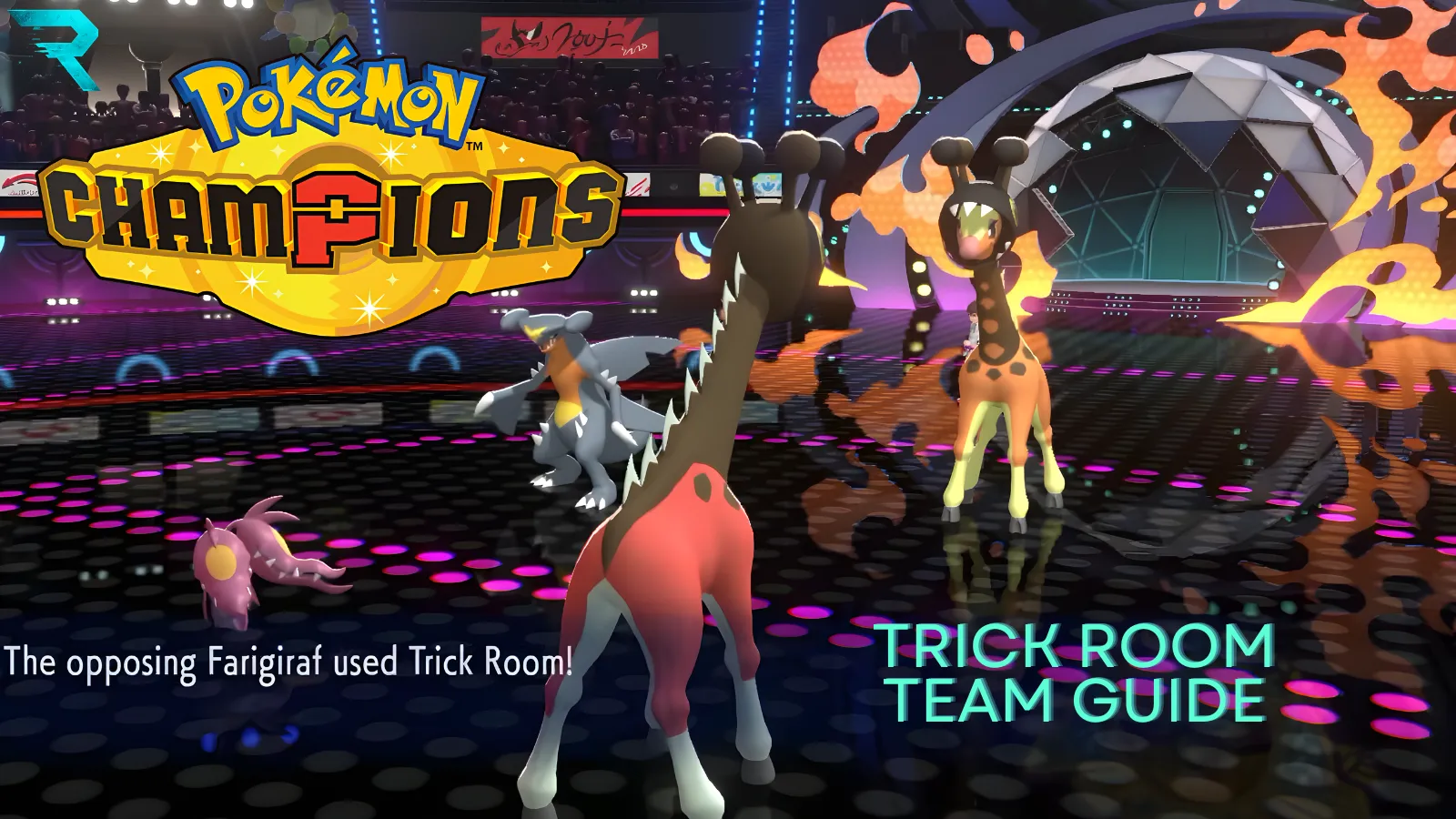
Trick Room flips the normal turn order, letting slow, bulky Pokémon move first instead of fast ones, and it remains one of the strongest forms of speed control in the game precisely because it turns the format's usual logic upside down. Sinistcha's rise to the most used Pokémon in Regulation M-B this season is largely a Trick Room story: a Grass and Ghost type that sets the field reliably while being awkward to punish for doing it.
A solid Trick Room team needs a dependable setter, several bulky attackers with naturally low Speed built to abuse the reversed turn order, support Pokémon that help the setter survive long enough to actually use the move, and a backup plan for games where Trick Room never goes up at all.
The payoff is disruption. Teams built entirely around natural Speed or Tailwind can struggle badly once the field flips against them. The cost is planning. Getting Trick Room up safely is only step one, and the limited number of turns it stays active means every one of those turns has to count. It is also the archetype most directly threatened by Whimsicott's Prankster Tailwind plus Encore, which can lock a Trick Room setter out of using the move at all.
6. Tailwind Teams
Tailwind doubles the Speed of an entire side for a few turns, and its value is so immediate that plenty of teams run it regardless of their overall archetype. It does not require any setup investment beyond the move itself, which makes it one of the more efficient tools in the format.
Tailwind builds usually pair a reliable Tailwind user with fast attackers ready to capitalize on the temporary Speed advantage, along with Protect and pivot moves for flexible positioning and a secondary win condition for once the Tailwind turns run out. Whimsicott's rise this season is a good example of how far Prankster Tailwind can go on its own, especially paired with Encore to shut down whatever the opponent was trying to set up.
The tradeoff is duration. Because Tailwind only lasts a handful of turns, wasting even one of them on a cautious play can cost the team most of its value. Used well, though, Tailwind gives a team control over turn order at exactly the moments that matter most.
Archetype Comparison at a Glance
Every archetype above solves the same core problem, controlling Speed and positioning, in a different way. Here is how they stack up against each other on the traits that matter most.
| Archetype | Primary Strength | Main Risk |
|---|---|---|
| Balance | Consistent across almost every matchup | Requires strong positioning to close games out |
| Hyper Offense | Ends games before opponents stabilize | Falls apart fast after losing early momentum |
| Rain | Forces defensive switches immediately | Vulnerable if weather control is lost |
| Sun | Explosive early Fire-type pressure | Can struggle if opposing Rain controls the weather. |
| Trick Room | Disrupts Speed-based strategies entirely | Limited turns once set, needs a backup plan |
| Tailwind | Immediate Speed control, low setup cost | Value disappears once the turns run out |
How Tournament Teams Are Built
Most tournament-winning teams look nothing alike on the surface, but the process behind them is usually similar. Players start with a small core, typically two or three Pokémon that naturally cover each other's weaknesses, and build outward from there rather than picking six strong individual Pokémon and hoping they gel.
Role compression matters a lot at this stage. A Pokémon that can provide Intimidate while still applying real offensive pressure, or one that offers redirection alongside solid bulk, effectively gives a team an extra slot's worth of value without actually running an extra Pokémon. That kind of overlap is a big part of what separates a good core from a great one.
From there, it is testing, and a lot of it. EV spreads get adjusted after a team keeps losing to the same matchup. Held items change once a specific speed tier or damage roll becomes relevant. Sometimes an entire Pokémon gets swapped out after enough reps expose a weakness that was not obvious on paper. Tournament teams are rarely finished after one session. They evolve as the player gathers more experience against increasingly sharp opponents.
Common Mistakes Competitive Players Make
Even experienced players lose winnable games by focusing too much on individual Pokémon and not enough on how the team functions as a whole. A few mistakes show up constantly on the Regulation M-B ladder.
The first is building around several strong attackers without asking how they actually support each other. Individually powerful Pokémon can still lose to a team with better defensive synergy or more reliable speed control, and it is an easy trap to fall into when a Pokémon looks great on a tier list.
The second is depending entirely on one win condition. If the whole plan hinges on Trick Room going up, weather staying active, or one specific sweeper getting a clean run, a good opponent will find that plan and take it apart. The strongest teams always have a second route to victory sitting in reserve.
The third is overreacting to a single bad loss. One rough matchup does not necessarily mean the team is built wrong, and swapping Pokémon or EV spreads after every defeat usually just resets the learning curve. Look for a pattern across several games before making a change.
And the last one is underrating practice itself. Knowing exactly when to switch, when to Protect, and when to push for damage comes from reps with your own team, not from copying whatever list is trending that week. Familiarity is an advantage that a fresh, unfamiliar team simply does not have yet.
Which Competitive Team Should You Choose?
The best team is the one you actually understand well enough to play with confidence across a wide range of opponents. Tournament team lists are a fine starting point, but real results come from learning your archetype, not from copying it move for move.
If consistency across a lot of different matchups matters most to you, balance is still one of the safer picks in Regulation M-B. If you would rather force a fast, decisive game, hyper offense, Rain, or Sun will suit that style better. And if you enjoy setup and long-term planning over reacting turn to turn, Trick Room rewards exactly that kind of patience.
Whatever you land on, spend time learning the common leads you will face, figure out your own win conditions cold, and study how your team actually performs against the format's most popular strategies. That groundwork matters far more to your results than switching teams every time something new starts trending.
Frequently Asked Questions
What is the strongest team archetype in Regulation M-B?
No single archetype dominates the format right now. Recent tier tracking across a large sample of ranked battles shows a fairly even spread of viable strategies, which is part of why balance, offense, weather, and Trick Room all continue to appear near the top of tournament standings.
Is Trick Room strong in the current meta?
Yes. Sinistcha's rise to the most used Pokémon in Regulation M-B has pulled Trick Room back into relevance across the whole ladder, though Whimsicott's Prankster Tailwind and Encore combination has become one of the more reliable answers to it.
Do I need a Mega Evolution to compete in Regulation M-B?
Not strictly, but Mega Evolution is the format's main mechanic this Regulation, and the new roster added 16 Mega forms on top of the ones already available in M-A. Most top tournament teams do run at least one.
How long does Regulation M-B last?
Regulation M-B is scheduled to run from June 17 through September 2, 2026, covering multiple ranked seasons before the format changes again.
Should beginners start with balance teams?
It is a reasonable starting point. Balance teams rarely walk into a completely unwinnable matchup, which makes them more forgiving to learn than an archetype that depends on a single strategy working out.
Final Thoughts
Regulation M-B has stayed genuinely varied this season, and that is good news no matter which style of play you gravitate toward. Balance, hyper offense, Rain, Sun, Trick Room, and Tailwind have all shown up in high-level tournament results, and none of them has taken over the format completely.
The individual Pokémon inside each archetype will keep shifting as new Megas settle in and balance patches land, but the underlying plans behind these six approaches are what actually decide games. Pick the one that matches how you like to play, learn it properly, and the specific team list becomes a lot easier to figure out.
Looking to go deeper on a specific archetype? Check out our Balanced Team Guide and Trick Room Team Guide for a full breakdown of roles, cores, and matchups.
Note: This guide reflects the current Pokémon Champions Regulation M-B competitive metagame, based on ranked ladder data, tournament results, and the most successful team archetypes as of early July 2026. We'll continue updating this page as balance patches, official events, and the evolving competitive meta shape the strongest teams.