

Tomorrow morning, June 25 at 10 AM PT, Valve closes the Steam Machine registration window. After that, the list locks, the randomization runs, and whoever did not sign up in time gets placed at the back of a waitlist that Valve says could stretch into 2027. No second chances. No early access workaround. You either register before Thursday morning or you wait.
This is not a standard pre-order. Valve is not selling the Steam Machine on a first-come, first-served basis. They built a randomized lottery system where every person who registers before the deadline gets an equal shot at a unit, regardless of whether they signed up five minutes after the page went live or five minutes before it closes. The whole point was to avoid the controller launch fiasco where Valve underestimated demand and buyers who hit refresh at the wrong second were locked out entirely.
The hardware costs $1,049 for the 512GB model. That is more than most people expected when Valve announced the Steam Machine back in November 2025, and Valve has been upfront about why. A global DRAM shortage, driven primarily by AI data center operators pulling semiconductor wafer capacity away from consumer memory toward high-bandwidth memory for accelerators, pushed the bill of materials well above the original target. Valve engineers had been looking at something closer to Steam Deck pricing. What they ended up with is a $1,049 living room PC that, for better or worse, is still roughly competitive with what you would spend assembling a comparable desktop from scratch right now.
If you are on the fence, this piece will walk you through exactly what the registration process looks like, what you need to qualify, what happens after you sign up, and what you are actually buying before you hand over four figures to Valve.
The Registration Window: What You Need to Know Right Now
The deadline is June 25, 2026 at 10 AM Pacific Time. That is 1 PM Eastern, 6 PM BST for UK readers. Registration is handled directly through the official Steam Machine page on the Steam store. There is no separate site, no third-party retailer queue, no retail partner lottery running alongside this. It is all going through Steam itself.
Valve will close sign-ups the moment that clock hits 10 AM PT on Thursday. Anyone who registers after that point is automatically placed at the back of a waitlist rather than the randomized pool. Those on the waitlist are not locked out forever, but Valve has said openly that it intends to work through the reservation queue by the end of 2026, which puts waitlist buyers squarely in 2027 territory unless someone in the queue drops out.
If you are selected in the lottery, you will receive a notification email on June 25 itself, after the randomization runs. Purchase invitations for those with reserved spots begin rolling out during the week of June 29, which is when units actually become available for shipment. Once you receive an invitation to buy, you have 72 hours to complete the purchase before Valve passes the slot to the next person in line. Do not let that email sit unread.
Who Qualifies to Register
Valve put three requirements in place, all designed to keep bots and scalpers out of the pool.
First, you need a Steam account in good standing. If your account has been flagged for fraud, banned, or suspended in any way, you are not eligible. A clean account with normal purchase history is fine.
Second, that account must have made at least one purchase on Steam before April 27, 2026. This is the bot-blocking rule. Someone who creates a fresh account the day registration opens and tries to queue up will not qualify. The April 27 cutoff predates the announcement of the registration window by several weeks, which means there was no way to game that requirement in advance.
Third, one registration per household. Valve is cross-checking payment methods, shipping addresses, and other account information to remove duplicate entries. If you and your roommate both try to register from the same address with the same payment method, expect one of those entries to get pulled. The intent is clear enough: one unit per home, not one per Steam account.
Regional sign-up lists are separate. Valve is running distinct pools for North America, the United Kingdom, the European Union, and Australia. You register in the region where you intend to have the unit shipped. If you are in Japan, South Korea, Taiwan, or Hong Kong, purchases go through Komodo, Valve's official distributor for those markets. The Steam Machine is not currently shipping to South Korea at all.
How to Register: Step by Step
Head to the official Steam Machine hardware page on the Steam store. You will need to be logged into your qualifying account to see the registration option. Select the model or models you are interested in and submit your registration before the deadline.
One thing worth noting: you can register for multiple configurations if you want any Steam Machine more than a specific one. Each storage tier and bundle variant has its own sign-up list. If you get selected for more than one model, Valve will automatically allocate you the highest-tier one you were drawn for and remove you from the others. If you are not selected for any model you registered for, you go onto the waitlist for whichever you were closest to the front of.
The timing of your registration within the window does not affect your odds. Someone who registered on June 22 when the page went live has the same chance as someone who registers at 9:59 AM PT tomorrow. The randomization treats all entries as equal. There is no benefit to signing up earlier beyond making sure you do not forget.
The Full Pricing Breakdown
Four configurations are available at launch. Pricing in USD:
512GB without Steam Controller: $1,049. This is the entry point. You get the hardware without the new Steam Controller bundled in.
512GB with Steam Controller: $1,128 (the controller adds approximately $79 to the base price, compared to the standalone retail price of $99.99, so the bundle is a slight saving).
2TB without Steam Controller: $1,349.
2TB with Steam Controller: $1,428. The 2TB models also include two additional swappable front faceplates, one in red fabric and one in solid walnut, alongside the standard black. Those are cosmetic. The hardware inside is identical across all four configurations.
UK pricing starts at £879 for the 512GB base model and goes up to £1,208 for the 2TB controller bundle. EU pricing starts at 1,039 euros for the base 512GB.
Valve has acknowledged publicly that the final price came in higher than the company originally planned. The AI-driven memory shortage that pushed DRAM prices up sharply after November 2025 is the direct cause. Valve does not subsidize its hardware the way Sony or Microsoft subsidize PlayStation and Xbox hardware, because the Steam Machine is fundamentally a PC. Someone could buy one, install Windows, and never open Steam again. Valve has to price it to at least break even on the hardware itself, which means every component cost increase passes through to the buyer more directly than it would with a traditional console.
For context: assembling a desktop with roughly comparable specs from off-the-shelf parts currently runs around $1,072 according to independent component analysis. The Steam Machine at $1,049 is, in that environment, not an outrageous price. It is not cheap, but it is not being sold at a premium over what the components cost.
What the Hardware Actually Is
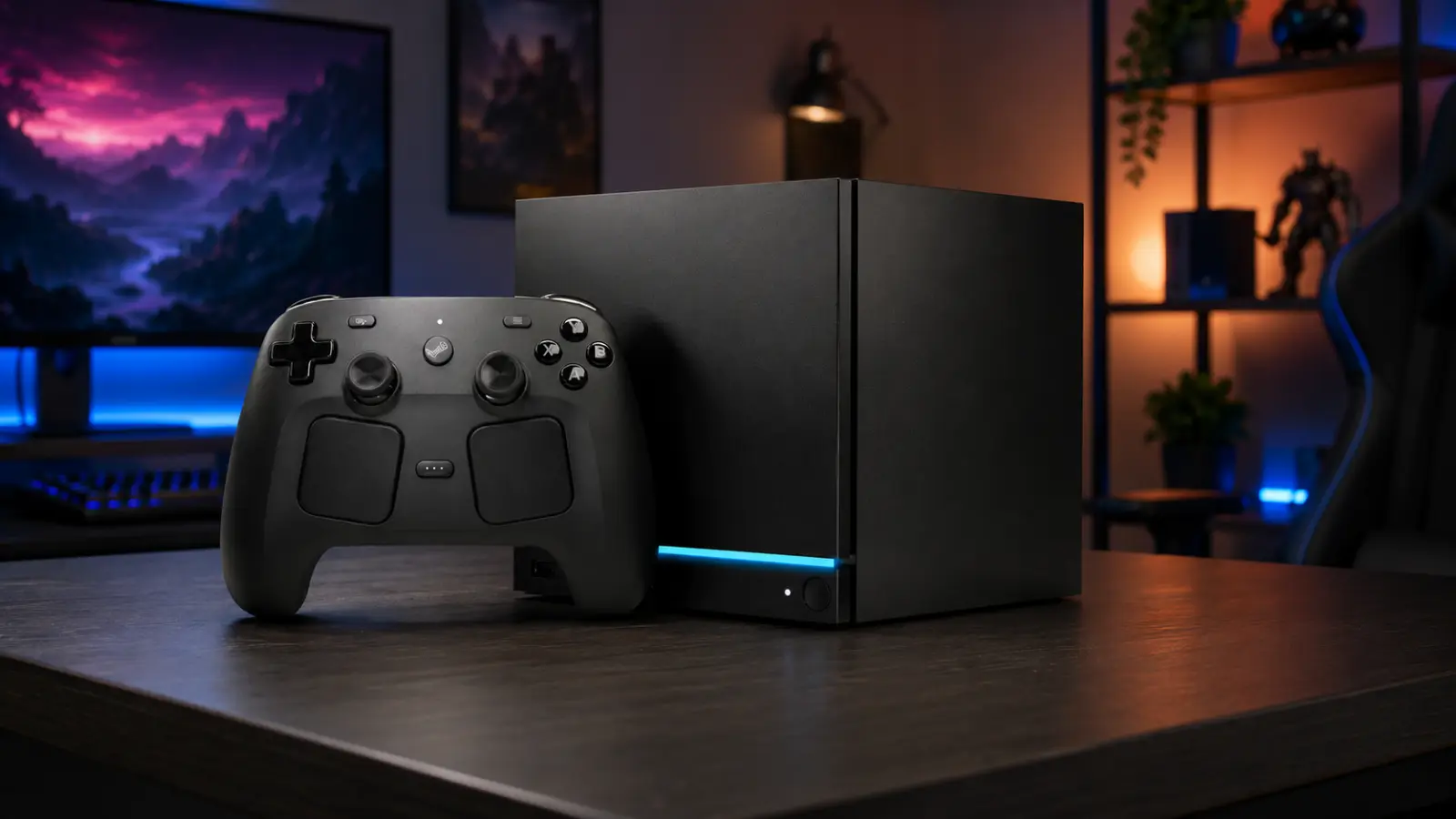
The Steam Machine is a small form factor gaming PC built to sit under your TV. The chassis measures approximately 156mm wide, 162mm deep, and 152mm tall. That is roughly cube-shaped and considerably smaller than most mini gaming PCs on the market. It has a 17-LED RGB strip on the front edge, swappable front panels, and a design that is clearly aimed at living room shelves rather than desks.
Inside, Valve is running a custom AMD setup. The CPU is a six-core, twelve-thread Zen 4 chip clocked up to 4.8 GHz. The GPU is a semi-custom RDNA 3 part with 28 compute units and 8GB of dedicated GDDR6 video memory. System RAM is 16GB DDR5 across both storage configurations. The GPU is rated at 110 watts board power, which puts it in entry-level desktop territory well above anything in the Steam Deck's handheld envelope.
Valve says the Steam Machine delivers roughly six times the gaming performance of a Steam Deck. In Cyberpunk 2077 testing, the hardware hit approximately 65 fps at 4K on medium settings with ray tracing enabled using FSR 4.1 upscaling. Drop to full ray-traced lighting and that number falls into the 30 fps range. The honest summary is that this is a solid 1440p gaming machine that can produce 4K output through upscaling in most titles, with ray tracing performance that is workable but not a strong suit.
Connectivity on the back includes one DisplayPort 1.4, one HDMI 2.0, two USB-A 2.0 ports, one USB-C 3.2 Gen 2, and a Gigabit Ethernet port. The front adds two USB-A 3.2 Gen 1 ports. Wi-Fi 6E and Bluetooth 5.3 are built in. There is also a microSD card slot for storage expansion and an integrated wireless adapter for the Steam Controller. The NVMe SSD is user-replaceable and supports both 2230 and 2280 form factors. The DDR5 RAM can technically be upgraded too, though the compact thermal design makes it more involved than a standard desktop swap.
The OS is SteamOS 3 out of the box, with the option to install Windows 11 if you want it. SteamOS runs approximately 90 percent of the Steam library through Proton, Valve's DirectX-to-Vulkan compatibility layer. The titles that currently do not work are primarily games using kernel-level anti-cheat built for Windows, including Valorant, all Call of Duty releases, Battlefield 6, and EA Sports titles. That is a notable gap for anyone whose library leans heavily on those games, and worth checking before spending $1,049.
The Game Compatibility Picture
Valve runs a Steam Machine Verified badge program using criteria nearly identical to what it applies to the Steam Deck. The minimum bar for a Verified badge is stable gameplay at 1080p and 30 fps with full controller support. Games that have not been tested carry an Unknown designation, not an indication that they will not run.
For most of the Steam library, compatibility is not a concern. The Proton layer has matured considerably since the Steam Deck launched, and the broader pool of SteamOS-compatible titles keeps growing. The problem games are specifically the ones with anti-cheat software that requires Windows kernel access. Riot's Vanguard system on Valorant is the most high-profile example. These are not soft incompatibilities that a software update will fix. They require the anti-cheat vendors to release a Linux-compatible version of their software, and none of the major publishers have committed to that yet.
If you play mostly single-player games, RPGs, strategy, or indie titles, the compatibility picture is largely fine. If your main games are competitive shooters in the Valorant or Call of Duty category, the Steam Machine is not the right hardware for you right now. That could change, but it has not changed yet.
What Happens After You Miss the Deadline
If June 25 comes and goes without a registration, you are on the waitlist. That is not a death sentence, but the timeline is honest: Valve expects to clear the initial reservation queue by the end of 2026. Waitlist buyers are getting their units in 2027 unless a meaningful number of reservation holders choose not to complete their purchases within the 72-hour window.
There is one scenario where waitlist movement accelerates. Valve will extend a purchase invitation to the next person in line whenever someone in the reservation queue lets their 72-hour window expire. Buyers who get an invitation email and miss the deadline for whatever reason open up a slot for the person behind them. It is a slow trickle, but it is there.
The waitlist itself is also separate from whatever Valve does for additional production runs. If manufacturing capacity increases in late 2026 or early 2027, Valve could open another registration window. The current waitlist would presumably have priority in that scenario, but Valve has not confirmed how future waves will work.
Why Valve Built a Lottery Instead of a Standard Sale
This is worth understanding because it explains a few things about the Steam Machine launch that might otherwise feel strange. Valve's last major hardware launch, the new Steam Controller in May 2026, ran into the same problem the original 2015 Steam Controller launch did: demand outpaced supply, and the combination of bots and scalpers grabbed a significant portion of available units before real buyers had a chance. The result was immediate resale listings at two to three times the retail price and a lot of frustrated customers.
Valve designed the Steam Machine reservation system specifically to prevent that. A lottery where timing of registration does not affect odds removes the incentive to write bots that hit submit at the exact moment the page goes live. The April 27 purchase requirement blocks freshly created accounts. The one-per-household enforcement handled through payment method and shipping address verification cuts down on multi-entry abuse from individual buyers.
It is a considered system. It is also, practically speaking, a little unusual for hardware at this price point, and it adds a step that standard retail pre-orders do not have. But the alternative, based on Valve's own recent experience, was a launch day sell-out in minutes followed by months of secondary market inflation. The lottery is the less frustrating option.
Is It Worth Buying at $1,049?
That depends entirely on what you are replacing and what you value about the living room gaming experience.
If you already have a gaming PC and are thinking about Steam Link or just streaming games to your TV, the Steam Machine is probably overkill at this price. A Steam Link device does that job for a fraction of the cost.
If you are a Steam library owner who wants a dedicated living room device and does not want to build or buy a separate gaming PC, the value proposition is more defensible. The comparable DIY desktop build currently costs around $1,072 according to component analysis, which puts the Steam Machine at a slight discount to building it yourself, with the added benefit of a compact form factor, HDMI CEC support, controller wake functionality, and SteamOS optimized for TV use. You are not paying a console tax. You are paying approximately what the parts cost, and getting a ready-built package out of it.
If your main concern is games compatibility, check your library before registering. Pull up Steam's compatibility filter and see how your most-played titles sit. If the answer is mostly fine except for one or two anti-cheat titles, that is a reasonable trade. If Valorant is where you spend most of your gaming time, this hardware does not serve you right now.
The bottom line is straightforward. The Steam Machine is real hardware at a real price, built for a specific use case: playing your Steam library in the living room without a separate PC sitting on your desk. If that is what you want, register before 10 AM PT tomorrow. If you miss the window, it is a 2027 problem. The deadline is the deadline.
Registration is open at the official Steam Machine hardware page on the Steam store. The window closes June 25 at 10 AM PT. For more on the Steam Machine, including the hardware specs breakdown and how it compares to current console alternatives, see our full PC Gaming coverage on Respawnerz.