


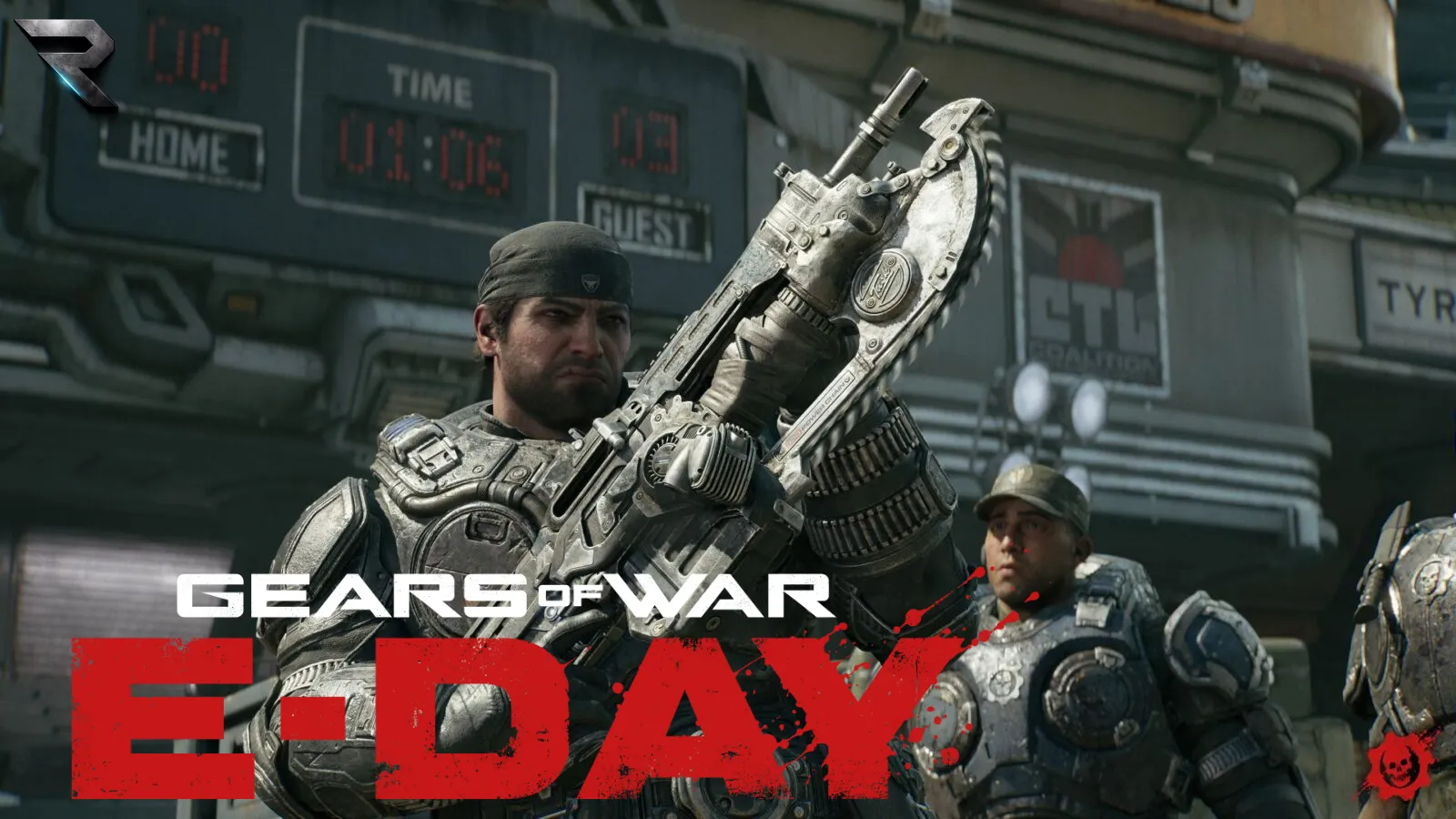
The Coalition has confirmed that Gears of War: E-Day has gone gold, one of the last big checkpoints before a game ships. Studio head Mike Crump broke the news himself, and it lands at a good moment for the prequel, just weeks out from its October launch and days before players can start filling up their SSDs.
Going gold means the build heading to store shelves and digital storefronts is locked and ready to manufacture. It doesn't mean the team stops working. Day one patches and post-launch updates are normal for games at this stage, and The Coalition hasn't said otherwise. What it does mean is that the version of E-Day players will boot up on release day is now set in stone.
Release Date and Early Access Breakdown
Gears of War: E-Day launches worldwide on October 6, 2026, on Xbox Series X|S, Xbox PC, and Steam. Anyone who picks up the Premium Edition gets a head start, with up to five days of early access kicking in on October 1. Game Pass Ultimate and PC Game Pass subscribers join everyone else at the full launch on October 6, so there's no early window through the subscription.
Put simply, the schedule breaks down like this:
- October 1: Premium Edition Early Access begins
- October 6: Worldwide launch across Xbox Series X|S, Xbox PC, Steam, and Game Pass
On the platform side, Xbox is getting a build built specifically for the current generation of hardware, while the PC version leans on a wider spread of graphical settings so it can scale across very different machines.
Pre-Install Begins September 29
Players don't have to wait for launch day to start downloading. The Coalition has set pre-install to open on September 29 at 8 AM PT, which works out to 8:30 PM IST for anyone playing from India. That gives everyone a runway of a few days to get the game onto their drive before the Early Access window opens on October 1.
Pre-installation covers every platform the game is launching on, so Xbox Series X|S, PC (via Steam) all get access on the same day. It's worth planning around, too, since the finalized PC requirements call for 115 GB of free SSD space. That's not a small download, and anyone hoping to jump in the moment Early Access unlocks will want that storage cleared out well ahead of September 29.
Final PC System Requirements
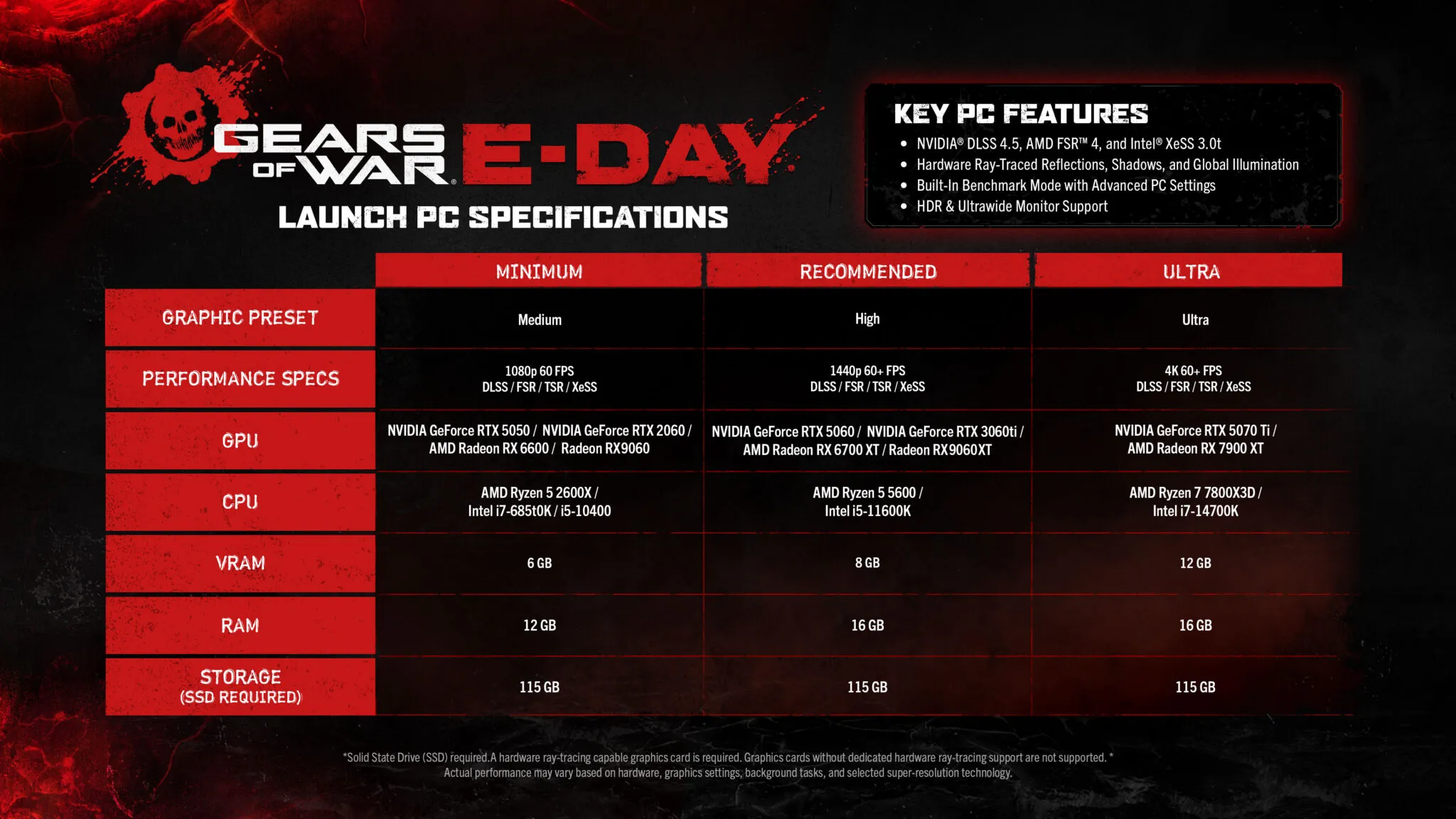
Alongside the gold announcement, The Coalition published the finished PC system requirements, and the studio says it kept refining stability and performance across a broad spread of hardware since the Multiplayer Open Beta back in July. The specs are split into three tiers, running from 1080p at the low end up to full 4K at the top.
Minimum (1080p / 60 FPS, Medium preset)
- CPU: AMD Ryzen 5 2600X, Intel Core i7-4850K, or Intel Core i5-10400
- GPU: NVIDIA GeForce RTX 5050, RTX 2060, AMD Radeon RX 6600, or RX 9060
- VRAM: 6 GB
- RAM: 12 GB
- Storage: 115 GB SSD
Recommended (1440p / 60 FPS, High preset)
- CPU: AMD Ryzen 5 5600 or Intel Core i5-11600K
- GPU: NVIDIA GeForce RTX 5060, RTX 3060 Ti, AMD Radeon RX 6700, or RX 9060 XT
- VRAM: 8 GB
- RAM: 16 GB
- Storage: 115 GB SSD
Ultra (4K / 60 FPS, Ultra preset)
- CPU: AMD Ryzen 7 7800X3D or Intel Core i7-14700K
- GPU: NVIDIA GeForce RTX 5070 Ti or AMD Radeon RX 7900 XT
- VRAM: 12 GB
- RAM: 16 GB
- Storage: 115 GB SSD
An SSD is mandatory across all three tiers, and every configuration listed assumes hardware ray tracing support. The official spec sheet also lists several upscaling technologies, giving PC players more than one way to balance resolution against performance.
Hardware Ray Tracing Is Now a Requirement
One detail stands out from the rest of the sheet: E-Day requires a GPU with hardware ray tracing support on PC. That's not an optional toggle buried in the graphics menu, it's baked into the baseline spec. Cards without dedicated ray tracing hardware simply won't meet the official requirements, full stop.
That requirement traces back to how the game is built. E-Day runs on Unreal Engine 5 and DirectX 12, with hardware ray tracing woven into the engine's rendering pipeline rather than sitting off to the side. The Coalition has previously said the PC version was designed to hold onto visual fidelity while still scaling across a wide hardware range, and the studio worked closely with NVIDIA to get there. The PC build supports DLSS 4.5, including Super Resolution and Dynamic Multi Frame Generation, plus NVIDIA Reflex for cutting down input latency. For anyone with the right hardware, ray tracing isn't a bolt-on effect here, it's one piece of a much larger rendering stack.
DLSS 4.5, FSR, TSR, XeSS, and Shader Delivery
Since not everyone is running the same GPU, The Coalition packed E-Day with several upscaling and reconstruction options at launch, including:
- NVIDIA DLSS 4.5 (DLSS Super Resolution and Dynamic Multi Frame Generation)
- NVIDIA Reflex
- AMD FSR
- Unreal Engine TSR
- Intel XeSS
- Advanced Shader Delivery
DLSS is there for compatible NVIDIA cards, while FSR, TSR, and XeSS cover everyone else depending on what GPU they're running. Advanced Shader Delivery is a separate piece of the puzzle. It ships precompiled shaders alongside the game itself, which The Coalition says is meant to cut load times and stop the first-run stutter that shows up when a game compiles shaders on the fly.
RTX Mega Geometry Makes Its Debut in E-Day
E-Day is also the launch title for NVIDIA RTX Mega Geometry, a new technology aimed at a specific headache in modern ray-traced games. Unreal Engine 5's Nanite system can render extremely dense geometry for what's on screen, but ray tracing has traditionally had to fall back on a simplified version of that same geometry because of how expensive full detail is to compute. That mismatch is what causes reflections or shadows to look noticeably less detailed than the objects casting them.
RTX Mega Geometry is built to close that gap by letting ray tracing work directly with the higher-detail Nanite geometry instead of a stripped-down stand-in. NVIDIA's own demos using E-Day show the difference on things like vehicles, shopping carts, rocks, and foliage, along with reflections that hold onto more of the source detail rather than reverting to simplified meshes. NVIDIA has said the tech will appear in E-Day before it's folded into Microsoft's DirectX Raytracing 2.0 standard more broadly. Combined with DLSS 4.5, ray tracing, and Reflex, it rounds out a PC version that's leaning on several generations of graphics tech at once.
Unreal Engine 5 Powers a Much More Detailed Emergence Day
Built from scratch in Unreal Engine 5 and DirectX 12, E-Day gives The Coalition a noticeably stronger technical base than any previous mainline Gears game. The studio has called it its most technically ambitious entry yet, and a lot of that comes down to three specific systems doing the heavy lifting.
Nanite handles virtualized geometry, and according to NVIDIA, it pushes object detail in E-Day up to 100 times beyond what Gears 5 managed, without forcing the art team to hand-build traditional level of detail assets for every object. Lumen covers ray-traced global illumination and ambient occlusion, while MegaLights lets the game cast ray-traced shadows from as many as 100 light sources at once, which goes a long way toward the darker, more oppressive atmosphere the game is going for.
None of that is just window dressing on individual rooms, either. The Coalition built the fictional city of Kalona as one connected space rather than a string of separate levels, so players see the city change and break apart as the Locust invasion tears through it in real time. Real-time destruction, large-scale particle effects, and volumetric effects round out the technical package, all aimed at making Emergence Day feel like a single unfolding catastrophe instead of a series of boxed-in combat arenas.
How the Final Specs Compare to the Beta
It's worth noting these numbers aren't the same as what The Coalition published for the Multiplayer Open Beta earlier this year. The studio was upfront at the time that the beta specs weren't final, and true to that, the team kept tuning PC performance and stability across a wide hardware pool after the July test.
What arrived on September 17 is the version players should actually plan around. It settles the three performance tiers (1080p/60 at Medium, 1440p/60 at High, and 4K/60 at Ultra), locks in 115 GB of SSD storage as a baseline, and confirms hardware ray tracing as a requirement rather than a nice-to-have. Anyone who checked their rig against the beta specs earlier in the year should run through this updated list again before launch.
What Players Can Expect at Launch
Gold status and finalized specs are the headline here, but they're part of a much bigger release. E-Day takes place 14 years before the original Gears of War, following a younger Marcus Fenix and Dominic Santiago through the earliest days of the Locust invasion, rather than picking up where the more recent games left off.
Four-player campaign co-op is back for the story, a decision The Coalition has said comes from how central four-person squads have always been to Gears. Outside the campaign, the game ships with Horde Siege, a reworked version of the series' cooperative survival mode, along with competitive Versus multiplayer, both of which already went through a round of testing and tuning during the summer beta. The Coalition has also put out the full achievement list ahead of release, which offers another window into what's waiting across the campaign's different acts and beyond.
Gears of War: E-Day Launch Timeline
With the gold milestone locked in, here's the complete countdown to release, all times listed in Pacific and UTC:
| Date | Event |
|---|---|
| September 29 | Pre-install begins, 8 AM PT / 15:00 UTC |
| October 1 | Premium Edition Early Access begins, 8 AM PT / 15:00 UTC |
| October 6 | Worldwide launch, 8 AM PT / 15:00 UTC |
| October 6 | Game Pass Ultimate and PC Game Pass availability |
Gears of War: E-Day launches on Xbox Series X|S, Xbox PC, and Steam, with day one availability through Game Pass Ultimate and PC Game Pass. After years of development, The Coalition's message to players is about as direct as it gets: the game is done, and the countdown is now measured in days rather than months.