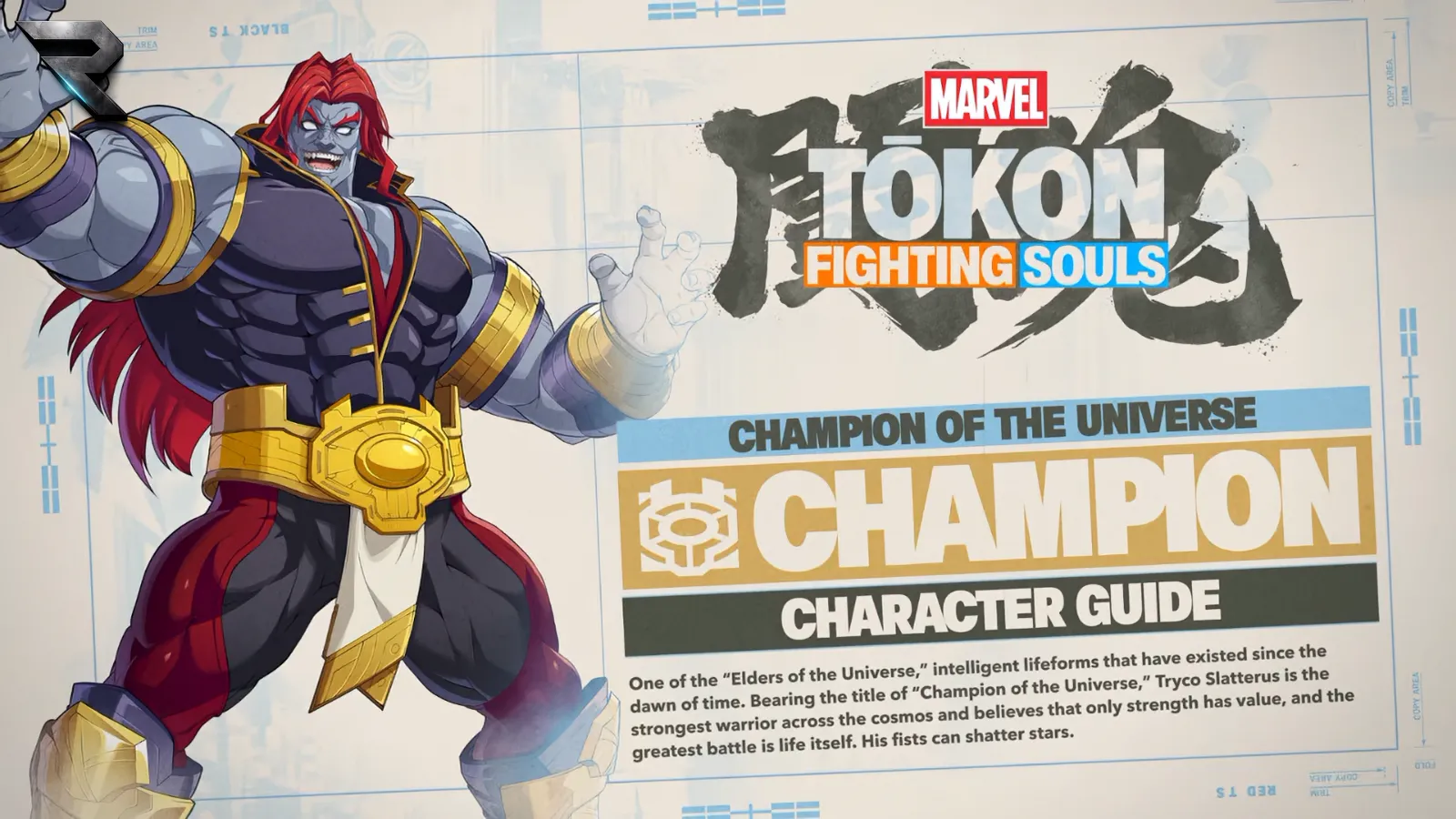
Champion Overview
Champion is the cosmic Elder of the Universe who anchors Marvel Tōkon: Fighting Souls' story, and his moveset matches the fantasy. He is enormous, hits like a truck, and leans on grappling and brute-force offense more than any other fighter revealed so far. Earth becomes his latest target in the game's Challenge of the Champion tournament, and once you pick him up, it is easy to see why he never stops looking for a fight.
He is not a mindless button-masher, though. Champion's strongest tools come from knowing when to close distance, when to force a block, and when to spend Skill Gauge on a real conversion. His kit includes Skills like Flying Meteor and Star Duster, the Super Skill Big Bang Barrage, the Ultimate Skill Primordial Face Breaker, and the full-team Tōkon Assemble.
What sets him apart from a typical grappler is his Primordial Soul. Build enough Pride and Champion enters his Awakened Form, where his fighting spirit manifests as a spectral extension of himself, giving him access to five unique assist options that let him effectively become his own team.
This guide walks through his core attacks, his Skill Gauge and Pride Gauge resources, the full Awakened Form assist suite, and the habits that separate a Champion player mashing forward from one making the opponent guess wrong.
In This Guide
- Champion Move List
- Champion's Core Gameplan
- Link Attacks, Quick Skills, and Manual Inputs
- Flying Meteor
- Star Duster
- Super Skill: Big Bang Barrage
- Ultimate Skill: Primordial Face Breaker
- Tōkon Assemble
- Primordial Soul and Awakened Form
- Lone Champion Assists
- Strengths & Weaknesses
- Team Building Around Champion
- Beginner Tips
- Advanced Tips
- Is Champion Worth Learning?
- Champion FAQ
- Final Thoughts
Champion at a Glance
- Archetype: Grappler / Close-Range Powerhouse
- Difficulty: Easy to pick up, deep to master
- Unique Mechanic: Pride Gauge, Primordial Form, and Awakened Form
- Strengths: Devastating close-range pressure, a genuine strike-or-grab dilemma, momentum tools that stay live even when blocked, a self-contained assist system once Awakened.
- Weaknesses: Struggles to close distance against patient opponents, becomes predictable if his approach tools are overused, needs deliberate Pride and Skill Gauge management.
- Best For: Players who want to walk opponents down, threaten a command grab, and get progressively scarier as a round goes on.
Champion Move List
Here's every move covered in this guide.
| Move | Type | Cost |
|---|---|---|
| Flying Meteor | Skill | 25 Skill Gauge (Heavy) |
| Star Duster | Skill | 25 Skill Gauge (Heavy) |
| Big Bang Barrage | Super Skill | 50 Skill Gauge |
| Primordial Face Breaker | Ultimate Skill | 100 Skill Gauge |
| Tōkon Assemble | Team Ultimate | 150 Skill Gauge |
| Crowd Pleaser | Unique Action | Free (Primordial Form) |
| Lone Champion Rush | Awakened Assist | Free |
| Lone Champion Aerial | Awakened Assist | Free |
| Lone Champion Assault | Awakened Assist | 1 Assemble Gauge |
| Lone Champion Vertical | Awakened Assist | 1 Assemble Gauge |
| Lone Champion Shooter | Awakened Assist | 1 Assemble Gauge |
Champion's Core Gameplan
The simplest way to describe Champion is this: get close, make them block, force them to guess, then make them regret it. His Link Attack system lets you chain repeated Light, Medium, or Heavy attacks into progressively stronger Skills, and that structure matters more for Champion than for most of the roster, because his individual moves become far more threatening once you know how to convert a basic opening into something bigger.
His lunging attacks close space in a hurry. His grappling tools punish opponents who get too comfortable blocking. Big Bang Barrage gives him space control from a Super Skill, and Primordial Face Breaker gives him an explosive close-range finisher that can turn a single opening into a huge chunk of health.
A simplified version of his offense looks like this: close the distance, establish pressure, force a defensive response, extend with a Skill, create space or a follow-up, then threaten a heavier attack. Once Champion has access to his Super and Ultimate, the opponent has to consider more than whether his next attack lands. They have to guess which attack is coming.
Link Attacks, Quick Skills, and Manual Inputs
Champion's basic strings aren't just filler between special moves. An extra Medium press at the end of an M Link Attack can transition straight into Big Bang Barrage, and an extra Heavy press at the end of an H Link Attack leads into Primordial Face Breaker. That means his normal attacks double as a gateway into his strongest tools.
Every Skill in his kit also supports two input methods. Flying Meteor, for example, can come out from a Quick Skill input of down plus QS, or from the traditional Manual input of down, down, plus Light. Quick Skills make execution far easier for newer players, while Manual inputs reward players comfortable with fighting game motions and generate slightly more damage and Skill Gauge in return.
If you're new to Champion, start with Quick Skills so you can focus on spacing and pattern recognition. Once his neutral game feels natural, start switching over to Manual inputs where the extra reward actually matters.
Flying Meteor
Flying Meteor is one of Champion's key forward-pressure tools. He leaps into the air and swings down with a powerful fist, which gives it a very different profile from his grounded attacks. The real value isn't the damage, though. Champion can move again before his opponent even after the attack gets blocked, so instead of automatically having to retreat, he can keep advancing and keep the opponent guessing about what's next.
The Medium and Heavy versions send the opponent flying backward, opening the door for a follow-up. The Heavy version costs 25 Skill Gauge, so it isn't something to throw out carelessly, but used at the right moment it can turn a successful interaction into continued offense.
Flying Meteor Quick Facts
- Leaping strike with a different profile from grounded attacks.
- Champion regains movement even when the attack is blocked.
- Medium and Heavy versions knock the opponent back for a follow-up.
- Heavy version costs 25 Skill Gauge.
- Best used as a pressure and approach tool, not an automatic response.
Star Duster
If Flying Meteor gives Champion an aerial approach, Star Duster is his ground-based answer to closing distance fast. He launches himself forward with a lunging kick that drives the opponent away on contact. Like Flying Meteor, the Medium and Heavy versions knock the opponent back and set up a follow-up, and the Heavy version also costs 25 Skill Gauge.
Star Duster matters most in neutral. Instead of slowly walking an opponent down, Champion can turn his size into a weapon and surge forward whenever the spacing is right.
| Move | Primary Function | Key Benefit |
|---|---|---|
| Flying Meteor | Leaping strike | Champion can move even when blocked |
| Star Duster | Lunging kick | Rapidly closes distance and pushes the opponent away |
| Flying Meteor M/H | Knockback | Creates a follow-up opportunity |
| Star Duster M/H | Knockback | Creates a follow-up opportunity |
| Heavy versions | Enhanced versions | Cost 25 Skill Gauge |
Alternating between the two, along with normal movement, keeps Champion from becoming predictable. A player who leans on one approach tool exclusively is a player a good opponent will eventually solve.
Super Skill: Big Bang Barrage
Skill Gauge Cost: 50
Big Bang Barrage is Champion's Super Skill. He drives his fist into the ground and unleashes a series of projectiles that expand outward from his position, turning the space around him into a hazard instead of simply firing something across the screen. It can be performed from neutral or by pressing Medium an extra time at the end of an M Link Attack, following the standard sequence of Medium, Medium, Medium, Medium. A Quick Skill input is also available for players using the simplified control scheme.
The biggest advantage here is area coverage. In a 4v4 fighter where assists and team mechanics can change the screen state fast, having a Super that generates a large threat around Champion helps him regain control of a chaotic exchange, and unlike his Ultimate, he doesn't need to be right on top of the opponent to get value from it.
Big Bang Barrage Highlights
- Expanding projectile Super Skill centered on Champion.
- Can come out from neutral or from an extended M Link Attack.
- Doesn't require close range to be useful.
- Strong for regaining control during chaotic team exchanges.
- Costs 50 Skill Gauge.
Ultimate Skill: Primordial Face Breaker
Skill Gauge Cost: 100
If Big Bang Barrage is about controlling space, Primordial Face Breaker is about one thing: getting your hands on the opponent. Champion grabs them and follows up with a devastating attack, and it can be activated from neutral or by pressing Heavy an extra time at the end of an H Link Attack, following the sequence Heavy, Heavy, Heavy, Heavy. He can also perform an EX version before the Ultimate by holding a direction during the H Link Attack.
One property makes this move especially dangerous: it isn't restricted to grounded opponents. Primordial Face Breaker can also catch an aerial opponent while they're in hitstun, which means it can become part of Champion's offensive conversions rather than something reserved for a direct mix-up on a blocking opponent.
Primordial Face Breaker Highlights
- Devastating command-grab Ultimate Skill.
- Activates from neutral or after an H Link Attack.
- Supports an EX version through a held direction.
- Can catch aerial opponents in hitstun, not just grounded ones.
- Costs 100 Skill Gauge.
| Attack | Type | Gauge Cost | Main Purpose |
|---|---|---|---|
| Big Bang Barrage | Super Skill | 50 | Area control and pressure |
| Primordial Face Breaker | Ultimate Skill | 100 | Close-range grab and massive follow-up |
| Tōkon Assemble | Team Ultimate | 150 | Desperation and comeback attack |
Don't treat Skill Gauge as something to spend the instant it fills. If Champion already controls the screen, Big Bang Barrage helps hold that advantage. If you catch an opening or a confirm off hitstun, saving toward Primordial Face Breaker usually pays off more.
Tōkon Assemble
Tōkon Assemble is Champion's full-team attack, and it's a genuine last-chance mechanic rather than something you activate whenever you have 150 Skill Gauge. It only becomes available when losing the current round would end the match. The attack opens with an invincible strike before the entire team joins in for a finishing sequence.
It can be triggered from neutral or by pressing Light an extra time at the end of an L Link Attack, following the same philosophy as his other major attacks: normal strings naturally transition into the biggest tools in the kit. A Quick Skill input is available here too.
Tōkon Assemble Highlights
- Only available when losing the round would end the match.
- Opens with an invincible strike.
- Can activate after an L Link Attack.
- Brings the full team into a finishing sequence.
- Costs 150 Skill Gauge.
Because access to it depends on the match state, Tōkon Assemble also works as a psychological tool. Once the opponent knows Champion has a comeback option in his back pocket, they can't afford to play carelessly even while he's behind.
Primordial Soul and Awakened Form
Champion's most unusual mechanic is the one that changes his entire relationship with Tōkon's team system. While Big Bang Barrage and Primordial Face Breaker cost Skill Gauge, his Pride Gauge is a separate resource tied directly to his own transformation.
The Pride Gauge and Crowd Pleaser
While Champion is in his Primordial Form, his Assist button works differently from the rest of the cast. Instead of calling in a teammate, he performs Crowd Pleaser, a pose that increases how fast his Pride Gauge builds. It's an Input A move, it works in the air as well as on the ground, and the grounded version can be held to repeat the pose.
Champion needs Pride to unlock his strongest mechanics, but standing around posing obviously isn't safe against an opponent who's ready to punish it. Building Pride effectively becomes part of his neutral game, not a separate task. His normals, lunging Skills, and grabs let him stay threatening while working toward Awakened Form at the same time.
Crowd Pleaser at a Glance
- Input: A
- Air OK: Yes
- Purpose: Increases Pride Gauge accumulation
- Grounded version: Can be held to repeat
- Available in: Primordial Form
Entering Awakened Form
Once Champion has built enough Pride, he can enter Awakened Form, and this is the turning point of his gameplan. His Assist button changes again, this time summoning the Primordial Soul, a spectral version of Champion that acts as his substitute for a conventional teammate.
In other words, Champion can create his own backup. When he's the leader in Awakened Form, the Primordial Soul unlocks the full Lone Champion assist set, discussed below, and his fighting spirit effectively becomes a second source of offense.
Advanced Tip: Build Pride when the opponent can't easily punish you, not just because Crowd Pleaser is available. After a knockdown, a reset, or successfully forcing a block, you usually have a safe window. Standing directly in front of an opponent who's ready to attack is not that window.
Lone Champion Assists
Once Awakened and leading the team, Champion's Primordial Soul can perform five different assist attacks, collectively known as the Lone Champion assists. They aren't cosmetic reskins of the standard Assemble Assist types either. Each one covers a different situation, and understanding them individually matters more than mashing the Assist button and hoping for the best.
Lone Champion Rush
The Primordial Soul performs a rapid follow-up attack, functioning like the standard Assemble Rush assist. It requires Champion to be in Awakened Form and leading the team, and the input is Assist during an attack. It's the go-to option for extending pressure after Champion has already started an offensive sequence.
Lone Champion Aerial
The Primordial Soul rises and performs an aerial attack aimed toward the ground, similar to the standard Assemble Assist Aerial. It uses the Assist input at high altitude and requires Awakened Form plus leader status. It gives Champion a way to punish opponents who try to escape upward.
Lone Champion Assault
This variant has the Primordial Soul leap up and attack on the way down, serving the same role as a conventional Assemble Assist Assault. It uses a directional input plus Assist, requires Awakened Form and leader status, and costs 1 Assemble Gauge after it connects.
Lone Champion Vertical
As the name suggests, this assist attacks upward, making it the natural pick when an opponent tries to challenge Champion from the air. It functions like the standard Assemble Assist Vertical, uses a directional input plus Assist, requires Awakened Form and leader status, and also costs 1 Assemble Gauge on connect.
Lone Champion Shooter
Here, the Primordial Soul lunges forward to attack, functioning like the standard Assemble Assist Shooter and extending Champion's offensive reach. It fits particularly well alongside Star Duster, since both give him ways to occupy forward space. It uses a directional input plus Assist, requires Awakened Form and leader status, and costs 1 Assemble Gauge on connect.
| Assist | Function | Requirement |
|---|---|---|
| Lone Champion Rush | Rapid follow-up attack | Awakened + Leader |
| Lone Champion Aerial | Aerial attack toward ground | Awakened + Leader |
| Lone Champion Assault | Jumping attack on landing | Awakened + Leader |
| Lone Champion Vertical | Upward attack | Awakened + Leader |
| Lone Champion Shooter | Forward lunging attack | Awakened + Leader |
This is where Champion's design gets clever. He doesn't just get bigger numbers when he awakens. His entire relationship with the team system flips. Instead of asking which teammate to call, Champion players start asking which version of themselves to call.
Strengths & Weaknesses
Strengths
- Devastating close-range pressure backed by a genuine strike-or-grab dilemma.
- Flying Meteor and Star Duster keep Champion mobile and threatening even when blocked.
- Two separate resource systems, Skill Gauge and Pride Gauge, give him layered ways to escalate.
- Awakened Form turns him into a self-sufficient assist system through the Primordial Soul.
- Tōkon Assemble provides a genuine comeback tool in must-win rounds.
- Rewards patient, disciplined play rather than pure aggression.
Weaknesses
- Struggles to close distance against opponents who can keep him at range consistently.
- Flying Meteor and Star Duster become easy to anticipate if overused.
- Crowd Pleaser is unsafe unless the opponent genuinely can't punish it.
- Requires careful management of two separate gauges instead of one.
- His biggest tools, Primordial Face Breaker and Awakened Form, take time and setup to access.
Team Building Around Champion
Champion's unusual assist system doesn't make his actual teammates irrelevant. Quite the opposite. Before he reaches Awakened Form, his three teammates are still doing the heavy lifting, and even after he awakens, they determine how safely he gets there in the first place.
You don't need to master all four characters immediately. Learn Champion first, get comfortable with his neutral, pressure, and resource management, then choose teammates specifically to cover what he struggles with. Look for assists that help him approach safely, control space, cover his recovery, or buy him time to build Pride.
A good ranged assist can force the opponent to block or reposition while Champion advances behind it, creating a sequence like assist, opponent blocks, Champion advances, close-range pressure, grab or strike threat. The assist doesn't need to deal huge damage. Its job is to make Champion's approach safer.
Champion also makes the most sense as the point character specifically when your game plan revolves around his Lone Champion assists, since those require him to be leading the team while Awakened. That doesn't mean he has to stay on screen the whole match. A teammate can enter, reset neutral, and bring Champion back into a stronger position when the moment is right.
Beginner Tips
- Learn Champion's neutral before chasing combos. Knowing when to approach matters more than memorizing a long combo string.
- Make Flying Meteor and Star Duster unpredictable. They're approach tools, not autopilot buttons.
- Condition the opponent with strikes first. The more they respect your normal attacks, the more dangerous your grab becomes.
- Don't waste Pride opportunities, but don't get greedy chasing them either.
- Treat Crowd Pleaser as a strategic tool, not a button you press the instant the gauge isn't full.
- Learn all five Lone Champion assists individually before trying to weave them all into your pressure at once.
- Use your teammates. Champion can become a one-man army, but Tōkon is still a team fighter.
Advanced Tips
Once the basics feel comfortable, getting better with Champion is less about learning new inputs and more about managing two resources at once instead of one.
Don't spend Skill Gauge simply because you have it. Having 50 Skill Gauge doesn't obligate you to fire off Big Bang Barrage, and having enough Pride to Awaken doesn't mean you should force the transformation the moment it's ready. Ask what the resource is actually buying you before spending it.
Don't force the grab, either. If the opponent knows you're always looking for Primordial Face Breaker, they'll adapt around it. The strongest Champion players make the opponent afraid of the grab without needing to land it every time, since that fear alone makes the rest of the offense hit harder.
Once Champion is Awakened, avoid cycling through the five Lone Champion assists at random. Rush and Shooter answer a grounded opponent, Vertical answers someone trying to jump, Aerial answers awkward air space, and Assault changes the vertical timing of your pressure. Match the assist to what the opponent is actually doing.
Advanced Tip: Champion doesn't need to rush every second, chase his Ultimate constantly, or spend every resource as soon as it appears. His greatest strength is making the opponent feel like every decision they make could be the wrong one.
Is Champion Worth Learning?
Yes, especially if you want a character whose ceiling keeps climbing the longer a match goes. His basic gameplan, get close and make the opponent block, is easy to understand within a few matches. What takes longer to master is the layered resource system sitting underneath it: Skill Gauge for his Super and Ultimate, Pride Gauge for his transformation, and Assemble Gauge for his Lone Champion assists once Awakened.
He isn't the fastest way to learn every system in Marvel Tōkon: Fighting Souls, and he isn't built for players who want to zone from range. But if you enjoy characters who reward patience, punish overextension, and become genuinely frightening once they've built momentum, Champion is one of the more satisfying picks in the current roster.
Champion FAQ
Is Champion a beginner-friendly character?
Yes, with a caveat. His basic gameplan of getting close, attacking, and threatening the grab is easy to pick up, and his Link Attacks fit naturally into Tōkon's beginner-friendly combo system. The depth shows up later, once Pride management, Crowd Pleaser, Awakened Form, and the five Lone Champion assists all enter the picture.
What should I learn first?
Start with his normal attacks and Light and Medium Link Attacks, then move on to Flying Meteor and Star Duster. Once those feel automatic, add Big Bang Barrage, Primordial Face Breaker, Crowd Pleaser, and the Lone Champion assists one at a time.
Should I use Quick Skills or Manual Inputs?
If you're new to fighting games, start with Quick Skills. There's nothing wrong with sticking to them. Once you're comfortable with Champion's movement and pressure, start incorporating Manual inputs for the extra damage and Skill Gauge they generate.
What is Champion's biggest strength?
His ability to make every close-range interaction threatening. The opponent has to account for his normal attacks, his Skills, the threat of Primordial Face Breaker, and eventually the Primordial Soul attacking alongside him once he's Awakened.
What is Champion's biggest weakness?
Getting into his preferred range without becoming predictable. Flying Meteor and Star Duster are strong tools, but neither should be your automatic answer to every neutral situation, or a good opponent will start anticipating them.
When should I use Crowd Pleaser?
Whenever you have a genuinely safe opportunity to build Pride, not simply because the option is available. If the opponent is right in front of you and ready to attack, don't pose. Fight first, then look for the next safe window.
Should Champion always be the leader?
If your team is specifically built around exploiting his Lone Champion mechanics, yes, you want him leading when you intend to use Awakened Form. That doesn't mean he has to stay on screen for the entire match. Use teammates to create openings and bring Champion back when the situation favors him.
Key Takeaways
- Champion's core gameplan is close the distance, force a block, and threaten the grab.
- Flying Meteor and Star Duster are momentum tools, not automatic approach buttons.
- Skill Gauge and Pride Gauge are two separate resources that both need deliberate spending.
- Crowd Pleaser should only come out when the opponent genuinely can't punish it.
- Awakened Form and the Primordial Soul let Champion function as his own team through the five Lone Champion assists.
- Tōkon Assemble is a match-saving comeback tool, not an anytime attack.
Final Thoughts
Champion earns his place as one of Marvel Tōkon: Fighting Souls' most distinctive characters by building his entire identity around escalation. He starts as a massive fighter who wants to get close. His Skills start controlling the pace of the fight. His grab forces the opponent to respect another layer of pressure. Then his Pride mechanic and Awakened Form add a dimension almost nothing else in the roster can replicate: an opponent's own fighting spirit turning into a second member of the team.
That progression also lines up with who Champion is supposed to be. He's an Elder of the Universe who travels from world to world looking for the strongest possible fight, and his gameplay reflects that almost exactly. He doesn't hide, and he doesn't play small. Give him room to build momentum and you'll eventually be fighting something considerably more dangerous than the Champion who started the round.
Note: This guide is based on officially revealed gameplay, move lists, and developer demonstrations available before launch. We'll continue updating this guide as Arc System Works reveals additional mechanics, balance changes, and gameplay details after release.
Looking for more character breakdowns? Be sure to visit our Marvel Tōkon: Fighting Souls Guide Hub for complete guides covering every confirmed fighter.