

The Coalition has pulled back the curtain on Gears of War: E-Day's multiplayer, and it's a bigger overhaul than most fans expected. The campaign is still locked on the opening hours of Emergence Day and humanity's first brutal contact with the Locust Horde, but multiplayer is where the studio is taking the most risks.
The headline addition is Horde Siege, a 12-player rework of Horde mode that swaps the usual four-player defensive setup for three squads working across sprawling battlefields at once. Around that sits a refreshed Versus mode, deeper progression, weapon customization, a couple of new competitive modes, and a rewards system that leans on actually playing the game rather than a battle pass. Here's what The Coalition has confirmed so far.
Horde Siege Is the Biggest Evolution of Horde Yet
Horde has been a Gears staple since Gears of War 2, and Horde Siege is the biggest swing the mode has taken in that time.
Instead of one four-player squad holed up in a single arena, Horde Siege spreads twelve players across three squads of four. Each squad starts with its own objectives, and those objectives naturally pull the squads into contact with each other as the match goes on.
The Coalition says it wanted to keep the classic "back against the wall" tension that defines Horde while making the fights bigger, messier, and harder to predict. Rather than turtling in one spot for the whole session, squads keep moving between objectives spread across what the studio is calling the largest multiplayer maps it has ever built for the franchise.
The larger environments aren't simply designed for scale. They're intended to create moments where independent squads naturally intersect, helping one another during defensive encounters, sharing boss fights, or rescuing teammates in difficult situations.
Objectives Are More Dynamic Than Ever
Every Horde Siege mission mixes a primary objective with optional side activities, so matches don't play out the same way twice.
One of the core mission types has squads protecting R.I.G.s, large COG reconnaissance rigs scattered around Kalona to scan underground Locust tunnel networks. Turning these machines on is required to progress, but it also draws increasingly aggressive Locust attacks, so squads end up digging in and surviving escalating waves while the scan runs.
Alongside that main objective, timed side challenges can pop up anywhere on the map. Among them:
- Eliminating high-value Locust targets
- Defusing enemy explosives
- Delivering Power Cores to active R.I.G.s
- Completing additional support objectives before time runs out
None of these are mandatory, but pulling them off hands squads temporary in-match perks and Weapon Parts that feed into longer-term progression. That's the incentive to split attention across the map instead of parking the whole squad on one defensive line.
Every Horde Siege Class Explained
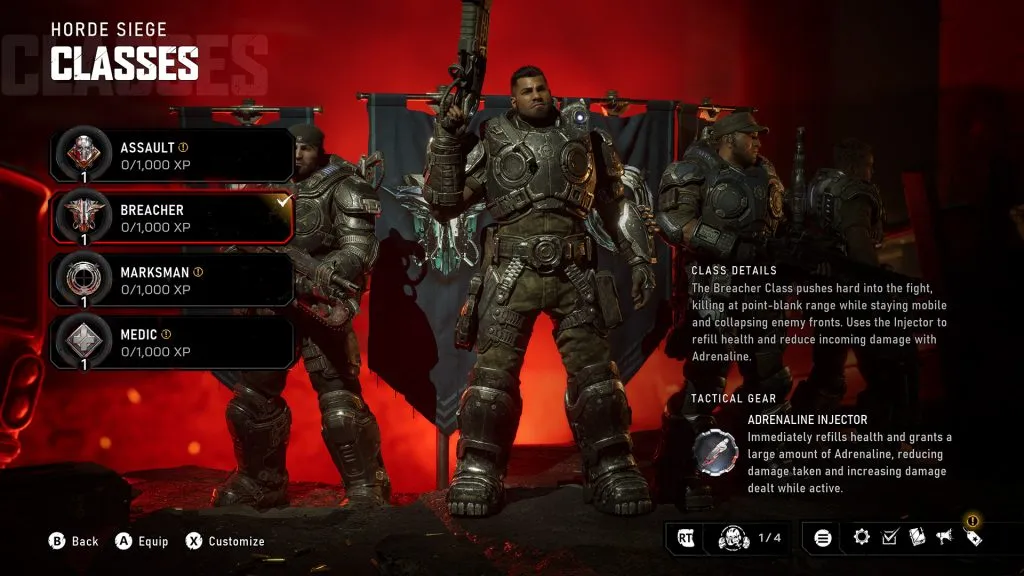
Before dropping into Horde Siege, every player picks one of four classes. Past Gears games used classes to define a role and not much else. E-Day goes further, giving each class its own tactical gear, progression path, loadout weapons, armor mods, and equipment upgrades that let players shape a class around how they actually want to play.
The Coalition's stated goal is squad composition that actually matters, so no two players are running identical builds during a mission. Each class leans hard into one area of combat, but they're built to click together as a unit, especially once boss fights and bigger objectives show up.
Assault
Assault is built to hold ground with steady mid-range firepower.
It's not the flashiest class. Assault is the backbone of a squad, chipping away at Locust forces while the Sonic Disruptor, a tactical gadget that stuns nearby enemies, buys the rest of the team room to reposition.
Since Horde Siege regularly puts squads under pressure from more than one direction at once, Assault ends up being the player defending objectives and holding chokepoints while everyone else moves. As the class levels up, players unlock more weapons, armor mods, and gear upgrades that push it further into that frontline role.
Marksman
Marksman is for anyone who'd rather line up a shot than push forward.
The Coalition built Horde Siege's bigger maps and longer sightlines with this class in mind. Marksman carries the Pulse Drone, a device that tags Locust enemies for the player and any nearby teammates, which makes it a lot easier for squads to focus fire during larger fights.
It's not purely a damage class either. Marksman doubles as a scout, flagging dangerous enemies before they reach the squad's position, which makes it as much about battlefield awareness as it is about kills.
Breacher
Where Assault holds the line, Breacher runs straight through it.
This is Horde Siege's close-quarters class, built for aggressive pushes and risky plays near the front. Its signature gear, the Adrenaline Injector, restores health and cuts incoming damage, which means a Breacher can survive fights that would drop most other classes.
That makes it the class for clearing an objective packed with Locust or forcing an opening for the rest of the squad to move through. Breacher rewards players willing to take the risk and lead the charge instead of waiting behind cover.
Medic
Every squad needs someone keeping the rest of the team alive, and that's Medic's job.
Medic still holds its own in mid-range fights, but its real value is keeping teammates upright through long firefights. The Stim Vaporizer revives downed Gears within range, and that includes players from other squads entirely, which makes Medic one of the most valuable classes once all twelve players are on the field together.
Because squads keep crossing paths through a mission, being able to save someone outside your own four-player group reinforces what Horde Siege is going for: cooperation across the whole battlefield, not just inside your own squad.
Building the Perfect Squad
Each class fills a different role, but The Coalition has clearly built Horde Siege around teamwork over solo heroics.
An Assault can slow the advance while a Marksman picks off priority targets from range. A Breacher clears the front before a Medic patches everyone up after a rough fight. As players unlock more armor mods, weapon upgrades, and gear improvements, those combinations start to matter more, pushing squads to build around each other instead of just picking favorite weapons.
With twelve players split across three squads, class composition looks like it's going to be one of Horde Siege's defining strategic layers, on par with raw shooting skill.
Progression, Weapon Mods and Supply Caches Add More Strategy
Bigger battles and more dynamic objectives are only part of the picture. The Coalition has also reworked how players progress both during and between missions. Instead of just surviving wave after wave, squads are constantly earning resources, unlocking upgrades, and adjusting loadouts as the battle unfolds.
One way this plays out is through contested Supply Drops. During certain missions, Command deploys supply crates onto the battlefield that every squad can race to secure. While all participating squads receive a share of the rewards, the first team to reach the crate earns the best loot, adding another layer of risk-versus-reward decision-making while objectives are still unfolding. According to the developer, these systems are designed to give players meaningful choices throughout a session while building toward long-term progression that carries over into future deployments.
Energy Powers Your Squad Throughout Each Mission
Completing objectives and clearing Locust forces earns squads Energy, Horde Siege's main in-match resource.
Energy gets spent at Supply Caches, and it's not just for fortifications. Supply Caches offer a range of options, including:
- Upgrading squad-wide perks
- Restocking grenades and equipment
- Deploying defensive tools such as sentry turrets and razor mines
- Swapping weapons to better suit upcoming objectives
Since objectives change from mission to mission, deciding when to spend Energy and when to hold onto it could end up mattering as much as the firefights themselves. Squads that manage that resource carefully should have an easier time with the tougher waves later on.
Weapon Parts Carry Progress Beyond a Single Match
Weapon Parts are one of Horde Siege's bigger additions, earned by finishing objectives, grabbing supply drops, and completing optional side missions.
Unlike upgrades that disappear the moment a match ends, Weapon Parts stick around and can be redeemed after a successful mission to improve gear for the next deployment.
That gives players a real reason to chase optional objectives instead of just focusing on survival, and it makes Horde Siege's progression feel more permanent than past Horde modes managed.
Iconic Weapons Can Now Be Modified
For the first time in a mainline Gears game, players can customize the franchise's signature weapons through a dedicated mod system.
Some mods are subtle, tweaking handling or improving what happens on a perfect Active Reload. Others change the weapon outright, like attaching a bayonet to the Gnasher shotgun.
Instead of everyone running identical guns, this lets squads build loadouts that actually fit their preferred combat style and class role.
Armor Mods and Tactical Gear Deepen Build Variety
Weapon customization is only one layer of this. Each class also unlocks armor modifications and upgrades for its tactical gear as players progress.
Whether that means better survivability, stronger support tools, or sharper offensive equipment, these upgrades stack with weapon mods to create builds tailored to different squad strategies. The Coalition says the interplay between weapon mods, armor upgrades, and tactical gear adds up to the deepest build customization the series has had.
Team Builds Could Matter as Much as Individual Skill
Players can tune their own Gear, but Horde Siege is clearly built around squad synergy rather than solo optimization.
A Marksman focused on precision damage pairs well with an Assault built for crowd control, while an upgraded Medic can be the difference during a long boss fight. A Breacher geared for close-range aggression opens doors the other classes can walk through.
The Coalition's pitch is that success comes from combining complementary classes, mods, and gear into a squad that can handle whatever the Locust throw at it, not from one player having the strongest individual loadout.
Invasions, Boss Battles and Extraction Keep Every Match Unpredictable
Horde Siege isn't just about surviving waves that get harder over time. Unexpected events can flip the pace of a mission at almost any point, and squads have to adapt fast.
Chief among those are Invasions, dynamic events that can trigger at nearly any moment, bringing new battlefield hazards, tougher Locust forces, or temporary restrictions on certain player actions until the squad fights the invasion off. Rather than a scripted boss fight, Invasions are built to knock a squad off its rhythm and force a quick decision: keep chasing objectives, or drop everything to deal with the bigger threat.
Massive Bosses Encourage Multi-Squad Cooperation
Some Invasions build toward fights against Locust monsters too dangerous for a single squad to take on alone.
When that happens, Horde Siege pushes all three squads toward the same objective, turning it into a twelve-player fight against long odds. The Coalition says these fights are meant to recreate soldiers banding together during humanity's desperate first fight for survival on Emergence Day. Winning also rewards every participating squad with extra resources and progression, rather than pitting squads against each other for the spoils.
Every Mission Ends With One Final Stand
Finishing the mission objectives doesn't end the match right away.
Command sends in a Raven helicopter for extraction, and squads have to fight off one last Locust assault while holding the landing zone until it arrives. Not every player has to reach the extraction point for the mission to count, but leaving teammates behind cuts into the rewards at the end, so there's still a reason to stick together instead of just sprinting for the exit.
No Two Horde Siege Missions Should Feel the Same
Beyond objectives and bosses, Horde Siege leans on a handful of systems meant to keep missions feeling fresh over repeated runs.
The Coalition says missions can carry different difficulty modifiers, objective combinations, enemy setups, and battlefield conditions. Some sessions might have Drones that explode on death, others might only reward perfect Active Reloads or even turn on friendly fire. Returning poison mechanics can also ramp up Locust strength as a mission drags on.
Add in randomized objectives, optional side missions, supply drops, and two other unpredictable human squads, and Horde Siege is built so matches rarely play out the same way twice.
Versus Brings New Modes While Staying True to Classic Gears
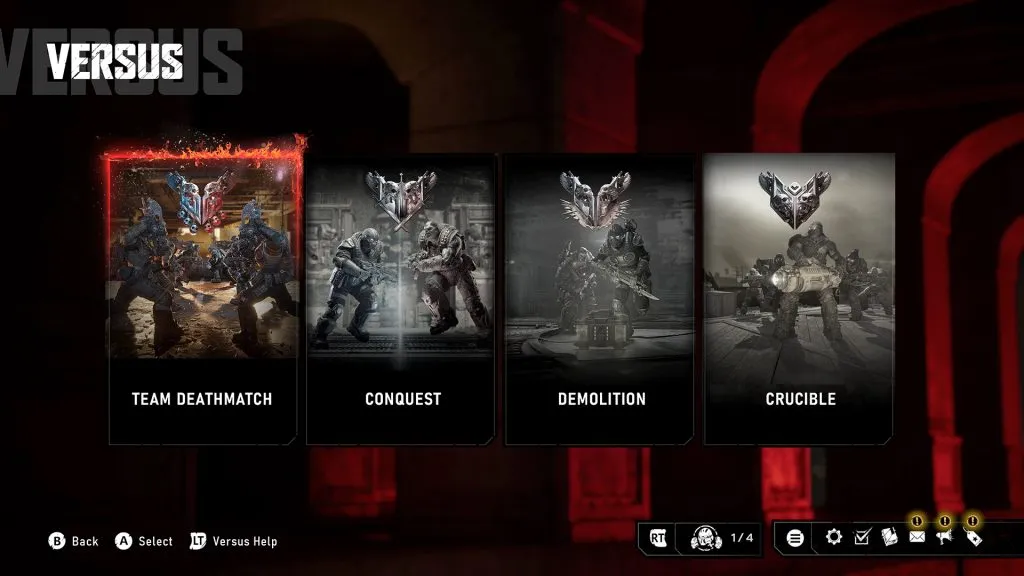
Horde Siege is the headline addition, but competitive players are getting attention too.
The Coalition is treating Versus as an evolution of classic Gears multiplayer, not a reinvention. The cover-based combat everyone knows is still there, but E-Day's updated movement mechanics add faster traversal and new ways to outmaneuver an opponent mid-fight.
Six Launch Maps
At launch, Versus ships with six maps:
- Park
- Battleship
- Outpost
- Precinct
- Market
- Skyward
All six are set around Kalona and built to keep the series' focus on cover, sightlines, and positioning while still making use of E-Day's faster traversal.
Four Competitive Modes
Gears of War: E-Day launches with four multiplayer modes. Team Deathmatch and Conquest are back, and two new modes join them.
Demolition has two squads fighting over a neutral bomb before trying to plant it at one of two enemy bomb sites, which keeps teams constantly shifting between attacking and defending. Crucible centers on a mobile Power Core: holding it earns points over time, but the scoring zone shrinks and moves across the map, so fights never really settle down. The Power Core itself can also be used as a weapon, rewarding teams that mix objective control with sharper tactical play.
Built for Veterans and Newcomers
Gears' cover-based combat can be a lot to throw at a new player, so The Coalition is adding onboarding tools to soften that curve.
A Boot Camp tutorial covers movement, combat, and weapon handling basics, and a separate Combat Training area lets players try out weapons, movement, and AI-controlled Locust encounters before jumping into competitive matches. Players can also pick from preset control schemes or build a fully custom setup, whether they're brand new or have been playing since the original trilogy.
Progression Focuses on Gameplay Instead of Battle Passes
Outside of matches, players keep earning experience, unlocking equipment, weapon upgrades, armor mods, and cosmetics just by playing.
Probably the biggest news for longtime fans: Gears of War: E-Day is not shipping a traditional battle pass.
Instead, nearly everything can be earned by completing matches, seasonal challenges, achievements, and the returning Classic Medal System. Extra rewards can also be bought with coins earned from playing, not from a card on file. The Coalition says premium purchases will mostly be limited to Premium Edition bonuses and select charity or partnership content, while seasonal updates keep adding characters, weapon skins, medals, challenges, and events after launch.
For anyone burned out on battle passes running every modern multiplayer game, this might be one of E-Day's most welcome changes.
Beta Dates and Release Information
The wait to try this out for real isn't long. The Early Access Beta starts August 6, 2026, and the Open Beta runs from August 13 through August 17 across Xbox, PC, and Steam. The full game arrives October 6, 2026, bringing Horde Siege, Versus, and the campaign to Xbox Series X|S and PC, with day-one access through Xbox Game Pass Ultimate and PC Game Pass.
| Phase | Dates | Platforms |
|---|---|---|
| Early Access Beta | August 6, 2026 | Xbox, PC, Steam |
| Open Beta | August 13 to 17, 2026 | Xbox, PC, Steam |
| Full Launch | October 6, 2026 | Xbox Series X|S, PC, Game Pass Ultimate, PC Game Pass |
The Bottom Line
Gears of War: E-Day isn't just adding another Horde mode. Horde Siege brings bigger battlefields, three independent squads, dynamic objectives, class-based progression, weapon mods, and large-scale boss fights that push all twelve players to work together instead of holding one defensive line. Versus, meanwhile, keeps the competitive identity longtime fans expect while adding new modes, faster movement, and better onboarding for newcomers.
Whether any of this reshapes Gears multiplayer for good will only become clear once players get hands-on with the beta starting August 6. Based on what's been shown so far, though, E-Day is shaping up to be the most ambitious multiplayer package the series has put out in years.