

There is a version of Clutch that could have looked very familiar. Fast cars, underground events, a criminal underworld lurking beneath the glamour. Throw in a police chase or two and you have a game that practically designs itself. Safe, predictable, and almost certainly forgettable.
Maverick Games went a different direction. In a podcast released alongside the game's reveal, creative director Mike Brown and the core development team were surprisingly specific about what Clutch is not trying to be, and why those choices matter. Three and a half years into development, the picture that comes through is of a studio that has spent serious time thinking about racing games, what makes them feel hollow, and how to build around those weaknesses rather than repeat them.
Two Worlds That Do Not Bleed Together
The most immediate structural decision in Clutch is the clean separation of its two core experiences. On one side is the R1K, a prestigious fictional racing championship with a century of in-world history. On the other is the Midnight Collective, a community of car enthusiasts who care nothing for sponsor money or championship tables. Most games that attempt this kind of duality end up blurring the line. Clutch does not.
Brown acknowledged the pull toward blending directly. He and several other Maverick developers came from Playground Games, the studio behind the Forza Horizon series, and he made the point with some care: Horizon sits in a channel between serious motorsport and underground street culture because it has to. Forza Motorsport covers the professional side, so Horizon cannot go there. Need for Speed covers the criminal underground, so Horizon cannot fully go there either. The result is a blend that works on its own terms but does not fully commit to either world.
Clutch commits to both, separately. The R1K has genuine invented history behind it: team backstories, former champions, historical sponsors, and liveries showing how cars would have appeared in the 1970s and 1980s. Art director Ben Penrose described collaborating with a real-world F1 livery designer to get the visual language right. The series even has a documented origin story, two friends who raced a thousand miles against each other, which the narrative team built an internal almanac around to keep every historical detail consistent. When you drive through R1K circuit locations on a non-race day, the rumble strips and colored tarmac runoffs are still present. The world behaves as though racing has happened there, because in its own history it has.
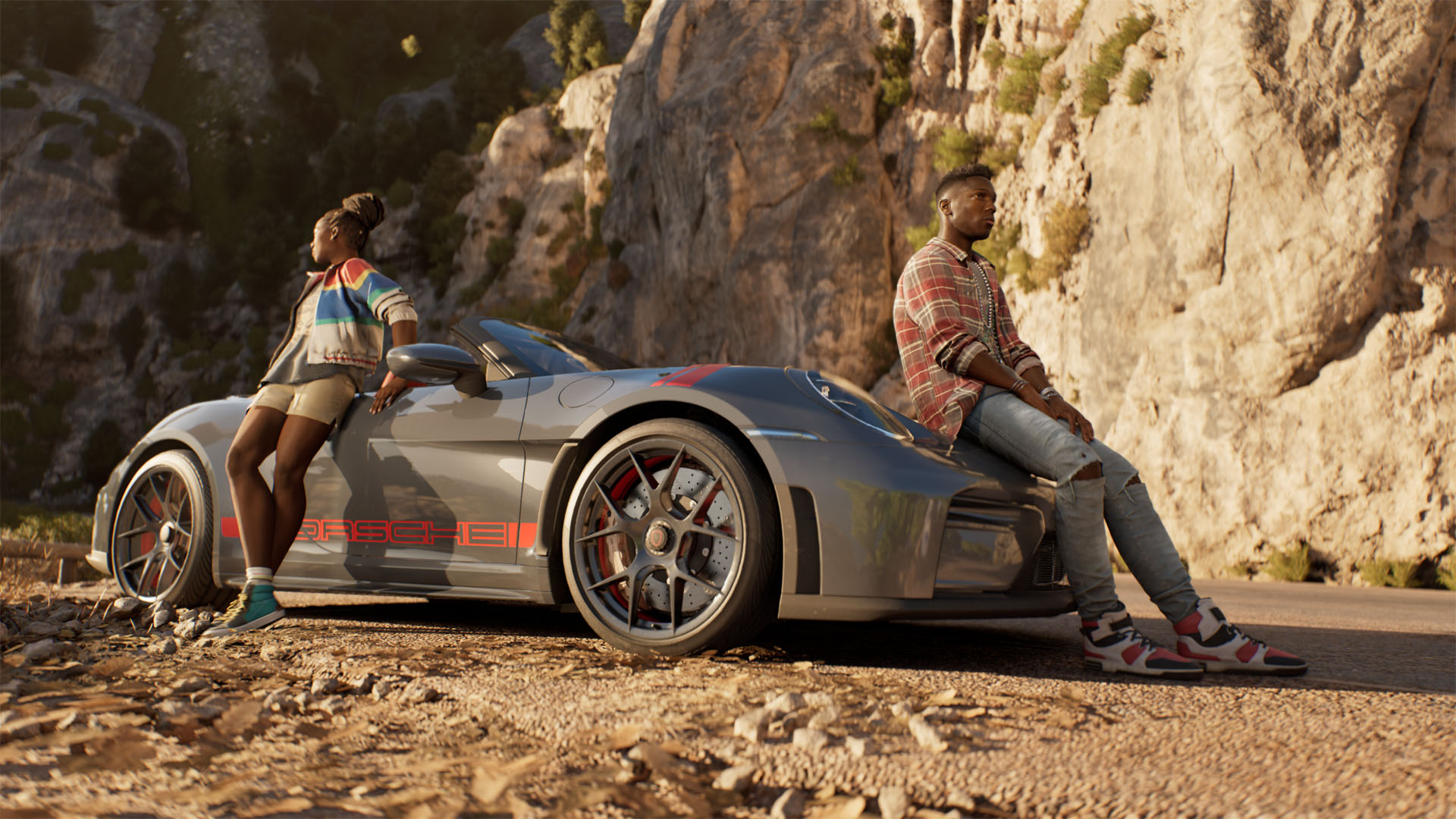
The Midnight Collective operates in a completely different register. It is not a rebellion against the R1K so much as an alternative to it, built around people who simply love cars. Brown described wanting it to feel like a cars and coffee event: enthusiastic, approachable, the kind of place where strangers want to talk to you about your vehicle. In Clutch's world, you are not earning your way into an exclusive scene. You are just showing up with a car you care about.
Why the Tone Actually Works This Time
Underground racing culture has a credibility problem in games. For decades the default version of it involves characters who are slightly impenetrable, with an attitude that suggests you are not quite cool enough to be there. Brown described the trap directly: these scenes in games tend to produce people who feel like a cologne advertisement about cars rather than actual car enthusiasts. The whole thing ends up feeling aspirational in a hollow way.
Maverick Games made two decisions that quietly fix this.
The first is that street racing in Clutch is legal. There is no criminal underworld to speak of, no police pursuit mechanic, no escalating stakes that require the world to treat the protagonist as a fugitive. When racing is a legitimate activity, the culture around it does not need to be defensive or coded. The people who show up can just be people who love cars, which is what most car enthusiasts actually are.
The second decision is that guns do not exist in Clutch's world. The game never says this out loud, Brown explained. There are simply no guns, anywhere. What that does practically is remove the easy answer from every conflict. When a character has a problem, the solution cannot be a threat or a shot. The story is forced into more creative territory, interactions carry real weight, and the stakes feel less predictable because you cannot see the obvious resolution coming.
What Legal Racing Actually Changes
The comparison to Need for Speed is worth sitting with, because that series has spent more than twenty years trying to make illegal street racing feel heroic without quite resolving the contradiction. When your protagonist is technically breaking the law, the world has to behave accordingly. Police give chase. Bystanders scatter. The moral framing gets genuinely awkward, especially when the game simultaneously wants you to feel like the good guy.
By simply declaring that the Midnight Collective races legally and moving on, Clutch sidesteps the entire problem. The story can be about people rather than fugitives. The world can feel like somewhere real people actually live. Brown's framing was blunt: not making it illegal just instantly means it is a legitimate thing. It sounds obvious stated that way. Most games in this genre have not done it.
A Car That Feels Like Yours
Customization in racing games typically means performance: engine upgrades, tire compounds, gear ratios, maybe a livery editor if the studio has the budget for it. Clutch does all of that, but the detail Brown spent the most time discussing was different. The development team has put real work into personal touches that make a car feel genuinely owned. A coffee cup left on the dashboard you were meaning to throw away. Parking tickets and receipts scattered across the interior. A hoodie thrown on the passenger seat. Signs of wear on older cars that suggest those vehicles have been places and done things.
Most game cars feel like props. They are visually impressive objects the player inhabits temporarily. What Maverick Games is trying to build is something closer to actual ownership: a car that carries evidence of your time with it. In an open-world game where you will spend dozens of hours in the same vehicle, that is a genuine difference in how the experience feels, not just a cosmetic one.
The Midnight Collective reinforces this further. Points in Collective events come from performance, finishing position, and driving style. The car you build and the way you race it both feed into how you score. Expression is not separate from competition. It is part of it.
Monaco as More Than a Visual Landmark
The reveal trailer confirmed that Clutch is set in a fictionalized Riviera, with Monaco as its largest city. From a level design perspective, Monaco is a strange choice. It is tiny, extraordinarily dense, and built around a cliff face in a way that seems to resist open-world game logic entirely.
The Maverick team leaned into all of that. Brown described Monaco as one of the most complex cities ever built in a video game. The reasoning holds up: real Monaco has tunnels beneath street level, elevated roads above, and organic road networks that wrap around the hillside rather than following any kind of grid. Each layer connects to the others, and in Clutch you can move between them in ways the real city would not allow. Drop from an overpass onto a road below, cut through an underground route, come out at a different elevation than you entered. Chases through this space will never play out the same way twice because there are simply too many options.
The in-game Monaco is slightly larger than the real city to give level designers room to work. The surrounding suburbs are also included, partly for storytelling coherence and partly because when you are on the cliff roads you can see what surrounds the city, and it needs to actually be there. Brown acknowledged these were expensive choices. A city that only shows you its famous corners is a theme park. A city with edges and surroundings is something closer to a world.
The Storytelling Ambition
Racing games are not usually taken seriously as narrative vehicles. Cutscenes exist to get you back to driving. Characters exist to hand out objectives. Story is, at best, a thin justification for the events, and at worst something the studio quietly deprioritized to ship on time.
Maverick Games is openly trying to do something different. The cast includes Toss and Cole as Theo Marshall and Little Simz as his sister Cass, alongside Gregory Montel as their adopted father Ludo and Jane Perry as Emory Whitman, a fixer whose leverage over Theo drives much of the plot's momentum. The game has two playable protagonists and the story shifts between them as the narrative requires.
What came through most strongly in Brown's account was not the plot mechanics but the quality of performance. He described Little Simz's work as breathtaking, and said a full cast table read was the moment the team knew the script would actually work as intended. He also spoke at length about the writer Jamie, whose approach to character involves letting genuinely bad things happen to people rather than protecting them. The characters in Clutch are described as flawed and somewhat damaged, behaving in ways that sometimes frustrate you but always make sense for who they are and what they have been through.
The reference points Brown reached for were Nathan Drake and Lara Croft: protagonists who do morally complicated things but remain compelling because the writing does the work to justify those choices. Theo is never allowed to feel like a criminal even when the plot puts him in criminal situations. That kind of moral architecture requires actual care to build.
When Story and Driving Actually Connect
The deeper ambition is not just to have a better story than other racing games. It is to have a story genuinely woven into the experience of driving rather than sitting beside it. Brown described Clutch repeatedly as a game about the love of driving, not a game where driving is the mechanic and story is the reward for completing it. That framing is easy to say and hard to execute.
Cinematic ambition and open-world freedom work against each other naturally. The more a game tries to tell a specific story with specific emotional beats, the harder it becomes to let the player wander without disrupting the narrative logic. Many games have attempted the blend. Most of them quietly pick one side when the tension gets uncomfortable. Whether Clutch avoids that problem is something only the finished game can answer.
What to Actually Watch For
Strip away the pre-release positioning and there are a few things worth tracking as more of the game becomes visible.
Does the R1K feel like a real institution? The team has built decades of invented history, liveries, former champions, and a series origin story. Whether all of that actually comes through when you are playing a race or just driving through a circuit location will tell you a lot about how well the worldbuilding translates from document to game.
Does the Midnight Collective avoid the cringe trap? Brown identified the problem clearly: games portray car enthusiast culture as either impenetrable or performatively cool, and it rarely feels real. Clutch's solution is to make it legal and approachable. Whether the characters and writing back that up is the real question.
Does the story earn its ambition? The casting is strong and the performances from the table read clearly convinced the team they had something. But a good cast and a good script are not the same thing as a good game narrative. The structural challenge of merging cinematic storytelling with open-world freedom is real, and plenty of studios with strong casts have not solved it.
The Honest Assessment
Clutch is not out yet. Everything written here comes from a podcast and a trailer produced by a development team with obvious reasons to present their game well. Every ambitious racing game announces itself as something different before release. Not all of them are.
What makes Clutch's case more credible than the usual pre-release positioning is how specific the decisions are. Keeping the R1K and Midnight Collective structurally separate is not a marketing angle. Removing guns and legalizing street racing reshapes the logic of the entire world. The personal car details reflect a genuine philosophy about ownership and identity rather than a feature list. The investment in motion capture, proper casting, and a two-week performance shoot is a real production commitment, not a trailer talking point.
Maverick Games has clearly spent a lot of time thinking about the kind of racing game they did not want to make. The one they are building instead looks genuinely different from what currently exists in the genre. Whether it lives up to those ambitions is a question only the finished game can answer. But in a space where most developers are iterating on the same set of assumptions, a studio asking genuinely different questions is worth paying close attention to.