
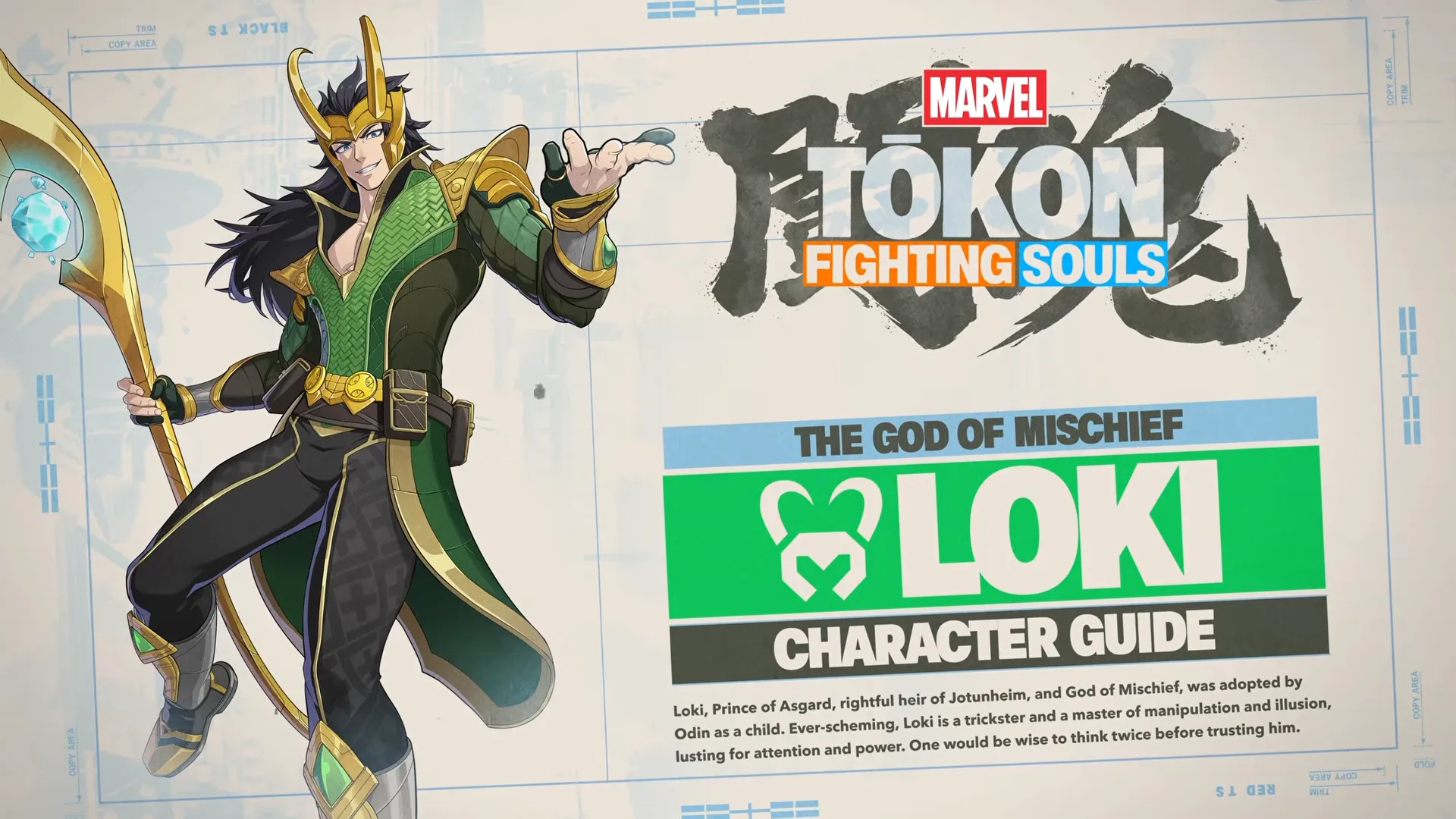
Loki Overview
Loki does not want to fight you head on. In Marvel Tōkon: Fighting Souls, the God of Mischief plays a completely different game from most of the roster, leaning on projectiles, illusions, and constant repositioning to keep opponents guessing about what's actually coming next. Instead of committing to straightforward rushdown, he wins by making sure you're never quite sure which threat to respect.
A lot of that comes down to Frigga's Grace, his teleport-based mobility Skill, and the branching follow-ups tucked into nearly every one of his specials. He can zone patiently from range, then suddenly appear on the other side of the screen and punish a defensive habit before you've had time to adjust. His Ultimate Skill, Lævateinn, adds another layer on top of that: land it once, and his sword stays transformed for the rest of the round, rewarding players who convert early.
None of that comes for free, though. Loki asks for sharper spacing and better decision-making than a lot of the cast, and predictable teleport patterns get punished fast. Knowing when to zone, when to close the distance, and which follow-up actually fits the moment is the real skill gap here, not raw execution.
This guide covers Loki's complete kit for Marvel Tōkon: Fighting Souls, including his normal attacks, throws, Link Attacks, all four Skills and their variations, his Super Skill, Ultimate Skill, Tōkon Assemble, assist options, and the strengths, weaknesses, and beginner habits worth knowing before you take him online.
In This Guide
- Loki Move List
- Basic Controls
- Normal Attacks
- Throws
- Link Attacks
- Frigga's Grace
- Fenris Fang
- Serpent Spike
- Jotun Mist
- Assist Types
- Super Skill: Laufey's Wrath
- Ultimate Skill: Lævateinn
- Tōkon Assemble
- Strengths & Weaknesses
- Beginner Tips
- Is Loki Worth Learning?
- Loki FAQ
- Final Thoughts
Loki at a Glance
- Archetype: Trickster / Zoner
- Difficulty: Medium
- Best Range: Mid to Long Range
- Strengths: Excellent mobility, deceptive offense, strong projectile pressure.
- Weaknesses: Requires precise spacing, punishes poor execution and predictable patterns.
- Best For: Players who'd rather win through misdirection and space control than brute force.
Loki Move List
Here's every move covered in this guide at a glance.
| Move | Type | Cost |
|---|---|---|
| Frigga's Grace | Teleport Special | 25 Skill Gauge |
| Fenris Fang | Advancing Special | 25 Skill Gauge |
| Serpent Spike | Spear Special | 25 Skill Gauge |
| Jotun Mist | Projectile Special | 25 Skill Gauge |
| Laufey's Wrath | Super Skill | 50 Skill Gauge |
| Lævateinn | Ultimate Skill | 100 Skill Gauge |
| Tōkon Assemble | Team Ultimate | 150 Skill Gauge |
Basic Controls
Loki runs on the same control scheme as the rest of the Marvel Tōkon: Fighting Souls cast. Every input reference in this guide sticks to the game's official terminology, so it's worth knowing what each one does before diving into his moveset.
| Input | What It Does |
|---|---|
| Light (L) | Fast attacks that open pressure and start combo strings. |
| Medium (M) | Balanced attacks with solid damage and combo potential. |
| Heavy (H) | Powerful attacks that launch opponents or extend combos. |
| Quick Skill (QS) | Executes Loki's special techniques, many with multiple follow-up variations. |
| Super Skill | Spends Skill Gauge for stronger attacks with unique properties. |
| Ultimate Skill | A high-damage cinematic attack that can flip the flow of a round. |
| Tōkon Assemble | A comeback mechanic that unleashes a devastating team attack under specific conditions. |
| Assist | Calls in a teammate to extend combos, apply pressure, or control space. |
Normal Attacks
Loki's normals lean on reach, mobility, and combo flexibility rather than sheer power. His Lights are built for starting pressure, while his Mediums and Heavies add range, stronger launches, and combo conversions. Together they're the foundation everything else builds on, feeding directly into his Skills, Link Attacks, and assist extensions. Even though he can fight from a distance with projectiles and illusions, getting comfortable with these normals is what lets him actually confirm into his more damaging routes.
Standing Normals
| Move | What It's Good For |
|---|---|
| Standing Light (L) | His fastest grounded attack and main combo starter. Quick enough to punish unsafe moves, interrupt pressure, and confirm into longer strings. |
| Standing Medium (M) | Extra reach and damage while keeping reliable combo potential, bridging Lights into heavier options and mid-range poking. |
| Standing Heavy (H) | One of his strongest grounded normals, ending strings, launching into aerial follow-ups, and canceling into Skills. |
Crouching Normals
| Move | What It's Good For |
|---|---|
| Crouching Light (2L) | A fast low that checks advancing opponents and starts grounded offense, useful during tick pressure and mix-ups. |
| Crouching Medium (2M) | Reaches farther than 2L and gives reliable confirms into his special attacks during mid-range footsies. |
| Crouching Heavy (2H) | His main anti-air, launching airborne opponents into juggles and covering defensive spacing against jumps. |
Jumping Normals
| Move | What It's Good For |
|---|---|
| Jumping Light (j.L) | A quick aerial attack for air-to-air exchanges and fast jump-in pressure. |
| Jumping Medium (j.M) | Extra reach for more consistent aerial confirms, air combo extension, and cross-up pressure. |
| Jumping Heavy (j.H) | His strongest aerial normal, ideal for finishing air combos and creating strong knockdown opportunities. |
A typical offensive sequence usually looks like this: open with a quick Light to confirm the hit, extend with Medium attacks for added damage, finish with Heavy to launch the opponent, then cancel into a Skill or call an Assist to keep the pressure going. Because Loki thrives on keeping opponents uncertain, his normals work best mixed with movement, teleports, and projectile pressure rather than repeated in predictable strings.
Throws
Loki also carries standard throw options for punishing opponents who lean too hard on blocking, especially once they've been conditioned to expect his illusion-based offense.
| Throw | What It Does |
|---|---|
| Forward Throw | Sends the opponent forward while dealing damage, useful for resetting neutral with favorable spacing or setting up zoning. |
| Back Throw | Sends the opponent behind Loki, handy for escaping corner pressure or reversing positioning. |
| Air Throw | Intercepts airborne opponents before they land safely, especially strong against predictable jump-ins. |
Link Attacks
Link Attacks sit at the core of the combo system in Marvel Tōkon: Fighting Souls, letting players chain normals into stronger follow-up strikes. Loki's versions naturally suit his deceptive style, opening launch windows, extending damage, and flowing straight into his Skills, Super Skill, and Ultimate Skill. Several of his specials can even be triggered by pressing an extra attack button at the end of a Link Attack, so it's worth getting comfortable with these sequences early.
Link Attack Types
- Light Link Attack: His quickest combo extension, ideal for confirming Light strings and transitioning straight into Skills. A good starting point before learning longer routes.
- Medium Link Attack: Adds more damage and carries opponents farther, with extra hit stun that makes follow-up Skills easier to land after a Light chain.
- Heavy Link Attack: His strongest Link Attack, launching opponents higher and opening the door to aerial follow-ups or Ultimate Skill conversions.
Unlike characters who rely on long normal strings, Loki's offense is built to keep branching. A typical combo runs Normal Attack into Link Attack into Skill into Follow-up into Assist Extension into Super or Ultimate Skill, with plenty of room to adapt based on how the opponent reacts along the way.
Frigga's Grace
Skill Gauge Cost: 25
Frigga's Grace is Loki's signature mobility tool, letting him instantly reposition around the battlefield before launching a surprise attack. It's less a simple teleport and more a mix-up generator, since its follow-up variations let him threaten from different angles and keep defenders guessing about where he'll actually show up. This move is the backbone of Loki's whole mix-up game, useful for escaping pressure, baiting whiffed attacks, continuing combos, or suddenly appearing behind an opponent.
The grounded version teleports Loki before a quick follow-up strike, working well after normals or Link Attacks to flip him from defense straight into offense. There's an aerial version too, which makes his jump-ins far less predictable since opponents have to respect both an air attack and a sudden teleport at the same time.
Frigga's Grace Quick Facts
- Available on the ground and in the air.
- Multiple follow-up options depending on the button pressed.
- Backbone of Loki's mix-up and repositioning game.
- Effective for escaping pressure or punishing predictable attacks.
Mix grounded and aerial teleports so you're never using the same pattern twice, and use Frigga's Grace after conditioning opponents to expect projectile pressure instead. It's also excellent for escaping the corner while immediately threatening a counterattack, so long as you're picking the follow-up that actually fits the situation rather than defaulting to one option every time.
Fenris Fang
Skill Gauge Cost: 25
Fenris Fang is one of Loki's main offensive Skills, sending him forward with a fast magical strike from either the ground or the air. It carries multiple strength variations and follow-up opportunities, making it both a combo tool and a reliable pressure option. Rather than a plain advancing attack, it rewards players who understand spacing: pick the right version and Loki can either safely pressure from mid-range or aggressively continue his offense off a confirmed hit.
The grounded version quickly closes distance before striking with Loki's enchanted weapon, working as both a combo extender and a punish against slower attacks. The aerial version lets him keep up pressure after jump-ins or extend aerial combo routes. Holding the input delays the timing slightly, adding another layer of mind games, and after connecting under the right conditions, Fenris Fang can transition into a Break follow-up that extends the combo further.
Fenris Fang Quick Facts
- Available on the ground and in the air.
- Held input delays the attack for extra deception.
- Can transition into a Break follow-up.
- Strong approach tool and combo extender.
Use it to punish opponents once they've learned to respect your projectiles, mix grounded and aerial versions to vary your approach, and don't lean on it as your only way in. Combine it with teleports and illusion pressure so your offense stays unpredictable.
Serpent Spike
Skill Gauge Cost: 25
Serpent Spike has Loki summon a magical spear for pressure, combo extension, or timing tricks through its held variations. It comes in Light, Medium, and Heavy versions, each suited to a different situation. Light is the quickest, ideal for combo confirms and keeping offensive momentum after a hit. Medium trades a bit of speed for more power while staying reliable in combo routes. Heavy hits hardest but asks for more commitment, so it's best saved for a confirmed opening rather than thrown out in neutral.
Holding the input delays when the attack actually comes out, forcing opponents to second-guess their defensive timing instead of comfortably countering the move they expect.
Serpent Spike Quick Facts
- Three strength versions: Light, Medium, and Heavy.
- Held input delays the attack's timing.
- Heavy version rewards confirmed openings.
- Strong combo tool at every range.
Alternate between immediate and held versions to keep opponents off balance, lean on the Light version while you're still learning, and save Heavy for guaranteed hits. Pairing Serpent Spike with Frigga's Grace makes Loki's offense noticeably harder to read.
Jotun Mist
Skill Gauge Cost: 25
Jotun Mist is one of Loki's defining Skills, giving him strong space control along with several deceptive follow-ups. He conjures freezing magic from range, pressuring opponents while staying at a relatively safe distance. The base version launches a projectile with respectable range, letting Loki challenge opponents before they can start their own offense comfortably. Once it connects, he can immediately branch into an Illusion follow-up that forces the opponent to quickly work out which threat is real, or a Misdirection follow-up that varies his approach so he isn't repeating the same sequence every time.
Jotun Mist Quick Facts
- Ranged projectile with two branching follow-ups.
- Illusion follow-up creates confusion on hit.
- Misdirection follow-up varies Loki's approach.
- Good for starting offense from a safer range.
Use it to open offense from distance, alternate between the two follow-ups so opponents can't anticipate what's coming, and pair it with Frigga's Grace to attack from angles they aren't expecting. It's a great tool for conditioning opponents before you commit to something more aggressive.
None of Loki's Skills work in isolation. A typical sequence might use Jotun Mist to control space, Frigga's Grace to reposition, Fenris Fang to keep pressure going, and Serpent Spike to close things out before transitioning into a Link Attack or Super Skill. Getting comfortable mixing all four is what actually makes him dangerous.
Assist Types
Like every fighter in Marvel Tōkon: Fighting Souls, Loki supports his team through multiple assist types suited to different situations, reflecting his deceptive style with a mix of offensive pressure, aerial coverage, and space control.
| Assist | What It Does |
|---|---|
| Assemble Rush | Sends Loki in fast with an offensive attack, helping teammates extend combos or punish opponents caught in recovery. |
| Assemble Assist Aerial | Attacks from above, giving teammates another option for controlling the air and extending aerial combo routes. |
| Assemble Assist Assault | Advances aggressively toward the opponent, helping teammates begin offensive pressure while keeping momentum. |
| Assemble Assist Vertical | Attacks upward, especially useful against opponents trying to approach from the air. |
| Assemble Assist Shooter | Provides ranged projectile support, letting teammates pressure from a safer distance while controlling horizontal space. |
Overall, Loki's assist lineup makes him a comfortable fit for both aggressive rushdown teammates and zoning-focused ones, since he can cover almost any gap a team composition needs.
Super Skill: Laufey's Wrath
Skill Gauge Cost: 50
Laufey's Wrath is Loki's powerful Super Skill, drawing on the icy magic of his Frost Giant heritage to control a large chunk of the battlefield. Rather than targeting a single point, it summons massive ice pillars that punish opponents from a distance, fitting naturally into his spacing-oriented game plan. It's available from both the ground and the air, so Loki keeps flexibility no matter where he is when he confirms it.
On the ground, Loki summons a series of towering ice pillars that erupt in front of him before advancing toward the opponent, covering considerable horizontal space. The aerial version starts the pillars further away and brings them inward, which changes how opponents need to defend and threatens anyone trying to avoid his grounded offense.
Laufey's Wrath Quick Facts
- Available on the ground and in the air.
- Wide horizontal coverage on the ground version.
- Aerial version threatens from a different angle.
- Brief startup invincibility.
One of its best properties is a short window of invincibility on startup, letting Loki challenge predictable offense or interrupt an aggressive opponent. It shouldn't be thrown out recklessly, but that invincibility gives the move real defensive value alongside its offensive coverage. Use it after confirming a combo rather than firing it blindly, pick the ground or aerial version based on the situation, and save enough meter that you can still threaten with his other Skills afterward.
Ultimate Skill: Lævateinn
Skill Gauge Cost: 100
Lævateinn is Loki's Ultimate Skill and one of the flashiest attacks in his kit. On activation, he channels magical energy through his scepter into a massive beam capable of tremendous damage. Unlike most Ultimate Skills, though, it keeps paying off after the cinematic ends: landing it permanently transforms his sword for the rest of the current round.
The beam covers significant space and works as an ideal combo finisher after a launcher, Link Attack, or assist extension. Connecting at close range triggers an enhanced follow-up sequence before the Ultimate finishes, rewarding players willing to fight up close with extra damage. Once it lands, Loki's sword stays empowered until the round ends, dealing increased damage on every attack performed with it, so Lævateinn keeps rewarding you well after the animation is over.
Lævateinn Quick Facts
- Massive beam attack, strong as a combo finisher.
- Enhanced follow-up when it connects at close range.
- Permanently transforms Loki's sword for the rest of the round.
- Rewards landing it early for maximum value.
Save it for confirmed combo finishers whenever possible, since landing it early in a round gives you more time with the transformed sword. Don't spend it recklessly. The permanent weapon boost is most valuable when you still have plenty of chances left to capitalize on it, so pair the transformed sword with Loki's illusion-based pressure to squeeze out the most damage.
Tōkon Assemble (Team Ultimate)
Skill Gauge Cost: 150
Like every member of the Marvel Tōkon roster, Loki has access to Tōkon Assemble, a cinematic team attack that lets him and his partner unleash a coordinated finishing sequence. It's designed as a comeback mechanic rather than a normal combo tool, and it only becomes available when losing the current round would also cost you the entire match. That restriction alone makes it worth treating as a high-impact resource rather than something you use the moment it's up.
Since opportunities to activate it are limited, timing matters more than usual. It's most effective after confirming a long combo or punishing a major mistake, ensuring the meter investment actually results in guaranteed damage rather than a wasted read.
Tōkon Assemble Quick Facts
- Cinematic team attack with Loki's partner.
- Only available when losing the round means losing the match.
- Best confirmed off a reliable combo.
- Can shift momentum entirely during a deciding round.
Strengths & Weaknesses
Strengths
- Excellent mobility and repositioning.
- Strong projectile pressure.
- Multiple teleport options.
- Illusion-based mix-ups.
- Flexible, branching Skills.
- Versatile assist lineup.
- Ultimate Skill permanently enhances his sword after connecting.
Weaknesses
- Higher execution demands than straightforward brawlers.
- Relies heavily on good spacing.
- Requires strong decision-making to get value from his branching Skills.
- Predictable teleport patterns get punished.
- Resource management matters more in longer matches.
Beginner Tips
- Learn each Skill on its own before trying to combine them.
- Mix teleports with projectile pressure instead of relying on just one approach.
- Alternate between Illusion and Misdirection follow-ups to stay unpredictable.
- Confirm into Laufey's Wrath rather than throwing it out in neutral.
- Save Lævateinn for guaranteed openings so you get full value from the sword transformation.
- Use assists to safely start pressure rather than extending every single combo.
- Avoid repeating the same teleport sequence throughout a match.
Is Loki Worth Learning?
Loki is one of the most technical and creative characters revealed so far for Marvel Tōkon: Fighting Souls. His teleports, projectiles, illusions, and branching Skills give skilled players a genuinely deep toolbox for confusing opponents and dictating the pace of a fight.
He asks for more patience and precision than a lot of the roster's straightforward powerhouses, but the payoff is real. Get comfortable with his spacing, movement, and mix-up potential, and you'll find a character who can dictate nearly every part of a match. Whether you'd rather outsmart opponents with deception or lean on carefully planned pressure over brute force, Loki offers one of the deepest playstyles currently in Marvel Tōkon: Fighting Souls, and his versatility should only get more interesting as players keep exploring the game after launch.
Loki FAQ
Is Loki beginner friendly?
He's more of a medium-difficulty pick. His individual Skills are approachable, but getting real value from his branching follow-ups takes practice with spacing and decision-making.
What is Loki's signature mobility tool?
Frigga's Grace, a teleport Skill with multiple follow-up variations that forms the backbone of his mix-up game.
What is Loki's Super Skill?
Laufey's Wrath, a wide-covering ice pillar attack available on the ground and in the air, with brief startup invincibility.
What is Loki's Ultimate Skill?
Lævateinn, a devastating beam attack that permanently transforms his sword for the rest of the round if it lands.
What assist types does Loki have?
Five: Assemble Rush, Assemble Assist Aerial, Assemble Assist Assault, Assemble Assist Vertical, and Assemble Assist Shooter, each suited to a different team plan.
Key Takeaways
- Loki is a trickster and zoner built around space control and mix-ups.
- Frigga's Grace and his branching Skills are what make his offense so hard to read.
- Good spacing and smart decision-making matter more than raw execution.
- Lævateinn rewards landing it early thanks to its permanent sword transformation.
- He's technical, but his versatility makes him one of the most rewarding characters to master.
Final Thoughts
Loki enters Marvel Tōkon: Fighting Souls as one of the roster's most creative and technical characters revealed so far. His mix of teleports, illusions, projectiles, and branching Skills gives him a game plan that's genuinely difficult to predict once a player understands how the pieces fit together.
He isn't a character you can win with on reflexes alone. Spacing, patience, and picking the right follow-up at the right time matter just as much as knowing the inputs. Players who enjoy outsmarting opponents rather than overpowering them will likely find Loki one of the most satisfying picks to master as the roster continues to grow.
Note: This guide is updated as Arc System Works reveals new characters, mechanics, and gameplay details. We'll keep adding new guides as more official information becomes available.
Explore more Marvel Tōkon: Fighting Souls character guides in our Marvel Tōkon Guide Hub.