
The Division 2's latest update has plenty of obvious headline material. TUY8S2.3 introduces the new Broken Rain Incursion, adds two more Exotic weapons, expands the Into the Dark seasonal progression with Stretch Goals, and brings another round of PvP balance changes. But the most interesting part of this patch might not be the new content at all.
With TUY8S2.3, Ubisoft is giving players a way to test their builds under actual PvP rules without leaving the Shooting Range. At the same time, the developer is pushing forward with its broader PvP overhaul, adjusting Gear and Brand Set bonuses, Prototype Augments, and individual talents, while making the Dark Zone's loot economy considerably more appealing. Taken together, it looks like something bigger than a routine seasonal drop. Ubisoft seems to be trying to make the PvP ecosystem easier to understand, easier to prepare for, and more rewarding to actually participate in. That could matter a lot more for the game's long-term PvP health than another Exotic ever would.
The Division 2 Finally Lets Players Test PvP Builds Before Committing to PvP
The most important addition in TUY8S2.3 is also the easiest one to overlook. The Shooting Range now includes dedicated PvP simulation options. Two new control panels let players toggle Normalization and Global PvP Balance, with their stats updating automatically once a setting is selected.
That means players can test how a build performs under PvP rules without setting foot in Conflict or the Dark Zone first. Ubisoft says Normalization applies the same rules used in normalized PvP, including SHD Levels, Expertise, and Prototype Gear normalization. Global PvP Balance applies the PvP-specific values for gear, talents, and Prototype Augments. When Normalization is switched on, the damage shown against range targets is meant to reflect what a player would actually deal to another Agent. Turn it off, and the range goes back to standard NPC damage behavior.
On paper, that sounds like a minor quality-of-life tweak. In practice, it fixes a problem that has followed buildcrafting in The Division 2 for years. A loadout can look incredible against PvE enemies and behave in a completely different way once PvP-specific rules kick in. Players have to account for different damage values, normalization, Expertise, talents, gear bonuses, survivability, and a handful of other systems that quietly reshape how a build performs against a real opponent. Until now, the only reliable way to find out if a build actually held up was to take it into live PvP and hope for the best. Not exactly friendly to experimentation.
Now players can put a build together, walk into the Shooting Range, flip on the relevant PvP settings, and start testing right away. That alone could turn the range into one of the more useful additions to The Division 2's PvP scene, especially for the crowd that has historically avoided competitive content because the learning curve felt too steep to bother with.
This Is More Than a Shooting Range Upgrade
The timing here is what really makes it interesting. TUY8S2.3 is the second phase of Ubisoft's larger PvP balancing project, not a standalone tuning pass. When Into the Dark launched in June, Ubisoft called its PvP changes the first step in a longer process. That phase focused mainly on Weapon and Gear Talents, aiming to close the gap between the options everyone was using and the ones nobody touched, while opening up more room for build variety. Ubisoft also said future updates would look at Skills, Attributes, Status Effects, and other systems tied to competitive play.
The Phase 2 PTS notes back that up. Ubisoft framed the second phase as a chance to examine how the different Dark Zone variants felt, whether the rewards actually justified the risk, and how the updated weapons and gear were landing in PvP. TUY8S2.3 is where that work moves forward. This phase focuses on Gear and Brand Set bonuses, Prototype Augments, and a handful of individual talents. Ubisoft says the Gear and Brand Set changes are meant to pull the strongest and weakest options closer together and give players more room to actually experiment with different builds.
Prototype Augments are getting their own dedicated PvP values too, aimed at trimming the more extreme combinations of damage and survivability without touching how those Augments perform in PvE. A few individual talents have also been adjusted wherever they were creating outsized advantages in competitive play.
This is exactly where the Shooting Range feature earns its keep. If Ubisoft keeps rewriting the rules around PvP builds, players need a real way to keep up. A balance pass can be technically sound and still feel completely inaccessible if nobody can figure out what the numbers actually mean for their own loadout. The Shooting Range simulation starts closing that gap. Rather than just telling players a talent or Gear Set changed, Ubisoft is handing them a controlled space to see the change for themselves, which is a far more useful approach than dumping numbers into patch notes and expecting everyone to sort it out on their own.
The Dark Zone Is Getting a Stronger Reason to Take the Risk
The Shooting Range might be the most interesting quality-of-life change, but TUY8S2.3 also overhauls the Dark Zone's reward structure. Loot across the Toxic, Classic, and Balanced Dark Zones now drops at Heroic quality. Classic and Balanced Dark Zone Elites and bosses also get a 25 percent chance to drop an extra item from a special contaminated loot pool, which includes high-value Gear Sets, legacy weapons, legacy gear, Named items and weapons, Exotics, and a smaller slice of high-value Exotics like Eagle Bearer and The Ravenous.
There's a catch. That extra loot is contaminated, so players have to extract it successfully before they can use any of it, and that's exactly what makes the change worth paying attention to. Ubisoft isn't simply throwing better rewards at Dark Zone players. It's raising the stakes to make the reward loop feel worth chasing in the first place. The Dark Zone has always run on the tension between grabbing valuable loot and getting it out in one piece, but that tension only works if the reward feels significant enough to bother risking. TUY8S2.3 is pushing harder on that equation than recent updates have.
Here's how the odds break down for the additional loot pool: a 40 percent chance at a high-value Gear Set, a 25 percent chance at a high-value legacy weapon, a 15 percent chance at high-value legacy gear, a 10 percent chance at Named Gear or Weapons, a 6 percent chance at one of several Exotics, and a 4 percent chance at either Eagle Bearer or The Ravenous whenever the additional item category actually triggers. That doesn't make the Dark Zone any less dangerous. If anything, it's the opposite. The better the potential haul, the more it matters when an extraction actually goes right, and that's arguably what the Dark Zone has needed for a while now.
Ubisoft Is Trying to Make Different Types of Dark Zone Players Coexist
Zoom out a bit and the bigger picture comes into focus. Into the Dark didn't just tweak Dark Zone loot tables. It redesigned the whole space around three rotating variants: Classic, Toxic, and Balanced. Classic keeps the traditional PvEvP risk-and-reward setup intact. Toxic strips out PvP entirely, disabling Rogue Protocol and Agent damage for a purely PvE experience. Balanced leans into competitive PvEvP, disabling SHD Watch and Expertise bonuses so long-term progression matters less than it usually would.
That structure was already Ubisoft's attempt at solving one of the Dark Zone's oldest problems: not every player wants the same thing out of it. Some people love the possibility of getting ambushed by another Agent around the next corner. Others just want to loot in peace without watching their back every second. And some want a genuinely competitive space where gear score and hours played matter less than skill. Rather than force one experience on everyone, Ubisoft split the difference and gave each crowd its own rule set. TUY8S2.3 keeps building on that same philosophy. Better loot gives players a reason to walk in. PvP balance changes try to loosen the grip of a handful of dominant combinations. And the Shooting Range gives everyone a place to actually understand those systems before committing to the real thing. Put side by side, these stop looking like three unrelated features and start looking like Ubisoft methodically sanding down the friction around PvP.
Broken Rain Has Its Own Interesting Approach to Loot
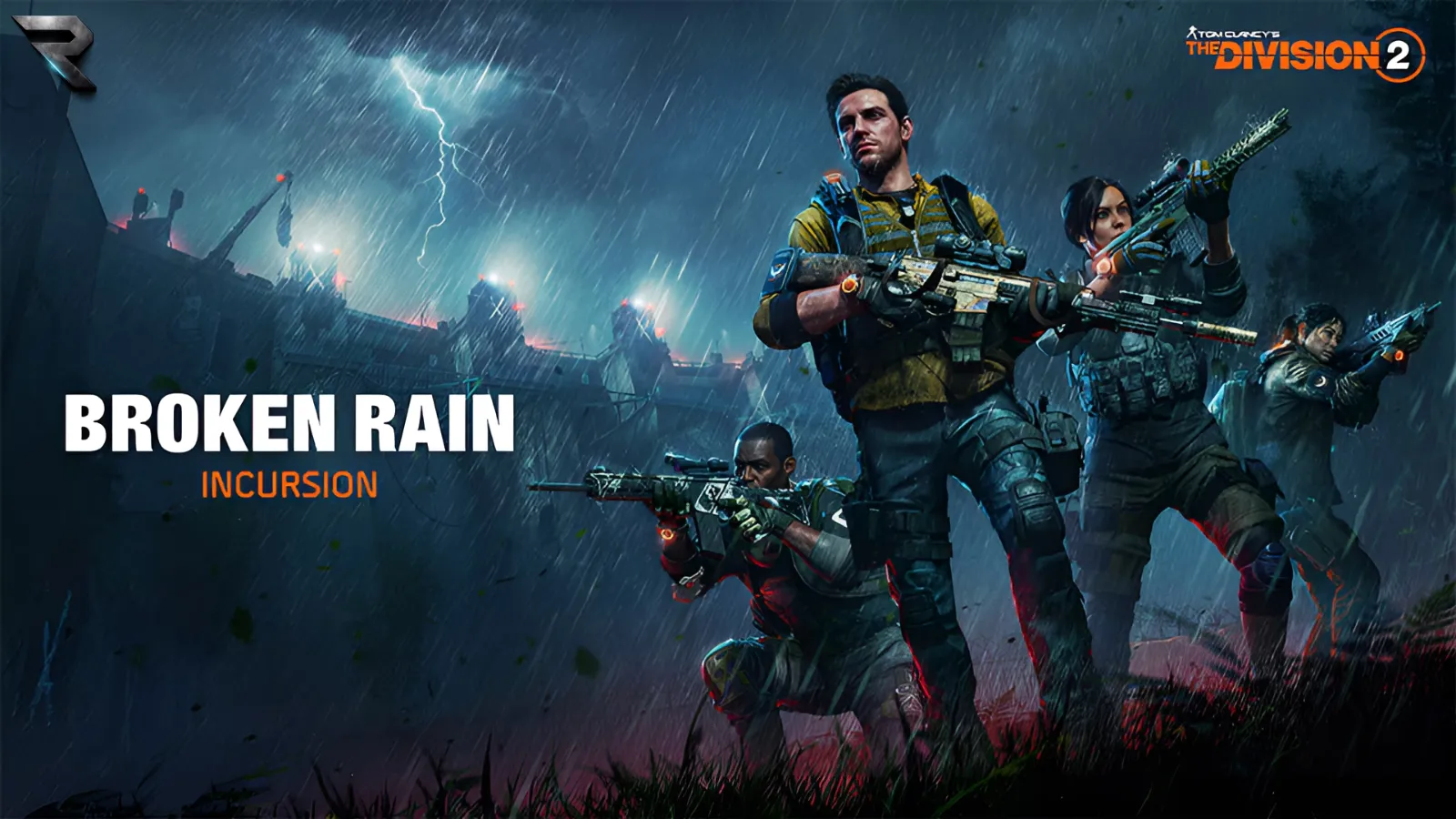
None of this means TUY8S2.3 skimps on conventional content. The Broken Rain Incursion sends Agents to rural Pennsylvania, where the Rikers have seized the Steel Creek Dam and Hydroelectric Power Plant just as Hurricane Morgan bears down on the region. The job is straightforward on paper and messy in practice: breach the Rikers' defenses, take out their leaders, and secure the facility before the storm turns it into a catastrophe.
There's also a reason to jump in fast. Completing Broken Rain within its first 24 hours awards both the Golden Beaver and Silver Beaver Arm Patches, while finishing within the first seven days still nets the Silver Beaver Arm Patch. Ubisoft says the reward window opens one hour after the August 11 maintenance wraps up, giving everyone time to actually log in.
The bigger prize, though, is the Steel & Sons ACR, an Exotic rifle exclusive to the Incursion. Its Confirm & Execute talent rewards players for stacking body shots on an enemy before finishing them off with a headshot. The PvE version adds 4 percent Amplified Damage per stack, and the next headshot consumes those stacks for 11 percent Amplified Damage per stack. Destroying an enemy's weakpoint tacks on an additional 10 percent Amplified Damage from the user for five seconds.
The acquisition system attached to it is worth noting too. The final reward chest gives each character one roll per week, resetting at the global weekly reset, and neither completion time nor individual performance changes the odds. Players can also run the Incursion repeatedly throughout the week for a chance at the Exotic from bosses, though repeated attempts don't improve the drop chance. In other words, Broken Rain isn't asking anyone to speedrun their way to the ACR. The fastest player in the world and the most casual weekend player get treated identically for that weekly chest roll, which is a pretty sharp contrast with the launch Arm Patches, where speed is explicitly the whole point. The update effectively separates bragging rights from the core Exotic grind. Chase the prestige of a fast clear if that's your thing, and the weapon itself stays reachable through the normal weekly structure either way.
The Underboss Exotic Could Be Even More Interesting for Teams
The Into the Dark Climax Mission gets its own Exotic as well. Players who clear it on Master difficulty for the first time receive the Underboss Exotic SMG as a guaranteed drop. After that first clear, Underboss can still show up on repeat runs, with higher difficulties improving the odds.
Its Gangland Hit talent is the interesting part, and it's built entirely around teamwork. Shooting an enemy applies a mark, and a second Agent carrying Underboss can stack an additional mark on that same target, up to four marks total. In PvE, Underboss deals 20 percent Amplified Damage to marked enemies, with another 5 percent added for every extra mark another Agent applies. That opens the door for a coordinated squad to actually build around the weapon instead of just slotting it into whatever loadout they already run. It's too early to say whether this turns into a genuinely dominant team composition, but it's worth keeping an eye on once players start putting real time into it.
Stretch Goals Could Solve Another Seasonal Problem
TUY8S2.3 also tackles a familiar issue with seasonal progression: what's left to do once the Season Pass is finished? Starting August 18, players who hit Tier 100 can keep progressing through the new Into the Dark Stretch Goals track for the rest of the season.
The track runs on Standard and Prestige Caches. Prestige Caches show up every 10 tiers and guarantee rewards that only had a chance of appearing in Standard Caches, while also boosting the odds of extra bonus drops. The reward pool covers vanity items, Named items, seasonal Exotics, and a small selection of particularly rare Exotics. Standard caches carry a 0.5 percent chance at a Rare Exotic Item, and Prestige caches bump that up to 2.5 percent. Prestige caches also raise the seasonal Exotic category from a 10 percent chance to 25 percent. It's another case of Ubisoft stretching what's already there instead of just bolting on a new progression track and calling it done.
TUY8S2.3 Is Really About Making The Division 2 Easier to Engage With
Taken one at a time, everything in TUY8S2.3 is easy enough to categorize. Broken Rain is new PvE content. Steel & Sons ACR is a new Exotic. Underboss is another Exotic. Stretch Goals extend the season. Dark Zone loot got better. PvP got rebalanced. The Shooting Range picked up new controls. But look at all of it together, and a more interesting story starts to take shape.
Ubisoft is clearly focused on cutting down the friction around The Division 2's more complicated systems. The Dark Zone is split into different flavors so players can pick the kind of risk they actually want. Loot got more valuable, so extraction carries more weight. PvP is being rebalanced across several systems instead of one isolated talent pass. And now players can test all of it in a controlled space before ever taking a build into a real fight. That last piece might end up mattering the most.
The Division 2 has piled up an enormous amount of build complexity over the years. That depth is part of the reason veterans stick around, but it also makes the game intimidating for anyone trying to figure out why a build works, why it suddenly falls apart, or why the numbers look completely different once PvP rules apply. A better testing space lowers that barrier. It gives players permission to actually experiment, and experimentation is exactly what a healthy build-driven PvP ecosystem runs on.
The Bigger Question Is Whether Players Come Back
The real test for TUY8S2.3 won't be whether Broken Rain pulls in a wave of players on launch day. It almost certainly will. The bigger question is whether these changes give players a reason to stick around afterward. If the new PvP simulation makes build testing genuinely easier, the balance changes open up more viable options, and the improved Dark Zone rewards make extraction feel worth the risk, Ubisoft may have something more valuable on its hands than another seasonal content drop. It might be building a PvP ecosystem that's easier to understand and more satisfying to actually mess around with, which is a much harder problem to crack than simply shipping another Exotic.
Ubisoft has already described the PvP overhaul as a multi-phase project, with earlier plans pointing toward more work across Skills, Attributes, and Status Effects down the line. So TUY8S2.3 shouldn't be treated as the finished product. It's another step, but a particularly telling one, because Ubisoft isn't just rewriting the rules anymore. It's finally giving players better tools to actually understand them. For a game as deep and mechanically dense as The Division 2, that might turn out to be one of the more important changes in the whole update.
The Division 2 TUY8S2.3 is available now from August 11, with Broken Rain, the updated PvP systems, and the rest of the seasonal content rolling out as part of the update.