
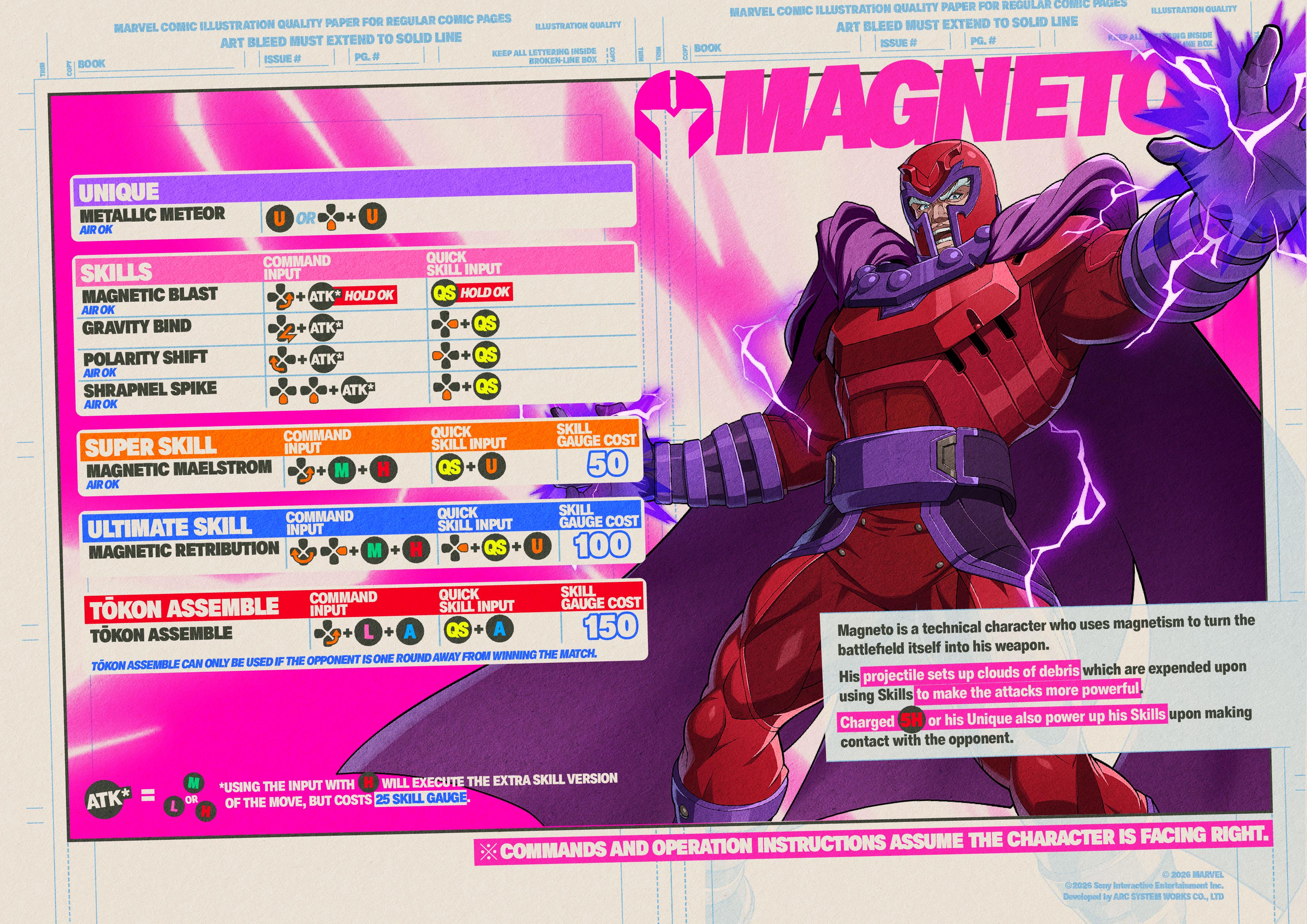
Magneto was playable in public for the first time at EVO 2026, and in an interview with IGN at the event, the developers behind Marvel Tōkon: Fighting Souls explained why their version of the character takes a very different approach from his Marvel vs. Capcom appearances. Battle Director Kazuto Sekine and Marvel Games Senior Producer Michael Francisco spoke to IGN about the thinking behind the redesign, and Sekine also touched on how the broader game has already changed since the first closed beta.
You can read the full interview over on IGN. Here are the biggest things that came out of it.
Why Arc System Works Abandoned the Marvel vs. Capcom Magneto
Magneto's MvC2 and MvC3 versions were genuinely dominant, built around flight cancels, beam supers, and relentless aerial pressure, and that's the version many fighting game fans still associate with the character. Speaking to IGN, Sekine acknowledged the weight of that legacy directly, saying the team felt real pressure given how iconic Magneto already is to the fighting game community. But rather than rebuild that version, Arc System Works went after something the older games barely touched: actual magnetism.
According to Sekine in the IGN interview, Magneto's kit in Tokon is built around generating debris mid-fight that he can reshape into weapons, plus a magnetized status effect the team designed specifically for him, something Sekine told IGN hadn't really been explored in previous fighting game interpretations of Magneto. Francisco told IGN that his team's one specific request to Arc System Works was simpler than the execution: find a way to make Magneto visibly manipulate metal as often as possible. He noted that's a harder ask than it sounds for a fighting game, since debris that lingers on a stage carries a real technical cost.
The "Coolest Version" Philosophy
Sekine told IGN that the studio's general approach to legacy characters isn't to ignore their history, but it isn't to be bound by it either. Some abilities are non-negotiable, he said, pointing to Iron Man's energy beams as something nobody would want changed. Other characters give the team more room to reinterpret, and Magneto landed in that second category: Arc System Works kept his core identity around gravity and magnetism, but built an entirely new battle style around it.
Beta Feedback Is Already Reshaping the Game
Magneto's redesign isn't happening in a vacuum. In the same interview, Sekine described an ongoing back-and-forth with the player base dating back to the first closed beta, one he credits with keeping Tokon's core mechanics intact while still letting the team tune the systems around them. That feedback loop has already produced visible changes elsewhere in the game, including updates to the Assist mechanic and character switching that showed up in the Unbreakable X-Men trailer earlier this year.
What Else IGN's Interview Covers
Sekine and Francisco's comments went beyond Magneto. The same interview also gets into how Tokon's roughly ten-hour story mode is structured around rival promoters recruiting fighters, and how Producer Takeshi Yamanaka's team built up its knowledge of Marvel's comics from scratch as a primarily Japanese studio, including Francisco's claim to IGN that the team has referenced specific comic panels when building individual attack animations.
There's considerably more in the interview than we've covered here, including a deeper discussion of the story mode and the team's research process. It's well worth reading the full interview on IGN if you're interested in those details.
Launch Details
Marvel Tōkon: Fighting Souls launches August 6, 2026 on PlayStation 5 and PC, with an open beta running July 24 through 26 on both platforms. Magneto is part of the Knights of Doom team alongside Doctor Doom, Green Goblin, and Carnage, one of five teams rounding out the full launch roster after the Samurai Outriders reveal at EVO 2026.
The comments referenced in this article were made during an interview with IGN at EVO 2026. The full interview, including the story mode breakdown and the team's research process, is available on IGN's site.